


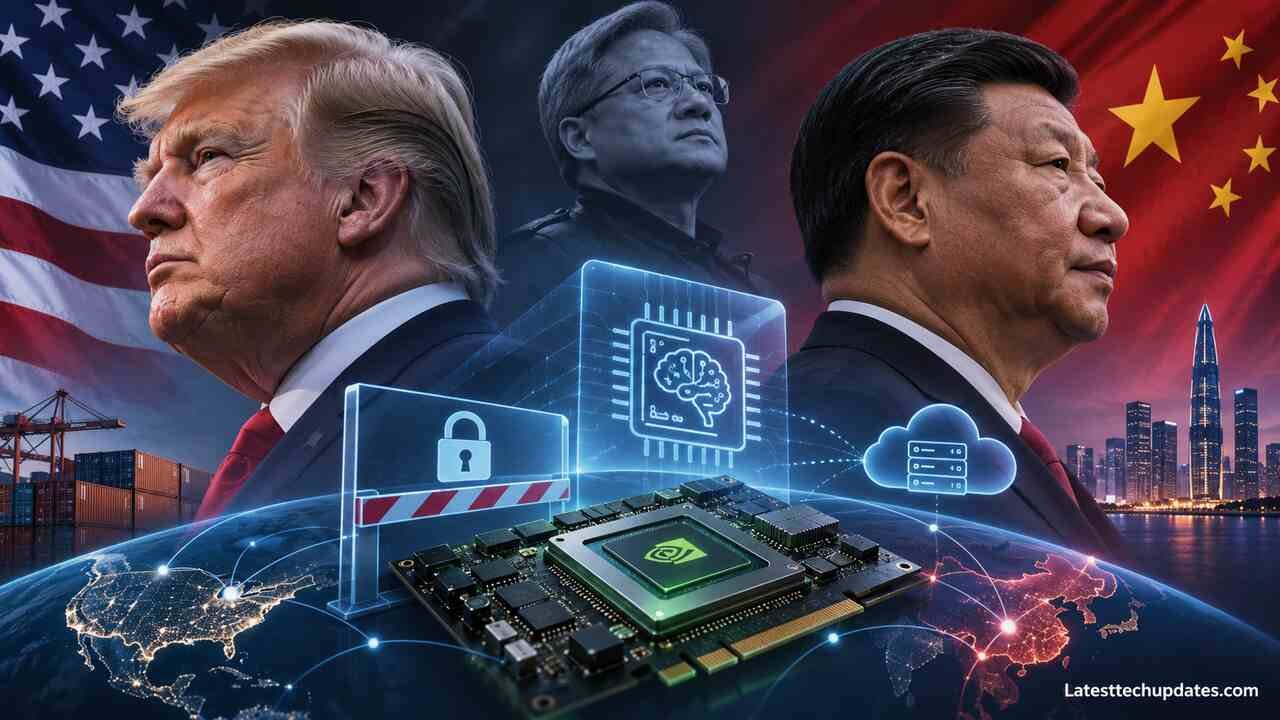
President Donald Trump is preparing to visit China for the November 18–19, 2026, APEC summit in Shenzhen, where he is expected to meet Chinese President Xi Jinping. The trip follows Nvidia CEO Jensen Huang’s resignation amid allegations involving a suspected Chinese intelligence operative, raising questions about whether Washington will tighten restrictions on China’s access to advanced American AI chips.
Nvidia CEO Resignation Adds Pressure Ahead of Trump-Xi Meeting
On November 12, Nvidia confirmed Jensen Huang’s resignation as president, CEO, and board member, effective immediately. The company appointed Chief Financial Officer Colette Kress as interim CEO and named Harvey Jones its first board chair.
The leadership change followed reports concerning Huang’s personal relationships, including one with Alice Huang, a former executive at Singapore-based cloud computing company Megaspeed International.
According to Reuters, U.S. authorities reportedly identified Alice Huang as a Chinese intelligence asset. Reuters said it could not independently verify that allegation, and Beijing has denied it.
On November 8, Nvidia’s board announced an independent investigation into whether Huang had been targeted by a foreign intelligence operation. At that time, the company said it had no reason to believe national security or Nvidia’s confidential information had been compromised.
The scandal could complicate relations between Washington and Beijing, particularly because Huang played an influential role in U.S. semiconductor policy.
He accompanied Trump during his May 2026 visit to China and repeatedly advocated maintaining access to the Chinese market. His departure removes a prominent voice from discussions about semiconductor exports at a politically sensitive moment.
Will Trump Tighten AI Chip Export Restrictions on China?
The controversy has renewed scrutiny of American technology exports, although there is no confirmed decision to introduce broader restrictions before Trump’s China visit.
In December 2025, Trump announced that certain Nvidia H200 processors could be sold to approved Chinese customers. The Commerce Department subsequently introduced a case-by-case licensing policy in January 2026, subject to national security conditions.
The arrangement allows some exports while maintaining restrictions on more advanced semiconductor technology.
However, concern is growing over another route through which Chinese companies can obtain American computing power: overseas cloud data centers.
Chinese developers may access restricted processors remotely by renting computing capacity outside mainland China, even when direct shipment of the same hardware would face U.S. export controls.
On November 12, Reuters reported that Chinese AI companies were exploring reservations for Nvidia-powered computing capacity at overseas facilities.
The reported activity reflects fears that Washington could restrict remote access to high-performance processors. It does not establish that additional controls have been approved.
Congress Pushes for Stronger Oversight of Advanced AI Chips
Pressure for tighter restrictions is also coming from Congress.
The Remote Access Security Act passed the House of Representatives by a 369–22 vote on January 12, 2026. The proposed legislation would expand federal oversight of remote access to restricted American technology.
The legislation has not yet become law and awaits further congressional action. The vote is documented in the official House record.
Separately, Democratic Senators Elizabeth Warren and Chris Coons requested that the Trump administration preserve government records concerning Nvidia chip exports to China.
Their request raised questions about export-control enforcement and potential national security risks associated with the allegations involving Huang.
These congressional actions demonstrate growing scrutiny of U.S.-China semiconductor trade, but they do not establish misconduct by Nvidia or confirm that new export restrictions are imminent.
China Rejects Espionage Allegations While Supporting Continued Talks
Beijing has rejected allegations connecting Alice Huang to Chinese intelligence operations.
During a November 12 news briefing, Chinese Foreign Ministry spokesperson Mao Ning criticized the allegations and warned against using espionage claims to justify additional restrictions on technology exports.
China also signaled that it remains willing to engage with Washington and maintain communication ahead of the anticipated meeting between Trump and Xi.
The comments were published in China’s November 12 foreign ministry briefing.
Diplomatic discussions have continued despite the controversy. U.S. Secretary of State Marco Rubio and Chinese Foreign Minister Wang Yi spoke on November 11, while Beijing confirmed communication concerning a possible meeting involving the leaders of China, the United States, and Russia.
No final arrangements for such a three-way meeting had been announced.
What Trump’s China Visit Could Mean for Nvidia and the AI Industry
The immediate question is whether the Nvidia controversy will influence Trump’s negotiating position when he meets Xi Jinping.
Huang’s departure could weaken an important source of industry advocacy for maintaining semiconductor exports to China. However, broader U.S.-China economic relations involve trade, security, and diplomatic priorities that extend beyond Nvidia.
Three developments will be particularly important in the coming weeks:
- H200 export licensing: Whether Washington changes the conditions governing sales of Nvidia processors to approved Chinese customers.
- Overseas cloud computing: Whether authorities pursue tighter controls on Chinese companies renting advanced AI computing capacity abroad.
- Congressional action: Whether the Remote Access Security Act moves forward and how the Commerce Department responds to growing demands for stronger enforcement.
For American semiconductor companies, additional restrictions could affect access to Chinese customers and complicate overseas data-center partnerships.
For Chinese AI developers, tighter controls could increase uncertainty over access to the computing infrastructure needed to train and operate advanced AI models.
The November summit may reveal how Trump intends to balance national security concerns with broader trade negotiations.
For now, stronger AI chip restrictions remain a possibility rather than a confirmed policy change. Nvidia’s leadership crisis has increased political scrutiny, but its longer-term effect on U.S.-China technology relations remains uncertain.
