


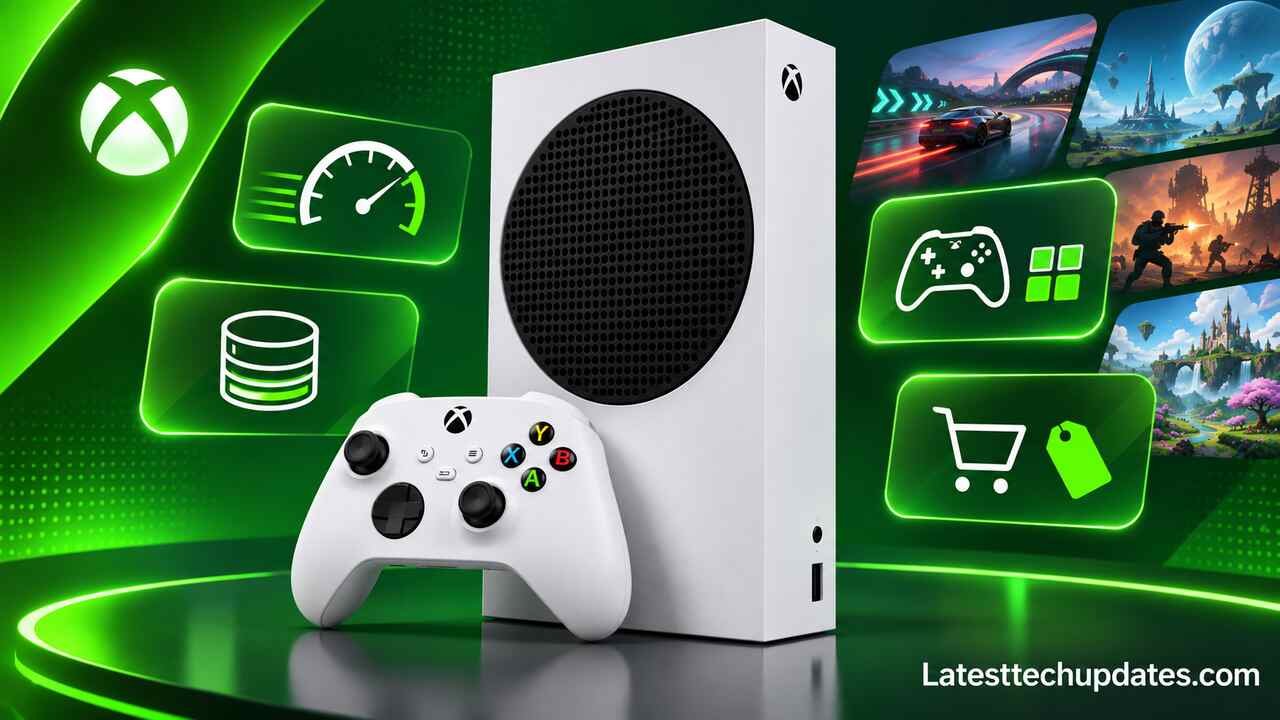
The Xbox Series S is Microsoft’s compact, all-digital gaming console designed for players who want modern Xbox games without the higher cost of more powerful gaming hardware. It supports fast SSD loading, up to 120 FPS in compatible games, ray tracing in selected titles, and access to a large digital game library.
But is the Xbox Series S still worth buying in 2026? That depends on your budget, preferred games, display resolution, and storage needs. This guide explains its specifications, real-world performance, game compatibility, ownership costs, and how it compares with the Xbox Series X and PlayStation 5.
What Is the Xbox Series S?
The Xbox Series S is a ninth-generation gaming console released by Microsoft on November 10, 2020, alongside the Xbox Series X. It provides access to modern Xbox games through digital purchases, Xbox Game Pass, and backward compatibility with supported games from previous Xbox generations.
Unlike the Xbox Series X models equipped with a disc drive, the Series S cannot play physical game discs or Blu-ray movies. Games must be downloaded from supported digital services.
The console is available with 512GB or 1TB of internal storage. Both configurations offer the same core processing and graphics capabilities, making storage capacity the main functional difference.
Xbox Series S Specifications
| Feature | Xbox Series S |
|---|---|
| Manufacturer | Microsoft |
| Release date | November 10, 2020 |
| Processor | Custom 8-core AMD Zen 2 CPU |
| Graphics | AMD RDNA 2 GPU, 4 TFLOPS |
| RAM | 10GB GDDR6 |
| Internal storage | 512GB or 1TB NVMe SSD |
| Target gaming resolution | 1440p |
| Maximum supported frame rate | Up to 120 FPS |
| Video output | Up to 4K |
| Ray tracing | Supported in compatible games |
| Optical disc drive | No |
| Backward compatibility | Supported Xbox One, Xbox 360, and original Xbox games |
| Connectivity | HDMI 2.1, USB 3.1, Wi-Fi, Ethernet |
| Storage expansion | Compatible Xbox storage expansion cards |
These specifications make the Xbox Series S capable of playing demanding modern games, although developers frequently adjust graphical settings and rendering resolution to accommodate its hardware.
The most important distinction is that 4K video output does not mean every game renders at native 4K resolution.
Xbox Series S Gaming Performance
The Xbox Series S delivers a noticeable performance improvement over the original Xbox One, particularly in loading speeds, processor capabilities, and support for games developed for the Xbox Series X|S generation.
Its custom AMD Zen 2 CPU and NVMe SSD allow compatible games to load faster and support more complex environments than older Xbox One hardware.
However, the Series S has less graphics processing power and memory than the Series X. Consequently, games may run at lower resolutions, reduced visual settings, or different frame rates.
Resolution and Graphics Quality
The Xbox Series S targets 1440p gaming, but actual rendering resolution varies between games.
Some titles operate around 1080p, while others target 1440p or use dynamic resolution scaling to balance graphics quality with frame-rate performance.
More demanding games may render below these resolutions to maintain smoother gameplay.
On a 4K television, the Series S can upscale its output to 4K. Upscaling allows the image to fill a 4K screen, but it cannot reproduce all the fine detail of a game rendered natively at 4K.
For players using 1080p televisions or 1440p gaming monitors, the Series S can provide an enjoyable gaming experience without requiring premium graphics hardware.
Does Xbox Series S Support 120 FPS?
Yes, the Xbox Series S supports up to 120 frames per second, but only in compatible games.
Higher frame rates can improve motion clarity and responsiveness, particularly in fast-paced shooters, competitive multiplayer games, and racing titles.
To experience 120 FPS, three conditions generally need to be satisfied:
- The game must support a 120 FPS performance mode specifically on Xbox Series S.
- Your television or monitor must support a 120Hz refresh rate.
- The console must be configured to use the appropriate display settings.
Not every game that supports 120 FPS on Xbox Series X offers the same mode on Series S.
A 120Hz display also does not guarantee that a game will consistently reach 120 FPS. Actual performance depends on the game and its optimization.
Ray Tracing and Visual Effects
The Xbox Series S supports hardware-accelerated ray tracing, a rendering technology that can create more realistic lighting, shadows, and reflections.
However, ray tracing is not available in every game. Developers may reduce or disable ray-tracing effects on Series S to preserve acceptable performance.
The console also supports compatible display technologies such as variable refresh rate (VRR), auto low-latency mode (ALLM), and HDR.
VRR can help reduce visible screen tearing, while ALLM allows compatible televisions to switch automatically to a lower-latency display mode.
These features can improve the overall gaming experience even when a title does not run at maximum resolution.
Xbox Series S vs Xbox Series X: Key Differences
The Xbox Series S and Xbox Series X support the same broad generation of Xbox games, but they differ significantly in graphics capability, memory, storage options, and physical media compatibility.
The Series S prioritizes affordability and compactness, while the Series X provides greater graphical performance.
| Feature | Xbox Series S | Xbox Series X |
|---|---|---|
| CPU architecture | AMD Zen 2 | AMD Zen 2 |
| Graphics performance | 4 TFLOPS | 12 TFLOPS |
| RAM | 10GB GDDR6 | 16GB GDDR6 |
| Main gaming target | 1440p | 4K |
| Maximum supported FPS | 120 | 120 |
| Storage configurations | 512GB, 1TB | 1TB, 2TB, and selected editions |
| Optical disc drive | No | Available on disc-drive models |
| Physical game support | No | Yes, with a disc-drive model |
| Console size | Smaller | Larger |
| Graphics capability | Lower | Higher |
The GPU figures describe theoretical processing capability rather than a direct measurement of gaming performance.
In practice, the Series X can offer higher rendering resolutions, improved visual effects, better image quality, and more consistent performance in demanding games.
Which Console Is Better for 1080p Gaming?
For players using a 1080p television, the Xbox Series S is often a sensible purchase.
It offers modern gaming features without requiring the additional processing power of the Series X.
However, resolution is not the only difference between these consoles.
The Series X can provide higher-quality textures, improved effects, and more consistent frame rates, even when connected to a 1080p display.
Whether those improvements justify the higher price depends on the games you play and how much you value graphical detail.
Which Console Is Better for 4K Gaming?
The Xbox Series X is generally the better choice for gamers who prioritize native 4K resolution and higher graphical fidelity.
Although the Series S supports 4K output, demanding games commonly render at lower resolutions and upscale the image.
For a large 4K television, the difference in image sharpness and visual effects can be more noticeable.
Players who value premium graphics, greater performance headroom, or physical game collections should consider a disc-drive Xbox Series X.
Xbox Series S Storage: Is 512GB Enough?
The 512GB Xbox Series S can be sufficient for players who keep only a few games installed at once. However, it can become restrictive for anyone who regularly plays large modern releases.
The operating system and reserved system files occupy part of the advertised internal storage.
The original 512GB model has commonly offered approximately 364GB of usable storage, although available capacity can vary with system software.
Some modern games require more than 100GB, and updates or downloadable content may increase installation sizes.
How Many Games Can Xbox Series S Hold?
The number of games depends on their installation sizes.
The following hypothetical examples illustrate how quickly approximately 364GB of usable storage can fill.
| Game type | Example installation size | Approximate number |
|---|---|---|
| Small indie games | 5GB | 72 |
| Medium-sized games | 25GB | 14 |
| Large games | 60GB | 6 |
| Very large games | 100GB | 3 |
These are theoretical estimates, not guaranteed installation counts. Actual space requirements vary, and additional storage may be needed for updates or temporary files.
A player who mainly enjoys smaller independent games may find 512GB sufficient.
Someone who regularly switches between large multiplayer titles or modern open-world games may benefit from the 1TB version.
Can You Expand Xbox Series S Storage?
Yes. Xbox Series S storage can be expanded using compatible storage expansion cards or external USB drives.
However, the two options have different capabilities.
Xbox Storage Expansion Cards
Compatible expansion cards connect through the dedicated storage expansion slot.
They provide high-speed storage designed to run Xbox Series X|S optimized games directly, similar to the console’s internal SSD.
External USB Drives
External USB SSDs and hard drives provide additional storage for supported games and content.
Most games optimized for Xbox Series X|S cannot run directly from ordinary USB storage. They generally need to be transferred back to the internal SSD or a compatible expansion card before playing.
Many backward-compatible Xbox One, Xbox 360, and original Xbox games can run directly from supported USB storage.
This makes an external USB drive useful for storing games, but it is not always a direct replacement for internal SSD capacity.
Is the 1TB Xbox Series S Worth It?
The 1TB Series S is worth considering when you frequently install multiple large games and want to avoid managing storage.
It does not provide higher CPU or GPU performance than the 512GB version.
Before purchasing, compare the price difference between the two configurations with the cost of adding compatible high-speed storage later.
A discounted 512GB console may represent better value for occasional gaming, while a reasonably priced 1TB model can be more convenient for frequent players.
Xbox Series S Games and Backward Compatibility
The Xbox Series S supports a broad library of digital games developed for Xbox Series X|S, alongside many compatible titles from earlier Xbox generations.
Players can purchase games from the Microsoft Store or download eligible titles through supported Xbox Game Pass subscriptions.
Popular games supported on Xbox Series S include:
- Forza Horizon 5
- Halo Infinite
- Microsoft Flight Simulator
- Sea of Thieves
- Minecraft
- Fortnite
- Rocket League
- Elden Ring
- Cyberpunk 2077
- Starfield
Game availability, editions, performance modes, and subscription inclusion can change.
Can Xbox Series S Play Xbox One Games?
Yes. The Xbox Series S supports most digitally available Xbox One games that are compatible with Xbox Series X|S.
It also supports selected Xbox 360 and original Xbox games through Microsoft’s backward compatibility program.
However, not every older title is supported.
Because the Series S has no disc drive, physical Xbox One, Xbox 360, and original Xbox discs cannot be used.
If you own a large library of physical Xbox games, purchasing a Series S may require you to buy digital versions again where available.
Are Xbox Series X Games Compatible With Series S?
Games developed for both Xbox Series X and Series S are designed to operate across the two consoles.
Developers can adjust rendering resolution, texture quality, visual effects, and performance modes for the less powerful hardware.
The gameplay experience may therefore differ between consoles even when the same game is supported.
Before buying a demanding title, check its Xbox Series S compatibility and any platform-specific performance information.
Xbox Game Pass on Xbox Series S
Xbox Game Pass is a subscription service that provides access to a changing library of games.
Because the Xbox Series S is completely digital, Game Pass can be useful for discovering new games without buying each title individually.
However, Game Pass is optional.
You can purchase digital games separately, download free-to-play games, and use supported console features without maintaining a Game Pass subscription.
What Does Xbox Game Pass Include?
Game Pass benefits depend on the subscription plan and region.
Depending on the membership, available features may include:
- A library of downloadable games.
- Access to selected new releases.
- Online console multiplayer.
- Xbox Cloud Gaming.
- Membership discounts and additional gaming benefits.
Not every subscription tier includes the same games or services.
Cloud gaming allows supported games to run on remote servers and stream to compatible devices. For additional background, this explanation of cloud gaming access describes the broader technology.
Cloud gaming quality depends on network conditions, service availability, supported devices, and account eligibility.
Is Game Pass Worth It for Xbox Series S?
Game Pass can be worthwhile if you regularly try different games or enjoy several titles included in your subscription.
However, buying games individually may cost less if you primarily play one or two favorites.
A practical way to decide is to compare the annual subscription cost against the prices of the games you realistically expect to play.
Remember that most subscription-based game access ends when the membership expires or a title leaves the catalog, unless you purchase that game separately.
Xbox Series S Price and Total Ownership Cost
The Xbox Series S originally launched in the United States at $299 for the 512GB model.
That is its historical launch price, not a statement of its current retail price.
Actual prices vary according to storage configuration, retailer, availability, promotions, and whether the console is new, refurbished, or used.
When comparing Xbox consoles, it is useful to calculate the total cost of ownership rather than focusing only on the purchase price.
Additional Costs to Consider
Additional expenses may include games, subscriptions, controllers, headsets, and storage expansion.
Consider this hypothetical first-year budget:
| Expense | Illustrative cost |
|---|---|
| Xbox Series S console | $350 |
| Additional controller | $55 |
| Two digital games | $100 |
| Optional subscription | $120 |
| Total | $625 |
These amounts are examples for explaining budgeting, not verified current retail prices or subscription fees.
Your actual spending may be lower if you mainly play free-to-play games or already own compatible accessories.
It may be considerably higher if you purchase several full-priced releases or need additional high-speed storage.
Does Digital-Only Gaming Save Money?
Digital-only gaming reduces the need for physical discs, but it does not automatically make game ownership cheaper.
Digital storefront discounts can offer savings. Game Pass may also reduce spending for players who enjoy a variety of subscription titles.
However, the Series S cannot use secondhand discs, borrowed physical games, or physical game collections.
Buyers should compare their long-term game purchasing habits before deciding whether the console’s lower initial price represents better overall value.
Xbox Series S Design, Connectivity, and Accessories
The Xbox Series S has a compact design suited to entertainment cabinets, desks, and smaller gaming spaces.
The original console measures approximately 27.5 × 15.1 × 6.5 centimeters.
A large circular ventilation grille forms part of its cooling design. Keep the ventilation areas unobstructed and allow sufficient airflow around the console.
Ports and Wireless Connectivity
The Xbox Series S includes:
- One HDMI 2.1 output.
- Three USB 3.1 Gen 1 ports.
- One Gigabit Ethernet connection.
- A dedicated storage expansion slot.
- Dual-band Wi-Fi.
- Xbox Wireless support for compatible accessories.
The console does not support ordinary Bluetooth audio headsets through a standard direct Bluetooth connection.
For wireless audio, use an Xbox-compatible headset or another supported audio solution.
What Comes in the Xbox Series S Box?
A typical new Xbox Series S package includes:
- Xbox Series S console.
- Xbox Wireless Controller.
- HDMI cable.
- Power cord.
- Documentation.
Controller batteries are commonly included, but exact packaging may vary by country and bundle.
Game Pass memberships, additional controllers, rechargeable batteries, and storage expansion cards are normally sold separately unless included in a promotion.
Can You Use Xbox One Controllers?
Yes. Compatible Xbox One controllers and many Xbox One accessories work with the Xbox Series S.
This can reduce upgrading costs for players moving from an older Xbox console.
However, compatibility varies for some third-party accessories and specialized devices, so check individual product support.
How to Set Up Xbox Series S for Better Gaming Performance
Setting up the Xbox Series S requires connecting the console to a display, completing the initial setup, and configuring the appropriate video and network settings.
Step 1: Connect the Console to Your Display
Connect the Xbox Series S to a television or monitor using the HDMI cable.
Select an HDMI input that supports the features you intend to use, such as 120Hz refresh rates or variable refresh rate.
Place the console in a well-ventilated location without blocking its exhaust grille.
Step 2: Complete Initial Setup
Turn on the console and follow the on-screen instructions.
A Microsoft account and internet connection are needed for initial setup and access to digital services.
The Xbox mobile app may help with parts of the setup process.
Step 3: Configure Resolution and Refresh Rate
Open the console’s display settings:
Settings > General > TV & display options
Choose the appropriate resolution and refresh rate for your television or monitor.
If your display supports 120Hz, select that option when available.
If it does not appear, verify the HDMI connection, display input settings, and supported video modes.
Step 4: Install Games and Manage Storage
Download games from your owned digital library or the Microsoft Store.
Game Pass subscribers can also install eligible titles included with their membership.
Check game installation sizes before downloading, particularly when using the 512GB console.
Step 5: Optimize Your Network Connection
A wired Ethernet connection can provide more consistent network performance than Wi-Fi.
If Ethernet is unavailable, use a reliable wireless connection and minimize interference.
Stable network connectivity is particularly useful for multiplayer gaming, large downloads, and cloud gaming.
Xbox Series S Advantages and Disadvantages
The Xbox Series S combines compact hardware, modern gaming features, and digital convenience. Its main compromises involve graphics performance, storage, and physical media support.
| Advantages | Disadvantages |
|---|---|
| More affordable entry into modern Xbox gaming | Lower graphics capability than Series X |
| Fast NVMe SSD loading | Limited storage on the 512GB model |
| Compact design | No disc drive |
| Support for compatible Xbox Series X|S games | Some games have fewer performance options |
| Quick Resume in supported games | Additional high-speed storage can be expensive |
| Digital game purchases and Game Pass access | Cannot use secondhand physical game discs |
| Compatible Xbox One controllers and accessories | Less suitable for premium 4K gaming |
The importance of these trade-offs depends on your preferences.
For example, a player who downloads only a few games may never need additional storage. Someone who owns dozens of physical Xbox games may consider the absence of a disc drive a significant disadvantage.
Xbox Series S vs PS5 Digital Edition
The Xbox Series S and PlayStation 5 Digital Edition both support digital game purchases, but they occupy different performance and pricing categories.
The PS5 Digital Edition generally offers stronger graphics performance, while the Xbox Series S emphasizes compactness and a lower hardware entry cost.
| Feature | Xbox Series S | PS5 Digital Edition |
|---|---|---|
| Graphics performance | Lower | Higher |
| Gaming focus | Primarily 1080p to 1440p | Higher-resolution gaming, including 4K |
| Maximum supported FPS | Up to 120 | Up to 120 |
| Game ecosystem | Xbox | PlayStation |
| Subscription service | Xbox Game Pass | PlayStation Plus |
| Physical disc support | None | Depends on model and compatible disc-drive options |
| Storage expansion | Compatible Xbox expansion cards | Compatible M.2 SSD upgrades |
| Console size | More compact | Larger |
| General positioning | Budget-oriented | Higher-performance |
Which Console Has Better Games?
Neither console is automatically the better choice for every player.
Xbox and PlayStation offer different gaming libraries, subscriptions, franchises, and platform features.
Some previously platform-specific games are now available on multiple systems, so exclusivity should be verified rather than assumed.
Before purchasing, identify five games you most want to play and confirm their availability on each console.
For historical context, our older Xbox 720 vs. PS4 comparison provides a look at how console competition was discussed in an earlier gaming generation.
What If You Prefer Portable Gaming?
Neither Xbox Series S nor PS5 Digital Edition is a handheld console.
If portability matters more than playing on a television, a handheld gaming PC may be worth considering.
Our Legion Go vs Steam Deck comparison explains the differences between two portable gaming options.
Is Xbox Series S Worth Buying in 2026?
The Xbox Series S can still be worth buying in 2026 for budget-conscious players who primarily use digital games and do not require premium 4K graphics.
It continues to support the Xbox Series X|S gaming ecosystem, provides fast loading times, and occupies relatively little space.
However, the console launched in 2020. Buyers should consider its hardware age, current pricing, available games, and long-term performance limitations.
Who Should Buy Xbox Series S?
The console is a suitable option for:
- Casual gamers who mainly play a few favorite titles.
- Students looking for a compact entertainment system.
- Families purchasing a shared gaming console.
- Players using 1080p televisions or 1440p monitors.
- Gamers who prefer digital purchases.
- Existing Xbox users with compatible digital libraries.
- Buyers seeking an additional console alongside another gaming device.
For these users, the Series S can deliver an enjoyable gaming experience without requiring more expensive graphics hardware.
Who Should Avoid Xbox Series S?
The Series S may be less suitable if you:
- Prioritize native 4K gaming.
- Want the highest available graphical settings.
- Own a large collection of physical Xbox discs.
- Frequently install numerous large games.
- Prefer buying and reselling used physical games.
- Want more performance headroom for demanding future releases.
These preferences may justify choosing an Xbox Series X or another higher-performance gaming system.
Three Practical Buying Scenarios
Scenario 1: Casual player with a 1080p television
The Xbox Series S may provide sufficient image quality and performance without the added cost of a premium console.
Scenario 2: Competitive player with a 120Hz monitor
The Series S can be suitable when favorite games provide supported high-frame-rate modes. Check individual game performance before purchasing.
Scenario 3: Player with a large 4K television and physical game library
A disc-drive Xbox Series X will usually be the stronger option because it offers higher graphics capabilities and physical media compatibility.
The right console depends on how you actually play, not simply which system has the strongest specifications.
Buying a Used Xbox Series S: What to Check
A used Xbox Series S can offer additional savings, but buyers should inspect its hardware, connectivity, storage, and included accessories before completing a purchase.
Check Console Functionality
Ask the seller to demonstrate that the console starts normally and reaches the Xbox dashboard.
If possible, run a game to check performance and stability.
Watch for unexpected shutdowns, display problems, abnormal fan noises, or overheating warnings.
A console that starts normally but crashes during gameplay may have underlying hardware issues.
Test the Controller and Ports
Confirm that the controller connects correctly and responds to button inputs.
Check analog sticks for drift, along with triggers, directional buttons, and other controls.
Test the HDMI output, USB ports, Ethernet connection, and power connection.
Verify Online Connectivity
Connect the console to the internet and confirm that it can access Xbox network services.
This is particularly important because the Xbox Series S depends on digital game distribution.
A console subject to an enforcement restriction may have limitations that are not apparent during offline testing.
Confirm Storage and Accessories
Open the storage settings to determine whether the console has a 512GB or 1TB internal drive.
Check that the controller, HDMI cable, and power cord are included.
Ask whether the system has undergone repairs or hardware modifications.
Avoid paying extra for digital games supposedly included through the seller’s personal account. Account access may be revoked, and digital purchases generally remain associated with their original account.
Compare Used and New Prices
The used price should provide enough savings to compensate for reduced warranty protection, previous wear, and potential repairs.
If a used unit costs only slightly less than a new console with a valid warranty, buying new may be the safer financial decision.
Conclusion
The Xbox Series S remains a practical choice in 2026 for gamers who want access to modern Xbox titles, fast SSD storage, and digital gaming convenience at a potentially lower cost.
Its biggest strengths are compact design, support for current-generation Xbox games, and compatibility with the wider Xbox digital ecosystem. Its main drawbacks are limited internal storage, lower graphics performance, and the absence of physical disc support.
For players using 1080p or 1440p displays who mainly purchase digital games, the Series S can offer good value at the right price.
However, gamers prioritizing premium 4K graphics, physical game collections, or additional performance headroom should consider the Xbox Series X.
Before purchasing, compare current console prices, check your favorite games, and calculate potential subscription and storage expenses.
Frequently Asked Questions
Can Xbox Series S Play GTA 6?
Yes. Rockstar Games has confirmed Grand Theft Auto VI for Xbox Series X|S, with a release date of November 19, 2026.
Xbox Series S players can pre-load the digital game ahead of launch. However, performance details such as actual rendering resolution and supported frame rates should be based on confirmed technical information rather than assumptions.
Can Xbox Series S Run 4K Games?
Yes, the Xbox Series S supports 4K output and can upscale games to 4K. Some less demanding titles may render natively at 4K, but demanding modern games generally use lower rendering resolutions.
Its primary gaming design target is 1440p.
Does Xbox Series S Need Internet to Play Games?
Not every game requires a continuous internet connection.
Many downloaded single-player games can work offline after the appropriate setup and license requirements are satisfied.
However, online multiplayer, downloads, cloud gaming, and certain digital license checks require internet access.
Can You Play Free Games on Xbox Series S?
Yes. The Xbox Series S supports free-to-play games such as Fortnite and Rocket League.
Eligible free-to-play online multiplayer games generally do not require a paid Game Pass subscription for online access.
Individual games may still offer optional paid content.
How Long Will Xbox Series S Be Supported?
Microsoft has not announced one universal date when all Xbox Series S game support will end.
Future compatibility depends on developer decisions, hardware requirements, and Microsoft’s platform plans.
The console’s compatibility with games released in the future should not be assumed indefinitely.
Can Xbox Series S Use a Keyboard and Mouse?
Yes. The Xbox Series S supports compatible USB keyboards and mice.
However, actual gameplay support varies by title. Some games support keyboard-and-mouse controls, while others limit these devices to text entry or interface navigation.
