
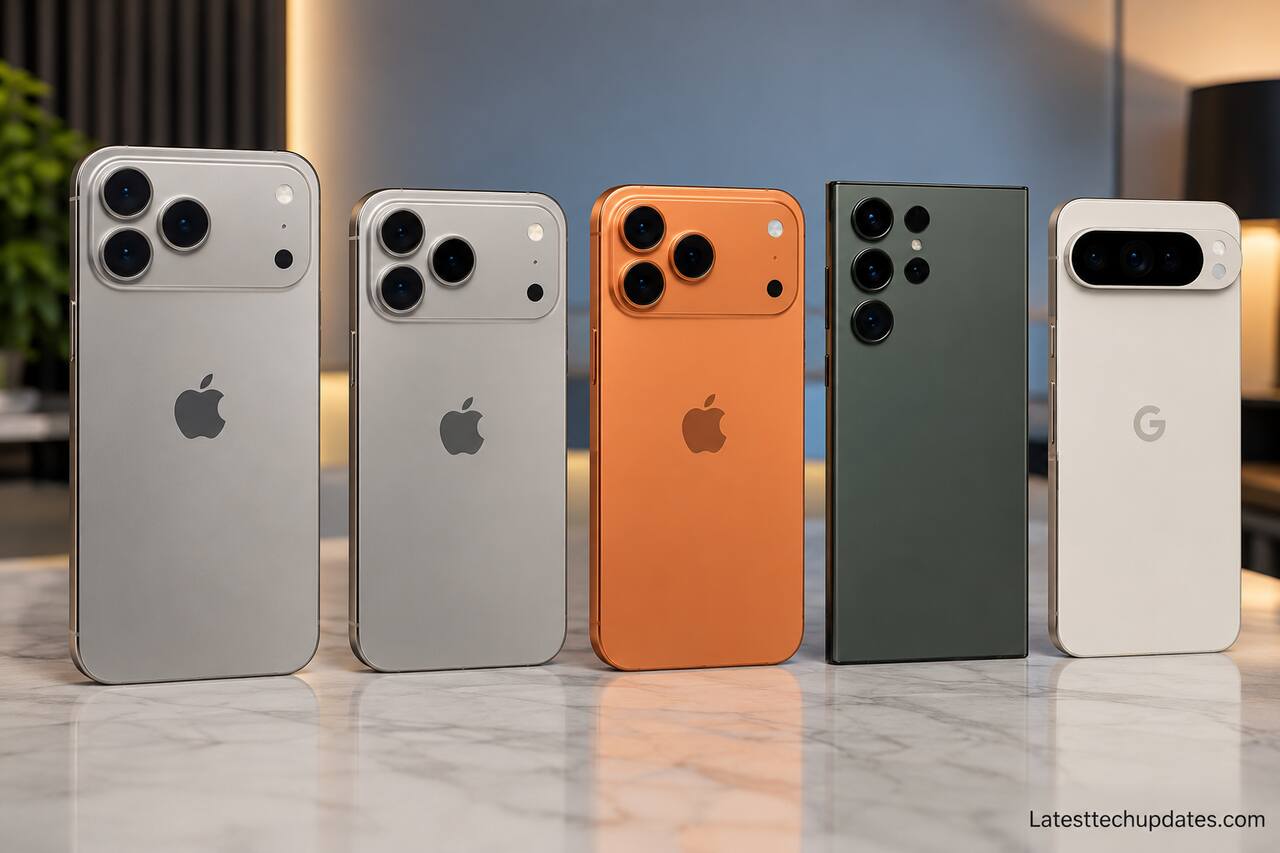
The iPhone 18 Pro Max is the iPhone to consider if battery life and a large 6.9-inch screen matter more than weight and price. The smaller iPhone 18 Pro gives you essentially the same A20 Pro performance and rear camera system in a much easier-to-handle 6.3-inch body. Meanwhile, the iPhone 17 Pro Max remains surprisingly competitive, particularly if you already own one, while Android flagships such as the Samsung Galaxy S26 Ultra, Google Pixel 11 Pro XL, and OnePlus 15 offer advantages in areas such as zoom flexibility, AI tools, multitasking, charging speed, and battery capacity.
This comparison uses the same practical criteria across the phones rather than judging them only by specification-sheet numbers.
Quick comparison
| Phone | Display | Processor | Main camera setup | Independent battery test* | Starting price |
| iPhone 18 Pro Max | 6.9-inch OLED, up to 120Hz | A20 Pro | 48MP variable-aperture main, 48MP ultrawide, 48MP 4x telephoto | 18h 27m | $1,299 |
| iPhone 18 Pro | 6.3-inch OLED, up to 120Hz | A20 Pro | Same rear system as Pro Max | 16h 17m | $1,199 |
| iPhone 17 Pro Max | 6.9-inch OLED, up to 120Hz | A19 Pro | 48MP main, 48MP ultrawide, 48MP 4x telephoto | 17h 54m | $1,199 launch price |
| Galaxy S26 Ultra | 6.9-inch AMOLED, up to 120Hz | Snapdragon 8 Elite Gen 5 for Galaxy | 200MP main, 50MP ultrawide, 3x and 5x telephotos | 16h 10m | $1,299.99 launch price |
| Pixel 11 Pro XL | 6.8-inch LTPO OLED, 1-120Hz | Google Tensor G6 | 50MP main, 48MP ultrawide, 48MP 5x telephoto | 14h 28m | About $1,299 at launch |
| OnePlus 15 | 6.78-inch LTPO, up to 165Hz in supported games | Snapdragon 8 Elite Gen 5 | Three 50MP rear cameras, including 3.5x telephoto | 25h 13m | $899.99 launch price |
*The battery figures above come from Tom’s Guide’s controlled web-browsing battery testing, making them more useful for relative comparison than mixing manufacturer battery claims measured under different conditions. The iPhone 18 Pro Max reached 18:27, the 18 Pro 16:17, the 17 Pro Max 17:54, the Galaxy S26 Ultra 16:10, the Pixel 11 Pro XL 14:28, and the OnePlus 15 25:13 in that testing.
Apple officially prices the 256GB iPhone 18 Pro at $1,199 and the iPhone 18 Pro Max at $1,299 in the United States. Both are also available with 512GB, 1TB, or 2TB of storage. Prices and promotions differ significantly by country and retailer.
iPhone 18 Pro Max vs iPhone 18 Pro: the difference is mostly size and battery
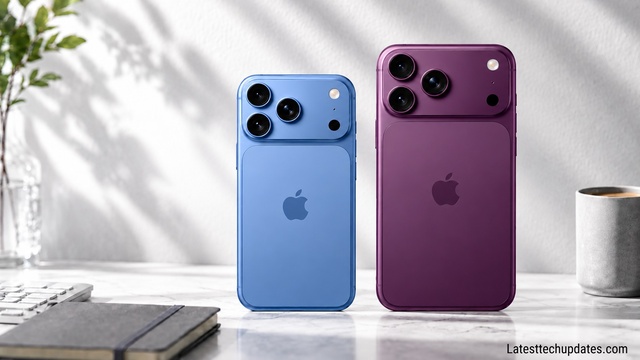
Choosing between the iPhone 18 Pro and Pro Max is simpler than the names suggest. Apple has not reserved a superior processor or rear camera system for the Max.
Both use the A20 Pro chip with a six-core CPU, seven-core GPU, Dual 16-core Neural Engine, hardware-accelerated ray tracing, and Apple’s new thermal design. Both also use the same three-camera Pro Fusion system.
The main camera is a 48MP unit with a mechanically variable aperture. It can operate at f/1.48, f/1.8, f/2.8, or f/4. The wider settings allow more light into the camera, while narrower apertures can keep more of a scene in focus. Apple has also added manual controls for aperture, shutter speed, white balance, and a histogram, making the Camera app more useful for people who want more control instead of relying entirely on automatic processing.
The telephoto camera is also the same on both models. It provides a native 4x perspective from a 48MP sensor and Apple’s 8x “optical-quality” option using the same telephoto system. Digital zoom extends to 40x for still photography.
The real differences are physical. The iPhone 18 Pro uses a 6.3-inch display and weighs 211 grams. The Pro Max increases the display to 6.9 inches and weighs 249 grams. That 38-gram difference is noticeable, particularly if you use the phone one-handed or add a protective case.
Battery life is where the Pro Max earns much of its extra size. Apple rates the 18 Pro for up to 36 hours of local video playback, while the Pro Max is rated for up to 45 hours. In independent testing, the difference was 16 hours 17 minutes versus 18 hours 27 minutes.
For someone who wants the new camera and A20 Pro performance but dislikes very large phones, the 18 Pro gives up surprisingly little. For frequent travelers, heavy camera users, gamers, and anyone who regularly finishes the day with a nearly empty battery, the Pro Max’s extra endurance can be more useful than its larger screen alone.
How much better is the iPhone 18 Pro Max than the iPhone 17 Pro Max?
The generational improvement is real, but an iPhone 17 Pro Max owner should not expect the entire phone experience to feel new.
The 17 Pro Max already has a 6.9-inch 120Hz OLED display with the same 2868 x 1320 resolution and 3,000-nit rated outdoor peak brightness. Apple also gave the 17 Pro generation an aluminum unibody and vapor-chamber cooling, so the 18 Pro Max is not introducing an entirely new physical concept.
The iPhone 18 Pro Max instead improves the components underneath that familiar design.
A20 Pro replaces A19 Pro
The 17 Pro Max uses the A19 Pro with a six-core CPU, six-core GPU, and 16-core Neural Engine. The 18 generation moves to A20 Pro with a seven-core GPU and Dual 16-core Neural Engine. Apple says A20 Pro also has 50 percent more memory bandwidth than A19 Pro, while independent testing has found very strong gains in demanding CPU and GPU workloads.
For everyday messaging, web browsing, social apps, and streaming, that does not mean everything suddenly feels dramatically faster. The extra performance matters more for demanding games, computational photography, video processing, sustained professional workloads, and increasingly complex on-device AI.
Variable aperture is the biggest camera change
The 17 Pro Max already has three 48MP rear cameras, including its 4x telephoto system and 8x optical-quality zoom. Its main camera, however, uses a fixed f/1.78 aperture.
The 18 Pro Max changes that main camera to the mechanical variable-aperture design. It can open to f/1.48 in darker conditions or narrow to f/4 when greater depth of field is useful. Apple has also added deeper manual controls. This is more meaningful to photographers and creators than simply raising the megapixel count would have been.
Early independent analysis suggests the variable aperture does not transform every casual photo, however. Its advantages become more relevant when lighting, subject depth, group focus, or manual creative control actually require it.
Battery improves, but not by as much as Apple’s playback figures suggest
Apple rated the iPhone 17 Pro Max for up to 37 hours of video playback. The iPhone 18 Pro Max increases that official figure to 45 hours.
Under Tom’s Guide’s standardized cellular web-browsing test, the 17 Pro Max lasted 17 hours 54 minutes and the 18 Pro Max lasted 18 hours 27 minutes. That is an improvement of 33 minutes under this particular test, not a revolutionary jump.
The lesson is important: manufacturer video-playback claims and mixed-use battery testing measure different workloads.
Charging is faster
The iPhone 18 Pro models can reach Apple’s claimed 50 percent charge in around 15 minutes when paired with a compatible 60W or higher USB-C adapter supporting Adjustable Voltage Supply. MagSafe can reach 50 percent in about 30 minutes with appropriate hardware.
The 17 Pro Max was rated for roughly 50 percent in 20 minutes with a 40W or higher adapter.
The change is useful when you need a short emergency top-up, although several Android flagships still push charging speed much harder.
The biggest drawback of the iPhone 18 Pro Max: weight
The iPhone 18 Pro Max weighs 249 grams. The iPhone 17 Pro Max weighs about 231 grams according to Apple’s specifications. That makes the new model roughly 18 grams heavier despite keeping essentially the same height and width.
That also makes the iPhone considerably heavier than some large Android competitors. Samsung’s 6.9-inch Galaxy S26 Ultra weighs 214 grams, while the OnePlus 15 weighs roughly 211 to 215 grams depending on finish.
A large battery can justify additional weight, but buyers who spend hours reading, gaming, filming, or scrolling one-handed should not ignore this difference.
iPhone 18 Pro Max vs Galaxy S26 Ultra
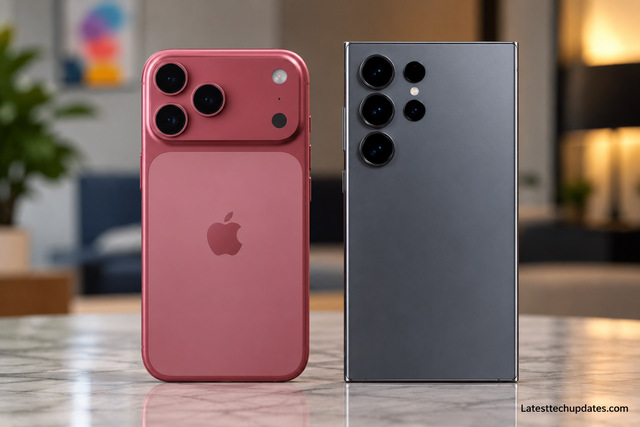
The Galaxy S26 Ultra is the closest mainstream Android alternative to the iPhone 18 Pro Max because both are large, premium phones built around top-tier cameras and processors.
Samsung uses a 6.9-inch 3120 x 1440 Dynamic AMOLED 2X display with up to a 120Hz refresh rate. The phone is only 7.9mm thick and weighs 214 grams, making it considerably lighter than the iPhone 18 Pro Max. It also retains the integrated S Pen.
Its Snapdragon 8 Elite Gen 5 for Galaxy processor is designed for demanding Android gaming, multitasking, AI workloads, and camera processing. Samsung has also improved its vapor chamber and thermal system.
Samsung gives you more dedicated zoom hardware
The S26 Ultra has a 200MP f/1.4 main camera, 50MP ultrawide, 50MP 5x telephoto, and an additional 10MP 3x telephoto. Samsung therefore provides more native focal-length options than Apple’s three-camera arrangement.
Apple counters with its new variable-aperture main camera and particularly strong professional video features. The iPhone supports ProRes, ProRes RAW, Apple Log 2, 4K Dolby Vision recording, and extensive manual controls.
For someone who frequently shoots distant subjects, concerts, wildlife, or travel scenes, Samsung’s dual-telephoto hardware is particularly useful. For creators who care about video workflows, color management, external recording, and consistency across Apple’s ecosystem, the iPhone remains especially capable.
Samsung also offers productivity features Apple does not directly match
The S26 Ultra includes the S Pen and Samsung DeX, which can provide a desktop-style workspace when the phone is connected to a larger display. It also introduces Samsung’s Privacy Display technology, designed to reduce side-angle visibility when you do not want nearby people reading the screen.
These features matter more than benchmark differences for some business users.
Samsung also supports faster 60W wired charging, with the company claiming up to 75 percent charge in around 30 minutes. Its 5,000mAh battery is rated for up to 31 hours of video playback.
The iPhone 18 Pro Max lasted longer in Tom’s Guide’s web-browsing battery test, but Samsung charges faster and is much lighter.
iPhone 18 Pro Max vs Google Pixel 11 Pro XL
The Pixel 11 Pro XL approaches the flagship-phone problem differently. Its biggest strengths are Google’s Android software, Gemini integration, computational photography, and long update commitment rather than maximum gaming benchmark performance.
It uses a 6.8-inch LTPO OLED display with a 1-120Hz refresh range and up to 3,600 nits of rated peak brightness. The Tensor G6 processor is paired with 12GB or 16GB of RAM depending on storage configuration.
Google’s rear camera system combines a 50MP main camera, 48MP ultrawide with macro focus, and 48MP 5x telephoto. Google’s Pro Zoom can extend much farther through a combination of optical and computational techniques.
The Pixel’s bigger weakness is endurance compared with the strongest rivals. Tom’s Guide measured 14 hours 28 minutes from the Pixel 11 Pro XL, versus 18 hours 27 minutes for the iPhone 18 Pro Max and more than 25 hours for the OnePlus 15 in the same general testing methodology.
Google does promise seven years of OS, security, and Pixel Drop updates, and the Pixel 11 Pro line launched with Android 17.
For someone deeply invested in Google services and Gemini, that software experience may matter more than having the fastest processor or longest battery.
OnePlus 15 remains the battery and charging outlier
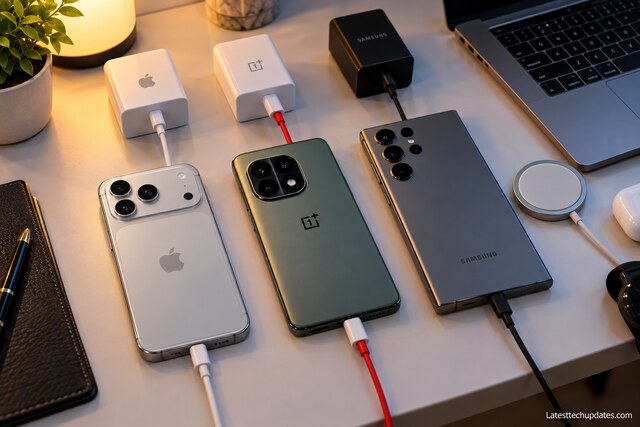
The OnePlus 15 is particularly interesting because it shows how aggressively Android manufacturers have adopted high-capacity silicon-based batteries.
Its 7,300mAh battery is much larger on paper than the batteries used by Samsung, Google, or Apple, yet the device weighs only around 211 to 215 grams. OnePlus supports 80W wired charging in its listed specifications, along with 50W wireless charging.
Tom’s Guide measured 25 hours 13 minutes in its battery test and reported 81 percent charge after 30 minutes in its testing.
The Snapdragon 8 Elite Gen 5 also gives the phone flagship-class performance, while its display can reach 165Hz in supported gaming scenarios.
OnePlus uses three 50MP rear cameras, including a 3.5x telephoto. Its camera system is capable, but independent testing has found its low-light performance less consistent than some leading camera-focused rivals.
For someone who prioritizes battery endurance, charging speed, gaming performance, and price over the Apple ecosystem or the most refined camera system, the OnePlus 15 represents a very different value proposition.
Android photography flagships go even further in camera hardware
Samsung and Google are not the only alternatives. Photography-focused Android phones such as the vivo X300 Ultra and OPPO Find X9 Ultra push camera hardware particularly hard.
The vivo X300 Ultra combines a 200MP main camera, 50MP ultrawide, and 200MP telephoto, along with a Snapdragon 8 Elite Gen 5 processor and a 6,600mAh battery with 100W wired charging.
OPPO’s Find X9 Ultra goes further still on paper, combining a 200MP main camera, 200MP telephoto, additional 50MP camera modules, a 7,050mAh battery, 100W wired charging, and 50W wireless charging.
Those numbers do not automatically make either phone a better camera. Sensor size, lens quality, autofocus, stabilization, image processing, color science, HDR, motion handling, and video processing all influence the final result.
Their availability, carrier compatibility, warranty service, and software support also vary by country, so these devices make more sense in markets where the manufacturer sells them officially.
iOS 27 vs Android: hardware is only half the decision
The operating system may influence long-term satisfaction more than small differences in camera resolution.
The iPhone 18 Pro series launches with iOS 27 and Apple’s newer Apple Intelligence and Siri AI capabilities. Siri AI began rolling out in beta in English with iOS 27, with additional language support planned after launch. Feature availability varies by language and region.
The practical advantage of iPhone is integration. AirPods, Apple Watch, Mac, iPad, iCloud, AirDrop, Continuity features, MagSafe accessories, and Apple’s photo and messaging ecosystem work particularly closely together.
Android gives you greater hardware variety and often more freedom over the interface, default apps, file handling, split-screen workflows, launchers, device form factors, charging systems, and manufacturer-specific features. Samsung adds DeX and the S Pen. Google puts Gemini deeply into Pixel. OnePlus concentrates heavily on speed, battery, and gaming.
Neither approach is universally better. Switching platforms can also create costs that have nothing to do with the phone itself, such as replacing a smartwatch, moving cloud photo libraries, changing accessories, or adjusting established app workflows.
Which phone makes sense for different users?
The iPhone 18 Pro Max makes the most sense when you want Apple’s largest screen, longest iPhone battery life, the new variable-aperture camera, professional video features, and maximum A20 Pro performance, and you do not mind carrying a 249-gram phone.
The iPhone 18 Pro is the more balanced Apple option for someone who wants almost everything the Pro Max offers but values one-handed use and lower weight more than maximum battery endurance.
The iPhone 17 Pro Max is still highly capable. An upgrade is easier to justify if you specifically want the variable-aperture main camera, manual camera controls, faster A20 Pro hardware, faster charging, or every extra bit of battery life. Someone already happy with the 17 Pro Max’s camera and performance has less reason to replace it immediately.
The Galaxy S26 Ultra suits users who want a lighter large-screen phone, S Pen support, DeX, strong long-range zoom options, faster charging, extensive Android customization, and Samsung’s productivity and AI features.
The Pixel 11 Pro XL is attractive for people who prioritize Google’s software experience, Gemini features, computational photography, and a clearly stated seven-year update policy.
The OnePlus 15 is especially compelling for users who care about exceptional battery endurance, very fast charging, gaming performance, and a lower launch price more than having Apple’s ecosystem or Samsung’s extensive camera hardware.
Is the iPhone 18 Pro Max worth upgrading to from the 17 Pro Max?
For most iPhone 17 Pro Max owners, it is an upgrade rather than a necessary replacement.
The A20 Pro is faster, the variable-aperture main camera is genuinely new, charging is quicker, and battery life improves. However, the 17 Pro Max already gives you a 6.9-inch 120Hz display, excellent A19 Pro performance, a three-camera 48MP system, 4x telephoto hardware, strong battery life, and modern Apple connectivity.
The new model also becomes significantly heavier.
Users coming from older generations such as the iPhone 14 Pro Max or iPhone 15 Pro Max will see a much larger collection of changes at once, including newer cameras, better thermals, battery improvements, newer processors, USB-C developments, newer wireless hardware, and Apple’s latest AI features.
Frequently asked questions
Does the iPhone 18 Pro Max have a better camera than the iPhone 18 Pro?
No meaningful rear-camera advantage is listed between them. Both use Apple’s 48MP Pro Fusion system with the variable-aperture main camera, 48MP ultrawide, and 48MP 4x telephoto. The Max mainly adds screen size and battery capacity.
Is the iPhone 18 Pro Max faster than the iPhone 18 Pro?
They use the same A20 Pro specification. Performance differences caused by size should therefore be much less important than the battery and display differences.
Is the iPhone 18 Pro Max much better than the 17 Pro Max?
It is meaningfully improved in camera control, processor performance, charging, and battery life, but the display size, resolution, basic form factor, and telephoto focal lengths remain familiar. A 17 Pro Max owner does not need to upgrade simply because a new model exists.
Which has better battery life, iPhone 18 Pro Max or Android flagships?
It depends on the Android phone. The 18 Pro Max outlasted the Galaxy S26 Ultra and Pixel 11 Pro XL in Tom’s Guide’s testing, but the OnePlus 15 lasted substantially longer.
Which Android phone is closest to the iPhone 18 Pro Max?
The Galaxy S26 Ultra is the closest direct comparison in size, premium positioning, price, performance, and camera ambition. Pixel emphasizes Google’s AI and computational photography more heavily, while OnePlus focuses more aggressively on battery and charging.
Should I buy the 18 Pro instead of the Pro Max?
The 18 Pro is a strong choice if 6.3 inches is large enough for you. You keep the same A20 Pro and rear camera hardware while reducing weight from 249 grams to 211 grams. The main sacrifice is battery endurance and screen area.
Final assessment
The iPhone 18 Pro Max is less about giving Apple users exclusive features unavailable on the smaller Pro and more about maximizing endurance and screen size. The iPhone 18 Pro delivers nearly the same core experience in a much lighter package.
Compared with the iPhone 17 Pro Max, the most important upgrades are the A20 Pro chip, variable-aperture main camera, expanded manual photography controls, faster charging, and improved battery life. Those are meaningful changes, but the 17 Pro Max remains close enough that upgrading after only one generation will depend heavily on how much you value those specific improvements.
Android makes the decision more interesting. The Galaxy S26 Ultra offers more zoom hardware, S Pen and DeX functionality, and a substantially lighter body. The Pixel 11 Pro XL focuses on Google’s software and AI experience. The OnePlus 15 shows what is possible when battery capacity and charging speed are given higher priority.
The right choice therefore depends less on which specification sheet contains the biggest number and more on what you actually do with the phone. Camera and video creators may value Apple’s new controls, productivity users may prefer Samsung’s additional tools, Google-centric users may find Pixel more natural, and heavy users who constantly worry about battery life may find OnePlus difficult to ignore.
Read Also: iOS 27 Finance Lock Rumors Spark Concern for JV and SIM Locked iPhones: What We Know So Far
