


You might be asking…
What advancements are being made in water rescue technology?
Search and rescue teams have historically used manpower and outdated equipment to perform underwater searches for victims. Methods like diver sweeps are costly, dangerous, and ineffective.
Problem:
A traditional underwater search can last several hours or even days. When you’re diving for a submerged victim every moment matters. Drowning is no joke. The CDC reports that an average of more than 4,500 people drowned annually between 2020 and 2022. That is 500 more annual deaths than reported in 2019.
Enter modern sensor technology.
Searching underwater with smart tools like sonar for water rescue is revolutionizing how first responders operate. Using AI and advanced sonar technology, water scanners can detect victims in minutes that would otherwise take teams hours.
The results speak for themselves.
Here’s what you’ll learn:
- Why Speed Is Of The Essence In Aquatic Search Operations
- Sensor Technology Is Advancing The Way Water Rescues Are Conducted
- 3 Types Of Rescue Sensors You Should Know
- Why AI-Powered Sonar Is Leading The Way
Why Speed Is Of The Essence In Aquatic Search Operations
Did you know…
Aquatic rescue teams are racing against the clock before they even get their first piece of equipment in the water. This thing called the “golden hour” is common knowledge in the first response community. When that hour passes, many water rescue teams switch from rescue to recovery.
This is horrific for families to hear.
Throwing divers in the water, dragging grapnels across the bottom, and conducting other forms of manual searches are extremely inefficient. Divers face poor visibility, freezing water temps, hidden dangers on the bottom, and limited air supply. What’s more is these methods only allow teams to cover small areas at a time.
Technology like sonar detectors allow responders to cover acres of water instantly without putting a diver in harm’s way. Not only can they cover more ground, but they can identify targets and relay real-time data to the command center.
Imagine how different things would be if:
Every minute spent searching manually is a minute wasted. Rescuers can locate targets within minutes, not hours. All while maintaining a clear picture of the situation.
Locating a Submerged Vehicle After Flash Flooding
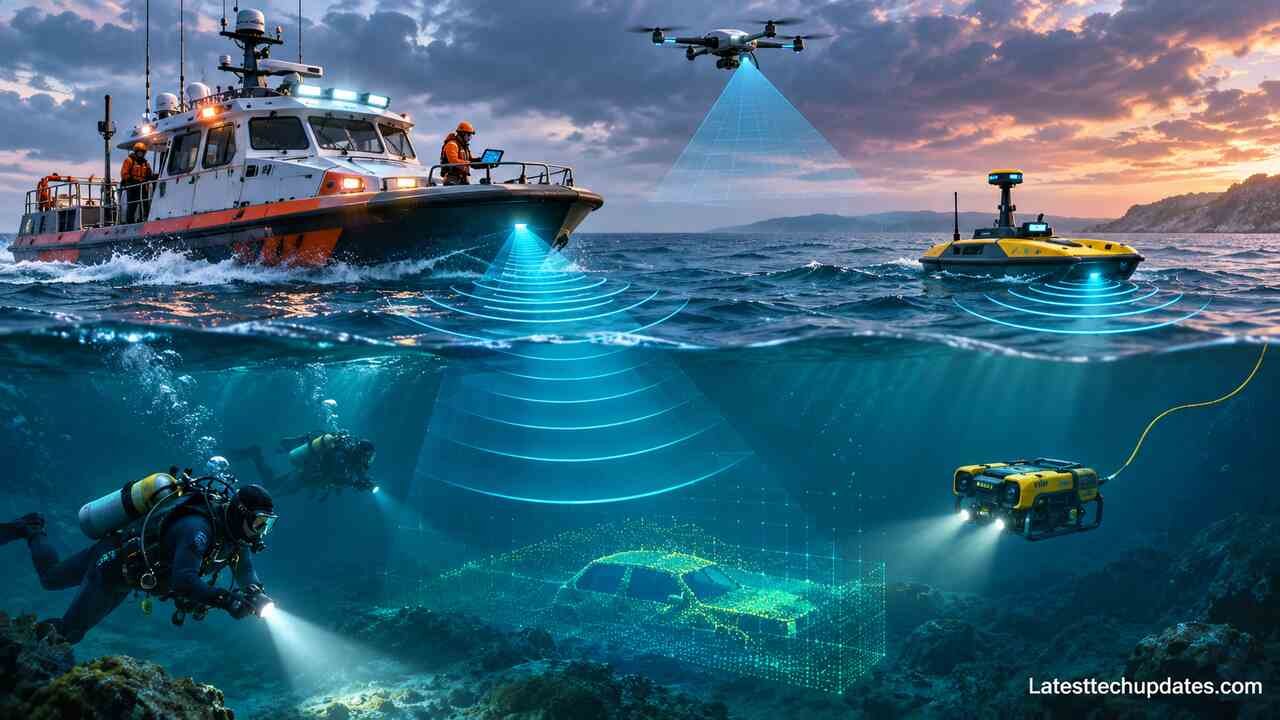
Imagine a rescue team responding to a flash flood where a vehicle has disappeared beneath muddy water near a flooded roadway. Strong currents, floating debris, and poor underwater visibility make an immediate diver search extremely dangerous.
Instead of sending divers into an unknown environment, responders could first deploy portable sonar from a safe position to scan accessible underwater areas. The sensor may identify an object resembling a submerged vehicle, allowing the team to narrow its search area before considering further action.
This example demonstrates how modern aquatic search technology can improve initial scene assessment, reduce unnecessary underwater exposure, and help rescue coordinators make faster, better-informed decisions.
Sensor Technology Is Advancing The Way Water Rescues Are Conducted
If you haven’t guessed by now. Sensor technology is advancing the way water rescues are conducted.
And it’s not just one type of sensor specifically. It’s a combination of technologies and tools that are making a difference.
Take a look at some of the impactful technologies listed below:
- High-quality sonar that creates an image of what’s below the surface
- Artificial intelligence to detect and identify potential targets
- ROVs to eliminate unnecessary dives
- Thermal imaging to identify people in the water from the surface
You’ll notice that no one technology can do it all. But that’s not how water rescue operations are commanded these days. Teams are leveraging strengths of each to create overlap.
Combining Drone Mapping and Underwater Sonar in Lake Searches
Consider a search operation at a large recreational lake where a swimmer is reported missing near an unfamiliar shoreline. Searching the entire lake without a coordinated strategy could consume valuable resources.
A drone equipped with a high-resolution camera could help responders map shoreline access points, identify visible surface obstacles, and monitor areas that are difficult to reach on foot. Meanwhile, boat-mounted sonar could examine selected underwater search zones based on the swimmer’s last known location and environmental conditions.
By combining aerial observations with underwater sensor readings, search coordinators could develop a more organized search plan. This approach illustrates how multiple sensor technologies can complement each other rather than relying on a single device to handle every challenge.
3 Types Of Rescue Sensors You Should Know
- Side-scan sonar
- Handheld sonar
- Scan sonar
Before we dive into what makes each unique. It’s important to highlight that not all sonar technology is created equal.
Side-Scan Sonar
Side-scan sonar has been used for years to search areas of water. It functions by towing a device behind a boat that emits sonar waves laterally. This technology creates an image of everything that’s on the bottom.
Pros:
- Ideal for large areas
- Works best in deep water
- High-definition imagery of the bottom
Now you’re probably thinking… What’s the catch? Unfortunately, side scan requires a boat and trained personnel to operate. It’s not very portable and works best in open areas.
Handheld Sonar
This is where it gets really exciting…
Handheld sonar devices are portable, affordable, and ready to deploy in minutes from the shore or a boat. Most handheld sonar devices on the market use artificial intelligence to detect sonar returns. Which means first responders don’t need to be trained in how to “look” for a victim.
This type of technology is ideal for rapid deployment and situations where every second counts.
Scan Sonar
Scan sonar is deployed underwater on a small tripod that sends out sonar beams in a 360 radius. The sonar is then depicted on a computer on the surface almost instantly. This technology has been used to guide diver units straight to a target, saving valuable time underwater.
Why AI-Powered Sonar Is Leading The Way
Ok, so AI sonar isn’t a “magic wand” that will save everyone who enters the water. But what it does do is allow rescue teams to locate victims faster than ever before.
Here’s how it works…
Traditionally, sonar returns require a trained eye to decipher and locate potential targets. AI technology can analyze sonar returns faster than the human eye. Not only that, but it automatically detects anything that could be recognized as a human shape.
Using AI, water rescue sonar is breaking barriers in the first response community.
The WHO estimates 300,000 fatalities due to drowning throughout the world in 2021. Drowning isn’t going down, so technology like AI-powered sonar can mean the difference between life and death.
AI sonar technology is designed to be low maintenance. It’s also used in low-visibility water, around obstructions, and deployed during daytime or night operations. And let’s not forget how less time spent searching manually equals less deployments for your dive team.
Some perks of using AI-powered sonar include:
- Locating victims quicker during that “critical window”
- Limiting unnecessary dives for your rescue team
- Easily operated by non-certified first responders
- Detects all types of targets in zero-visibility water
Mind. Blown.
How AI-Powered Sonar Can Help Prioritize Multiple Underwater Targets
Consider a search operation in a reservoir where sonar identifies several objects beneath the surface. Some may be rocks, submerged logs, or discarded equipment, while others could have characteristics that require further investigation.
An AI-assisted sonar system trained to recognize relevant patterns could help operators flag potential targets for closer review. For example, the software might highlight an unusual shape among surrounding objects, allowing the search team to prioritize its investigation instead of manually examining every sonar return with equal attention.
However, AI-generated alerts are not proof that a person has been located. Underwater reflections, overlapping objects, and environmental interference can produce false positives. Human interpretation and additional verification remain essential before responders act on a suspected detection.
This combination of automated analysis and professional judgment demonstrates how artificial intelligence can support aquatic search operations without replacing experienced rescue personnel.
Wrap Up
Aquatic search and rescue teams are using more sonar and technology than you might realize. AI-powered sonar, ROVs, and handheld detectors are changing the game when it comes to finding submerged victims.
Water rescue technology has evolved over the years but there is always room for improvement. As long as lives are at stake, the push to become better never stops.
Here’s your recap:
- When every second counts teams need to move fast
- Advancements in technology allow teams to cover more ground quickly
- There are different types of sensors that can be used for each situation
- AI technology is making sonar more accessible for all first responders
The teams taking advantage of technology will recover more victims than those who wait. And that’s what matters.
