


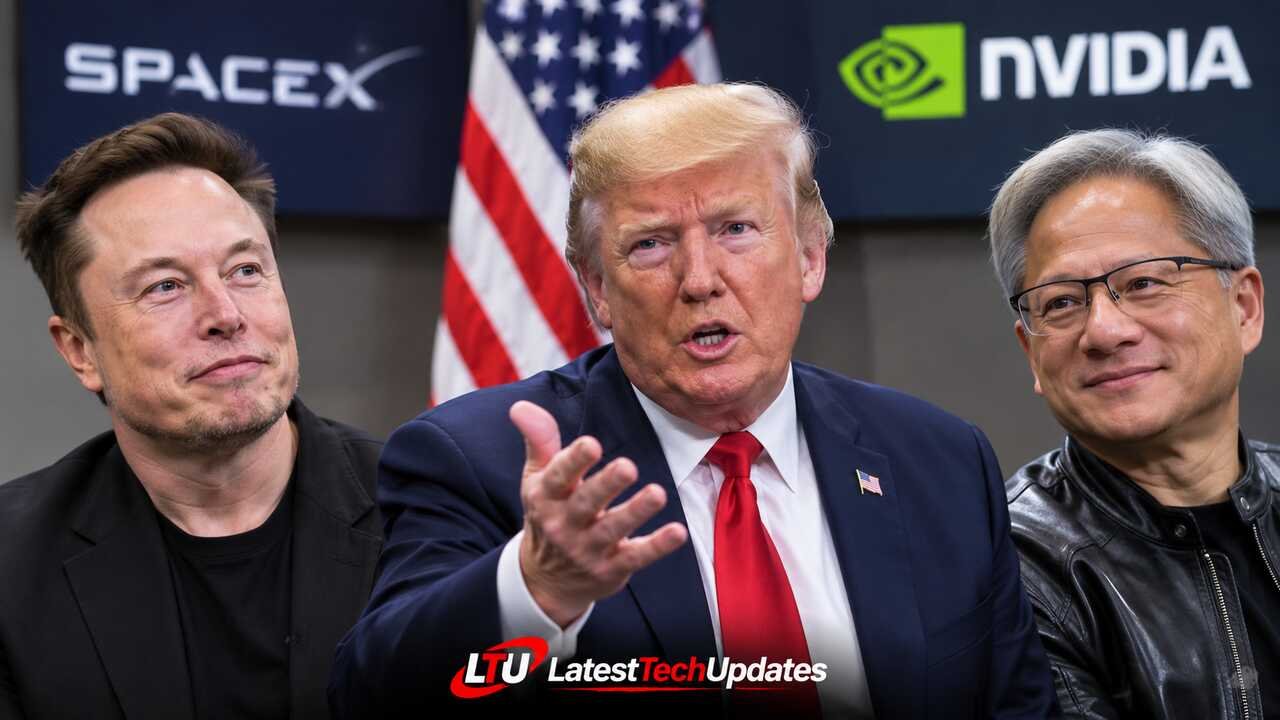
President Donald Trump said he protected Elon Musk during his first term and took credit for helping Jensen Huang return as Nvidia’s CEO. Trump made the remarks in a Nov. 23 CNBC interview, the same day Nvidia announced that its board had unanimously reinstated Huang as president, CEO and a board member.
Trump framed his support for both executives as part of a broader belief that the United States should protect people he considers exceptional. His account of helping Musk remains vague. In Huang’s case, Trump described speaking directly with Nvidia’s board and said he persuaded its members to bring the co-founder back.
What Trump said about protecting Elon Musk
Trump said his intervention for Musk involved a specific incident during his first term, but he gave no details about what happened or what action he took. He made a similar claim at a Nov. 20 White House news conference, where he praised Musk’s work on Starlink and argued that the United States needed to protect its “brilliant people.” At the same event, Trump called for Nvidia to give Huang a second chance.
Musk was also among the technology executives who publicly supported Huang’s return. He backed an open letter that urged Nvidia’s board to reinstate Huang while an independent investigation continued. The campaign called for the board to give Huang a chance to respond to the allegations. Read our earlier coverage of Musk’s support for Huang’s return.
How Nvidia’s board brought Jensen Huang back
Nvidia publicly announced Huang’s departure on Nov. 12 and appointed Chief Financial Officer Colette Kress as interim CEO. The leadership change came days before a quarterly earnings report, when investors were already watching Nvidia’s stock slide and weighing uncertainty over its access to the Chinese market. See our coverage of Nvidia’s earnings outlook after Huang’s exit.
The board voted to reinstate Huang on Nov. 22, and Nvidia announced the decision publicly the following day. Nvidia said directors met with Huang and received input from senior U.S. government officials before concluding that his return posed no national security risk. Kress continued as executive vice president and CFO.
The decision reversed the board’s earlier position. Less than a week before Huang’s return, board chair Harvey Jones had said Nvidia would not rehire him as CEO because his personal conduct was inconsistent with the company’s code of conduct, according to Reuters. The company’s internal investigation was still open when he returned. Read Reuters’ reporting on the board reversal and the response in Washington.
Why Congress is still asking about Nvidia’s AI chips
Lawmakers from both parties raised concerns after Huang’s reinstatement and called for stronger safeguards against advanced chips being diverted to China. One proposal, the Chip Security Act, would address chips that are exported legally and then redirected to destinations where their sale is restricted. Huang agreed to testify at a public Senate Banking Committee hearing scheduled for Dec. 3, according to Reuters.
The hearing gives senators a chance to ask how Nvidia tracks its chips after they leave the company and what it does when a customer or intermediary is suspected of redirecting them. For AI developers that rely on Nvidia hardware, those questions matter because export rules help determine where advanced computing capacity can be sold and deployed.
