
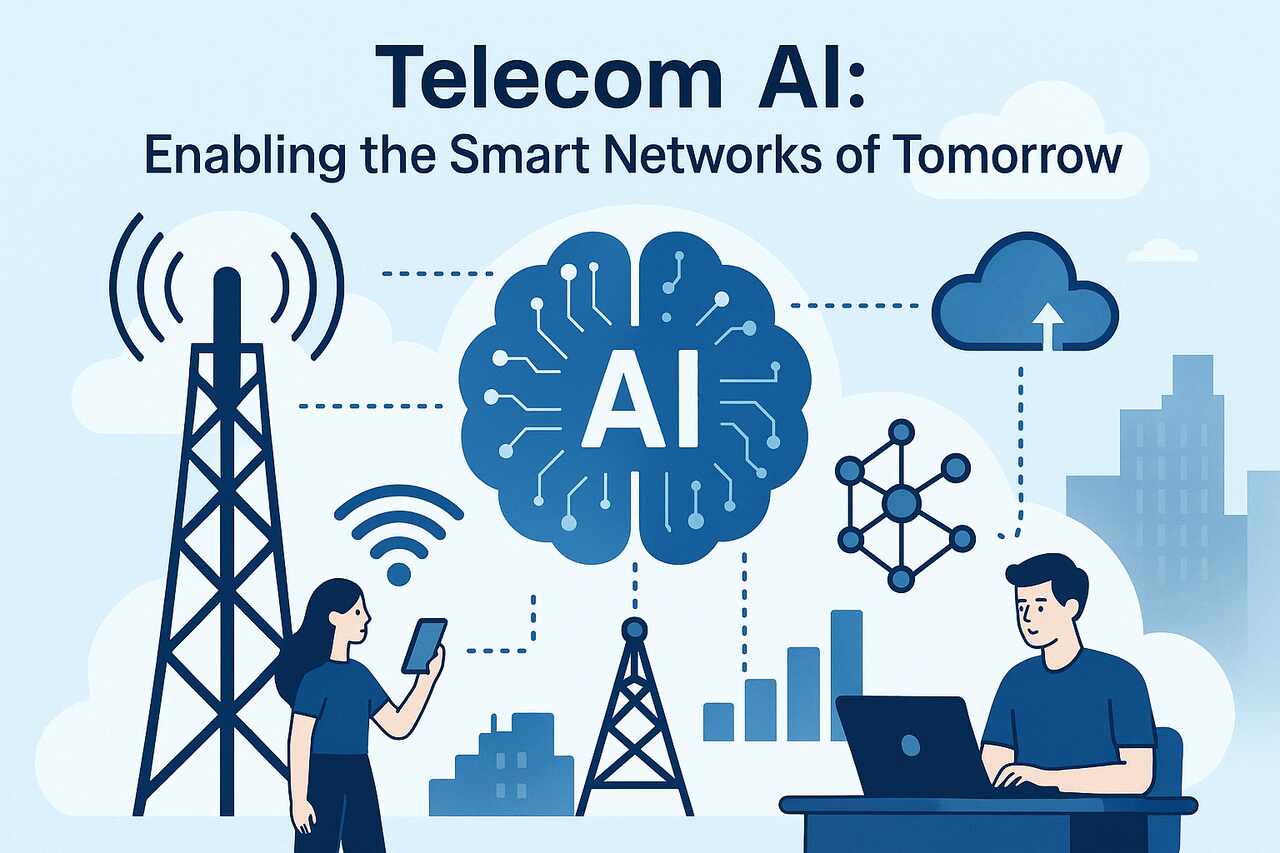
Defining Telecom AI and Its Business Potential
AI in telecom is more than automation. It’s about creating self-optimizing, intelligent networks that can predict problems, adapt to usage patterns, and enhance customer experience all in real time.
Telecom AI refers to the use of artificial intelligence technologies, such as machine learning, deep learning, and natural language processing, in telecom infrastructure, services, and operations.
Why Telecom AI Is Game-Changing:
- Scales efficiently across complex network environments
- Reduces operational costs via automation and predictive maintenance
- Improves customer experience with real-time data insights
- Enables new revenue streams through smart services
According to GSMA Intelligence, AI could drive over $15 billion in annual savings for telecom operators by 2026.
Enabling Technologies and Infrastructure
Telecom AI is powered by a stack of cutting-edge technologies and infrastructure layers.
-
Cloud-Native Architecture
Cloud environments enable scalable AI model training, deployment, and inference without being constrained by on-premise hardware.
-
5G and Edge Computing
With low-latency capabilities, 5G networks coupled with edge devices bring AI computations closer to users and devices, enabling real-time responsiveness.
-
Network Function Virtualization (NFV)
NFV abstracts network hardware into virtual software functions that AI can dynamically optimize.
-
Data Lakes and Real-Time Analytics
Storing and processing data from millions of endpoints allows AI models to learn, predict, and make decisions instantly.
-
API-First Integration
APIs allow AI engines to plug into OSS/BSS systems, billing engines, CRM tools, and network management platforms.
| Technology | AI Benefit in Telecoms |
| Cloud-Native Infrastructure | Scalable training and AI operations |
| 5G + Edge Computing | Real-time intelligent services |
| NFV | Software-defined, AI-optimized network control |
| Data Lakes & Analytics | Data-driven decision making |
| API-first Architecture | Seamless AI integration across layers |
AI Deployment Models in Telecom
How are telecoms actually implementing AI?
-
Centralized AI Platforms
Operators build in-house AI engines that serve multiple business units (e.g., marketing, operations, customer service).
Example: Vodafone’s “TOBi” chatbot is part of a larger internal AI platform.
-
AI-as-a-Service (AIaaS)
Smaller operators or MVNOs can subscribe to third-party AI tools through cloud platforms, removing the need for internal data science teams.
-
Embedded AI in Vendor Solutions
Many vendors now ship their network infrastructure with built-in AI features like anomaly detection, traffic optimization, and performance prediction.
-
Open-Source AI Stack
Some telcos use open-source ML platforms (e.g., TensorFlow, PyTorch) to build custom AI workflows for their operations.
| Deployment Model | Suitable For |
| Centralized AI Platforms | Large telecoms with R&D budgets |
| AI-as-a-Service | MVNOs, startups, Tier-2 providers |
| Embedded AI | Turnkey, low-complexity deployment |
| Open-Source Stack | Advanced teams wanting flexibility |
Metrics for Evaluating AI Success
Integrating AI is only step one. Telecoms need to track its performance and value creation through well-defined metrics.
-
Operational Efficiency Gains
- Reduced network downtime
- Lower maintenance cost per site
- Task automation rates
-
Customer Experience KPIs
- Call center response time
- Chatbot resolution accuracy
- Net Promoter Score (NPS) shifts
-
Revenue and ROI
- Average Revenue Per User (ARPU) lift through AI-recommended upsells
- Return on AI investment (RAII)
- Time-to-value (TTV) from AI pilots
-
AI Model Performance
- Precision/recall of anomaly detection models
- Latency in real-time decisions
- Model drift and retraining frequency
Pro tip: Align every AI project with a business objective to ensure long-term value creation.
The Strategic Value of Telecom AI
Telecom AI is an important strategic pillar.
How It Redefines Competitive Advantage:
- Speed to Insight: AI enables telecoms to understand and react to trends in near real time.
- Agility: Rapid deployment of new services through intelligent network reconfiguration.
- Cost Leadership: Fewer truck rolls, less downtime, and automation at scale.
- Customer Centricity: Data-driven personalization and 24/7 service through intelligent bots.
Case in Point: Rakuten Mobile leverages AI across planning, provisioning, customer interaction, and network performance to deliver a fully virtualized, software-defined network that scales efficiently.
Service providers are exploring how telecom AI can be embedded across network layers to boost efficiency.
Strategic Recommendations:
- Start with a high-ROI use case (e.g., churn reduction or network optimization)
- Build AI readiness into your digital transformation roadmap
- Partner with AI vendors or academic institutions to close the skills gap
- Focus on ethical and explainable AI to build trust with regulators and customers
📊 Key Takeaways: Telecom AI
| Focus Area | Summary |
| Definition | AI embedded across network, service, operations |
| Enabling Tech | Cloud-native, 5G, NFV, analytics, APIs |
| Deployment Models | Centralized, AIaaS, embedded, open-source |
| Success Metrics | Efficiency, CX, ROI, model performance |
| Strategic Value | Speed, agility, cost savings, personalization |
Final Thoughts
Telecom AI is no longer experimental. It’s a boardroom conversation, a budget line, and a decisive factor in digital competitiveness.
Companies that embrace AI now will lead in innovation, customer loyalty, and cost efficiency.
Those that delay will be disrupted.
Start with one AI use case. Measure obsessively. Scale intentionally.
