
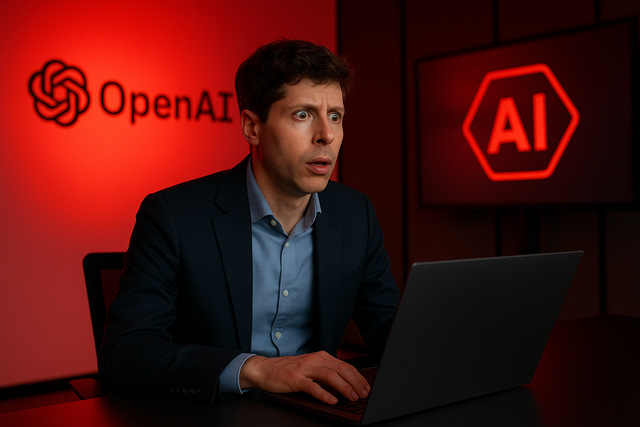
Why Did Sam Altman Declare a ‘Code Red’ at OpenAI?
Sam Altman, CEO of OpenAI, initiated a high-alert strategic directive referred to internally as a “code red” in response to rapidly intensifying competition in the generative AI sector. The decision reflects OpenAI’s urgent need to reassess its product roadmap, internal alignment, and innovation cycle as competitors accelerate their development cycles.
The announcement signifies a pivotal moment in the artificial intelligence landscape, where the performance, ecosystem integration, and scalability of ChatGPT face critical benchmarking against emerging language models from Anthropic, Google DeepMind, Mistral, Meta AI, and xAI.
What Triggered Competitive Tensions in the Generative AI Market?
1. Anthropic’s Claude Series Rapidly Gaining Traction
Anthropic’s Claude 2.1 and upcoming Claude 3 have significantly improved in long-context comprehension, RAG (Retrieval-Augmented Generation), and real-time summarization, outperforming ChatGPT-4 in specific enterprise use cases. Enterprise developers are increasingly integrating Claude’s API for document-heavy NLP tasks, reducing reliance on OpenAI’s model endpoints.
2. Google DeepMind’s Gemini Model Architecture
Gemini 1.5, powered by DeepMind’s Reinforcement Learning from Human Feedback (RLHF) and AlphaCode integration, showcases superior multimodal reasoning and agentic behavior. Google’s in-house silicon (TPUs) enables cost-effective scaling, drawing enterprise-level customers toward its ecosystem.
3. Meta’s LLaMA 3 and Open-Source Advantage
Meta Platforms introduced LLaMA 3 models with open licensing, allowing developers to finetune and deploy on local infrastructure. The open-source advantage offers higher flexibility and zero inference cost, challenging ChatGPT’s cloud-based monetization model.
4. xAI’s Integration with X (formerly Twitter)
Elon Musk’s xAI and its model “Grok” demonstrate seamless integration with the X platform, leveraging proprietary user engagement data. The vertically integrated ecosystem provides contextual personalization and conversational memory with real-time knowledge access, areas where ChatGPT currently lags.
5. Mistral’s Dense-Sparse Hybrid Models
Paris-based Mistral has gained attention for pioneering sparse mixture-of-experts architecture with dense retrieval. The innovation offers speed and efficiency, appealing to enterprise clients requiring lightweight inferencing across decentralized systems.
How Is OpenAI Repositioning ChatGPT to Sustain Leadership?
1. Enterprise-Specific Custom GPTs Development
OpenAI prioritizes developing verticalized GPTs tailored for finance, law, healthcare, and code engineering. These domain-specific agents utilize fine-tuned foundation models, private RAG pipelines, and plugin extensibility bridging performance with practical value.
2. Introduction of Memory in ChatGPT Plus
The reintroduction of ChatGPT memory capabilities in the Plus tier enables context continuity across sessions. Persistent memory aligns with user intent around long-term collaboration, agentic interaction, and personalized workflow automation.
3. Infrastructure Upgrades with GPT-4 Turbo
GPT-4 Turbo introduces a more efficient variant of OpenAI’s flagship model with extended context window (128K tokens) and lower inference latency. Microsoft Azure’s infrastructure enhances delivery, supporting high-throughput, low-latency operations required by enterprise deployments.
4. Developer Tools and OpenAI DevDay Expansion
Following the inaugural OpenAI DevDay, the company is expanding SDKs, Python wrappers, and endpoint customization tools for developers. These resources help retain loyalty among third-party app developers who are exploring alternative LLM providers.
5. Voice and Vision Capabilities for Multimodal Edge
ChatGPT’s vision and voice features allow users to interact using real-time images and voice commands. This multimodal functionality aligns with rising user expectations for seamless sensory-rich interaction, enhancing user retention.
How Does the Strategic ‘Code Red’ Reflect Market Dynamics?
1. Shift from Generalist LLMs to Specialized AI Agents
Market dynamics are evolving toward specialized models offering industry-specific capabilities. OpenAI’s pivot toward customizable agents mirrors this transition, driven by user demand for contextual understanding and domain-aware reasoning.
2. Cloud Infrastructure as a Competitive Moat
Control over infrastructure has become central to the AI arms race. OpenAI’s reliance on Microsoft Azure contrasts with Google and Amazon’s full-stack AI platforms. Sam Altman’s urgency reflects the need to optimize both inference cost and deployment flexibility.
3. Regulatory Landscape and Data Sovereignty Challenges
European AI Act and global data privacy regulations are influencing adoption decisions. Competitors offering on-premise or regionally-hosted solutions challenge OpenAI’s SaaS-centric delivery model, prompting reevaluation of compliance strategies.
4. Ecosystem Lock-In vs Open Interoperability
Open-source models and cross-platform interoperability threaten OpenAI’s ecosystem lock-in. The code red highlights OpenAI’s intent to counteract this by enhancing integration capabilities and reducing developer churn.
5. Capital Efficiency and Talent Wars
As venture capital tightens in AI, efficiency of training cycles, inference cost per token, and access to elite ML talent becomes critical. The urgency declared by Altman signals internal reallocation of R&D budgets and retention programs to outpace rivals.
What Is the Outlook for ChatGPT and OpenAI Going Forward?
1. Acceleration of GPT-5 Development and Pretraining
GPT-5’s architecture and pretraining processes are expected to integrate sparse mixture-of-experts, continuous context memory, and multi-agent coordination. OpenAI’s roadmap emphasizes pretraining optimization using Reinforcement Learning through Human Interaction (RLHI) for aligned general intelligence.
2. API Monetization Through GPT Store Ecosystem
OpenAI will scale monetization through its GPT Store, allowing developers to publish fine-tuned GPTs. Subscription-based usage and microtransaction-based inference present dual revenue streams, ensuring sustainability amid cloud costs.
3. Partnerships with Fortune 500 Enterprises
Strategic partnerships with Salesforce, PwC, and Morgan Stanley indicate OpenAI’s move to entrench GPT solutions within enterprise SaaS platforms. These integrations create feedback loops for product enhancement and client retention.
4. OpenAI Alignment Team and Safety Guardrails
To maintain trust amid capability increases, the Alignment Research team is working on scalable oversight tools, interpretability frameworks, and value alignment techniques. These ensure deployment of powerful agents within ethical boundaries.
5. User Retention through Continuous Feature Rollout
ChatGPT’s weekly feature rollouts, multilingual expansion, and mobile-first enhancements aim to drive stickiness. The roadmap prioritizes feedback-informed updates aligned with evolving user workflows and global market demands.
Conclusion
Sam Altman’s “code red” declaration reflects a pivotal inflection point for OpenAI amid mounting external competition and internal adaptation needs. As ChatGPT evolves from a general-purpose chatbot into a vertically integrated agent platform, success hinges on infrastructure agility, semantic precision, and multi-modal dominance.
