
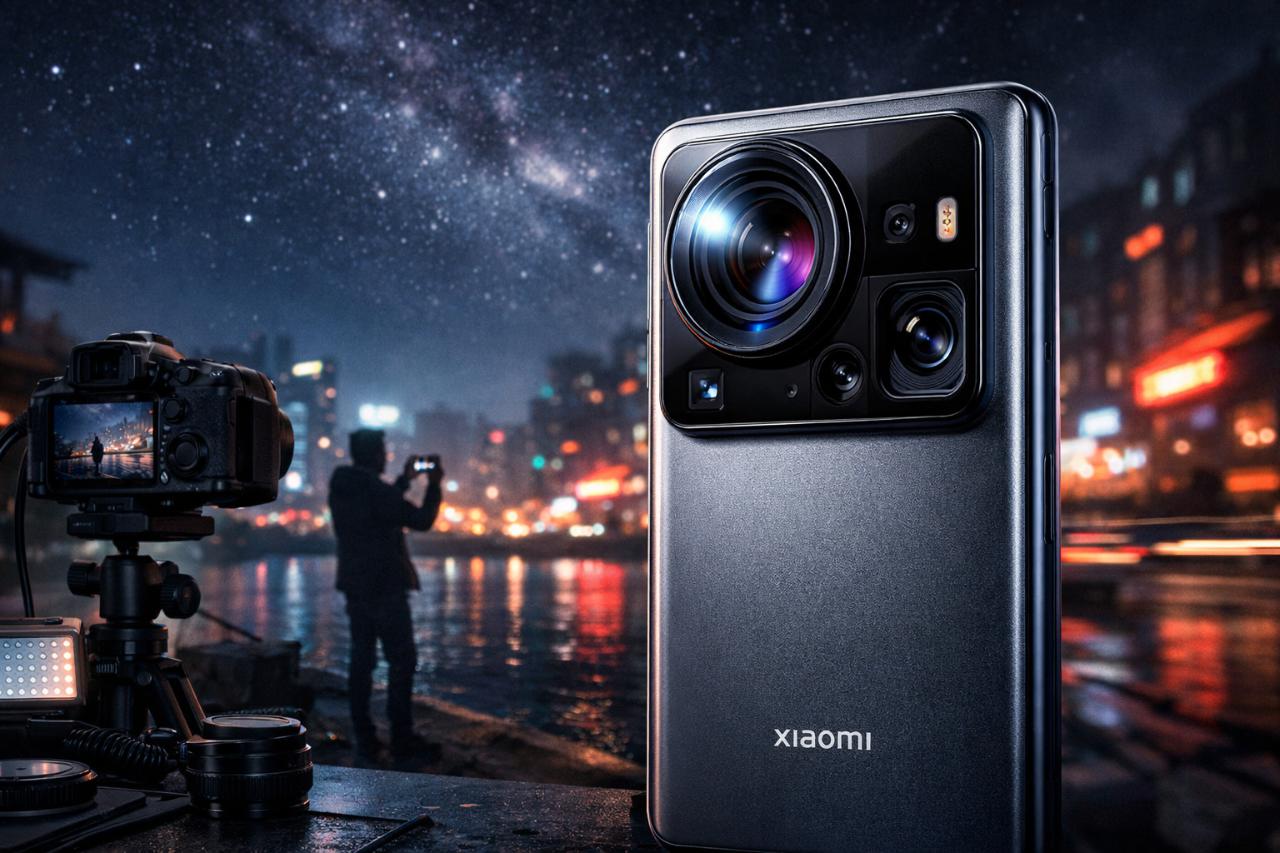
Highlights
- Launch Date Confirmed: Xiaomi 17 Ultra will be officially unveiled on December 25, 2025, in China.
- LOFIC Camera Sensor Debut: Xiaomi introduces LOFIC (Lateral Overflow Integration Capacitor) technology in smartphone photography for the first time.
- Night Vision Breakthrough: LOFIC sensor enables low-noise imaging in extreme low-light conditions, pushing mobile night photography to a new level.
- Enhanced Dynamic Range: Improved dynamic range capabilities using dual gain readout, enhancing clarity in both bright and dark areas.
- Powered by Snapdragon 8 Gen 3: The 17 Ultra is expected to be equipped with the latest Qualcomm Snapdragon 8 Gen 3 SoC.
- AI-Driven Image Processing: Integrated AI algorithms enhance photo clarity, tone mapping, and natural texture rendering.
- Design Inspired by Ceramic Craftsmanship: A sleek ceramic back with refined curvature is rumored, maintaining Xiaomi’s premium flagship design language.
- Battery & Charging: Ultra-fast 120W wired and 50W wireless charging with a 5000mAh battery for uninterrupted performance.
When is the Xiaomi 17 Ultra Launching?
Xiaomi has officially confirmed the launch date of December 25, 2025, for its upcoming flagship smartphone, the Xiaomi 17 Ultra. The announcement has generated significant anticipation, especially due to its inclusion of cutting-edge camera technology. The launch event will be hosted in China and is expected to feature demonstrations of the phone’s imaging capabilities.
Global tech communities and photography enthusiasts are particularly focused on the debut of the LOFIC sensor, signaling a paradigm shift in mobile imaging performance.
What is the LOFIC Camera Sensor and Why Is It Revolutionary?
The LOFIC (Lateral Overflow Integration Capacitor) sensor introduces a semiconductor-based architecture that drastically reduces electronic noise in image capture. This sensor, previously seen in high-end automotive and industrial imaging, is now adapted for mobile photography by Xiaomi in collaboration with Sony’s LYT-series CMOS design.
LOFIC works by temporarily storing excess photoelectrons in a side capacitor, allowing for a dual gain readout mechanism. This mechanism enables high sensitivity in low light while preserving dynamic range in brighter environments. The end result is cleaner, sharper images in extreme lighting conditions including true night vision-style photography without heavy post-processing.
How Will LOFIC Improve Low-Light Photography?
The LOFIC sensor enhances image clarity by using a low readout noise profile typically below 2 electrons RMS, compared to traditional CMOS sensors averaging 5–10 electrons RMS. This technical advantage allows the Xiaomi 17 Ultra to capture usable detail in scenes with less than 1 lux of illumination, such as moonlit landscapes or dimly-lit interiors.
Noise suppression is achieved at the hardware level, reducing the need for aggressive software denoising. This allows finer textures, edges, and gradients to remain intact, providing a more natural aesthetic in night shots.
What Other Camera Improvements Are Expected in the Xiaomi 17 Ultra?
Beyond LOFIC, Xiaomi 17 Ultra is expected to feature a quad-camera system co-engineered with Leica, continuing the brand’s imaging partnership. Rumored specifications include a 1-inch Sony LYT-900 main sensor, a periscope telephoto with 120x digital zoom, and an ultra wide lens with macro capabilities.
Each lens is supported by AI-powered computational photography, optimizing every shot for lighting, composition, and subject recognition. The camera system also benefits from multi-frame HDR stacking and real-time scene detection, allowing instant adjustment based on user intent and environmental conditions.
What Powers the Xiaomi 17 Ultra Internally?
The Xiaomi 17 Ultra is rumored to run on the Snapdragon 8 Gen 3 processor, built on a 4nm TSMC node. This chip delivers improved performance per watt, supporting on-device AI models for faster photo and video processing.
Complementing the CPU is LPDDR5X RAM and UFS 4.0 storage, ensuring lightning-fast data access. The phone is also expected to support Wi-Fi 7 and dual-frequency GPS, enhancing connectivity for data-intensive tasks like 4K video uploads and real-time image syncing.
What Is the Battery and Charging Setup?
Xiaomi 17 Ultra features a 5000mAh battery, supporting 120W HyperCharge wired charging and 50W wireless charging. A full charge is expected in under 20 minutes using the proprietary charger. The battery system includes smart thermal regulation and AI charging cycles to prevent long-term battery degradation.
How Does the AI Engine Enhance the Camera System?
AI integration in Xiaomi 17 Ultra is centered around semantic segmentation and contextual scene analysis. The phone detects objects, lighting conditions, and focal depth in real-time, applying targeted enhancements without user intervention.
Using natural tone mapping, the system ensures skin tones, skies, and vegetation appear true-to-life, not oversaturated. AI also assists in noise profiling, adapting the denoising intensity based on scene content, which complements the LOFIC sensor’s low-noise imaging.
What Design and Build Quality Can Users Expect?
The Xiaomi 17 Ultra is rumored to retain the ceramic unibody design, known for its durability and premium feel. Enhanced with nano-crystalline micro-texturing, the back panel resists fingerprints and provides better grip. The device will also feature IP68 certification, offering dust and water resistance, ideal for outdoor photography in challenging conditions.
