


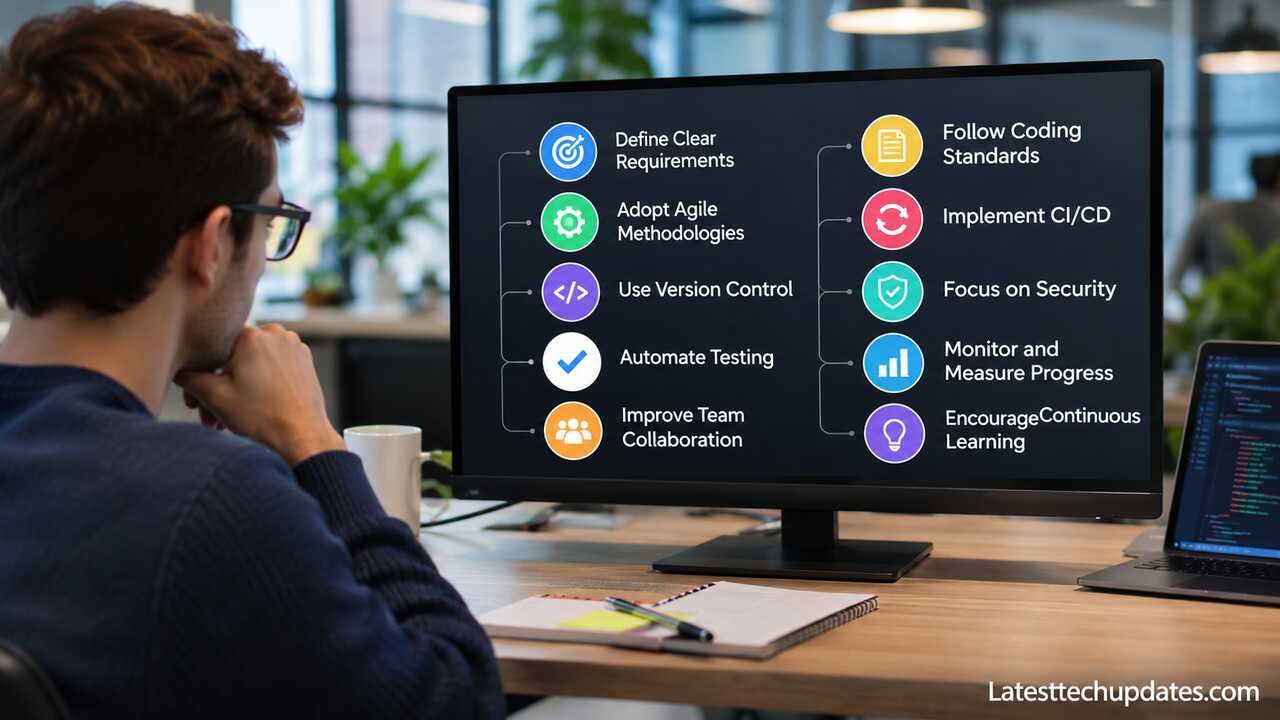
Improving the software development process starts with understanding customer requirements, selecting suitable technologies, automating repetitive tasks and maintaining consistent code quality. A well-structured development process helps businesses reduce operational costs, minimize errors and deliver reliable software that meets user expectations.
From initial planning to deployment and maintenance, every stage influences the quality of the finished product. Whether you are building a business application or improving an existing platform, the following strategies can help your development team work more efficiently.
1. Prioritize Customer Value and Requirements
Successful software development begins with identifying the problems your customers need to solve. Before selecting features or writing code, determine who will use the product, what they expect and how the software can simplify their activities.
Businesses looking to invest in better software should prioritize functionality, usability, reliability and scalability rather than unnecessary features that increase development costs.
Gather customer requirements through interviews, surveys, usability research and stakeholder discussions. Convert these findings into clear user stories and measurable acceptance criteria so developers understand what each feature must accomplish.
Once requirements are established, teams can evaluate their testing needs, technical resources and technology stack before creating a development roadmap.
2. Establish a Clear Software Architecture
Software architecture defines how an application’s components interact, process information and support business requirements. A well-planned architecture makes software easier to develop, maintain and expand.
Before development begins, consider database structures, application programming interfaces (APIs), security requirements, hosting environments and integrations with third-party services.
Developers can use architectural diagrams, wireframes and prototypes to communicate technical decisions with stakeholders. These visual representations help identify potential problems before significant development resources are committed.
For businesses outsourcing technical work, selecting the right custom software development company can also help align architectural decisions with long-term business objectives.
Avoid introducing unnecessary complexity. A modular monolithic architecture may be more practical for smaller applications, while microservices may suit larger systems with independently scalable components.
3. Adopt Agile Software Development Practices
Agile development improves flexibility by dividing software projects into smaller, manageable iterations. Instead of waiting until the entire application is complete, teams deliver working features incrementally and adjust priorities based on feedback.
Scrum and Kanban are commonly used approaches for organizing Agile workflows. Scrum typically structures work into fixed-length sprints, while Kanban focuses on visualizing tasks and managing work in progress.
Effective Agile practices include:
- Maintaining a prioritized product backlog.
- Establishing clear acceptance criteria.
- Conducting regular team meetings.
- Reviewing completed features with stakeholders.
- Identifying development bottlenecks.
- Improving workflows through retrospectives.
Agile works best when teams focus on meaningful outcomes rather than simply completing more tasks during each development cycle.
4. Choose the Right Technology Stack
A technology stack consists of the programming languages, frameworks, databases and infrastructure used to build and operate an application.
Selecting appropriate technologies reduces unnecessary development complexity and makes future maintenance more manageable. The decision should reflect application requirements, team expertise, security considerations and anticipated growth.
| Technology component | Common options |
|---|---|
| Front-end development | React, Angular, Vue.js |
| Back-end development | Node.js, Python, Java, .NET |
| Database management | PostgreSQL, MySQL, MongoDB |
| Cloud infrastructure | AWS, Microsoft Azure, Google Cloud |
| Version control | Git |
| Containerization | Docker |
Avoid choosing a framework solely because it is popular. An established technology that your team understands may deliver better results than a newer alternative requiring extensive training and additional maintenance.
5. Improve Collaboration and Code Quality
Effective collaboration helps development teams identify technical problems earlier and maintain consistent coding standards. Developers, designers, product managers and quality assurance specialists should share a clear understanding of project objectives.
Version control systems allow developers to track changes, collaborate on separate features and restore previous versions when necessary.
Peer code reviews provide another layer of quality control. They help identify programming errors, security weaknesses, performance issues and unnecessary complexity before changes reach production.
Teams should also maintain technical documentation covering architectural decisions, coding conventions, API behavior and deployment procedures. Clear documentation reduces dependency on individual developers and helps new team members become productive sooner.
6. Automate Repetitive Development Tasks
Automation reduces manual work and improves consistency throughout the software development lifecycle. Routine activities such as building applications, running tests, checking dependencies and preparing release packages are suitable candidates for automation.
Development teams can use platforms such as GitHub Actions, Jenkins and GitLab CI/CD to automate these workflows.
Resources from JFrog also explain how Docker registries support the storage and distribution of container images within software delivery environments.
Containerization can help maintain consistent application environments across development, testing and production. However, teams still need to manage configuration, access permissions, dependency updates and infrastructure security.
Automation should eliminate repetitive work without reducing oversight of critical development decisions.
7. Implement Continuous Testing and Quality Assurance
Software testing should take place throughout development rather than being postponed until the application is ready for release. Early testing helps teams identify defects before they affect additional components or reach customers.
Different testing methods address different quality requirements.
| Testing method | Primary purpose |
|---|---|
| Unit testing | Checks individual functions and components |
| Integration testing | Verifies interactions between software components |
| Functional testing | Confirms that features meet requirements |
| Performance testing | Evaluates responsiveness and stability under load |
| Security testing | Identifies potential vulnerabilities |
| User acceptance testing | Confirms that software meets business and user needs |
| Regression testing | Detects problems introduced by recent updates |
Beta testing can provide additional feedback from real users before a wider release. It helps identify usability problems and unexpected behavior that controlled testing environments may overlook.
Automated testing improves repeatability, while manual exploratory testing remains valuable for evaluating complex interactions and user experiences.
8. Integrate Security Throughout Development
Security should be incorporated into every stage of software development, from requirements gathering to production maintenance.
DevSecOps integrates security practices into development and operational workflows rather than treating security as a separate activity performed immediately before deployment.
Development teams should adopt practices such as:
- Validating user inputs.
- Reviewing third-party dependencies.
- Encrypting sensitive information where appropriate.
- Implementing role-based access controls.
- Protecting credentials and API keys.
- Performing regular vulnerability assessments.
- Applying security patches promptly.
Teams should also consider potential threats during architectural planning. Identifying security requirements early can reduce the need for expensive redesigns later in the project.
9. Streamline Deployment With CI/CD
Continuous integration and continuous delivery (CI/CD) help teams release software changes through repeatable, automated workflows.
Continuous integration involves regularly merging code changes into a shared repository and validating them through automated builds and tests.
Continuous delivery prepares validated changes for release, while continuous deployment automatically releases qualifying changes into production when pipeline requirements are satisfied.
A reliable deployment process may include:
- Submitting code changes for review.
- Building the application automatically.
- Running automated tests.
- Performing security and dependency checks.
- Deploying changes to a staging environment.
- Releasing approved updates to production.
- Monitoring performance and application errors.
Development teams should establish rollback or recovery procedures before releasing updates. Gradual rollout strategies, such as canary deployments, can also limit the impact of unexpected production issues.
10. Monitor, Maintain and Improve Software After Release
Software development continues after an application is deployed. Regular maintenance keeps products functional, secure and aligned with changing customer expectations.
Monitoring tools help teams detect application errors, service interruptions, resource consumption and performance problems. Customer feedback provides additional insight into usability challenges and feature requirements.
Post-deployment maintenance should include dependency updates, bug fixes, database optimization, security patches and improvements to existing functionality.
Teams should also allocate development time to managing technical debt. Continuously postponing architectural improvements and code refactoring can make future changes more difficult and expensive.
How to Measure Software Development Efficiency
Development efficiency should be measured using delivery performance, software reliability and customer outcomes rather than the number of tasks completed or lines of code written.
| Performance metric | What it measures |
|---|---|
| Deployment frequency | How often software changes reach production |
| Change lead time | Time required for committed changes to reach production |
| Change failure rate | Proportion of deployments that require intervention |
| Failed deployment recovery time | Time needed to recover from a failed deployment |
| Escaped defects | Software defects discovered after release |
| Customer satisfaction | How effectively the software meets user expectations |
Use these metrics to identify workflow problems and evaluate improvements over time. Avoid using individual metrics in isolation to judge developer productivity, as project complexity and technical requirements can influence the results.
Common Mistakes That Slow Down Software Development
Development delays often result from organizational and technical problems rather than insufficient programming resources.
Unclear requirements, excessive feature requests, unmanaged dependencies, delayed testing and poor communication can create avoidable rework.
Another common mistake is prioritizing release speed while neglecting software quality. Although skipping tests or code reviews may accelerate an individual release, it can introduce defects that require additional development time later.
Businesses should establish realistic deadlines, manage project scope carefully and maintain a balance between feature development and technical improvements.
Conclusion
Improving the software development process requires more than adopting new tools or increasing development speed. Businesses need clear customer requirements, suitable architecture, effective collaboration, automated workflows and continuous quality assurance.
By integrating Agile practices, CI/CD pipelines, security controls and regular maintenance, development teams can reduce unnecessary rework and deliver more dependable software. Start by identifying the biggest bottleneck in your current workflow, then measure the impact of each improvement before expanding it across the organization.
FAQ’s
What are the main stages of the software development process?
The main stages include requirements analysis, planning, software design, development, testing, deployment and maintenance. These stages may overlap or repeat depending on the development methodology.
What is the most effective way to speed up software development?
Identify workflow bottlenecks, clarify requirements, automate repetitive tasks and reduce unnecessary rework. The most effective improvement depends on the team’s existing processes and technical challenges.
How does Agile improve software development?
Agile divides projects into manageable increments, encourages regular feedback and allows teams to adjust priorities as requirements change.
Can automation reduce software development costs?
Automation can reduce recurring manual work, testing effort and deployment errors. However, businesses must also account for the initial implementation and ongoing maintenance of automated workflows.
Why is software maintenance necessary after deployment?
Software maintenance addresses security vulnerabilities, performance issues, compatibility changes and evolving customer requirements. It helps applications remain reliable and useful over time.
