
Highlights
- Gold hits all-time high as global investors seek safety amid economic uncertainty and geopolitical risk.
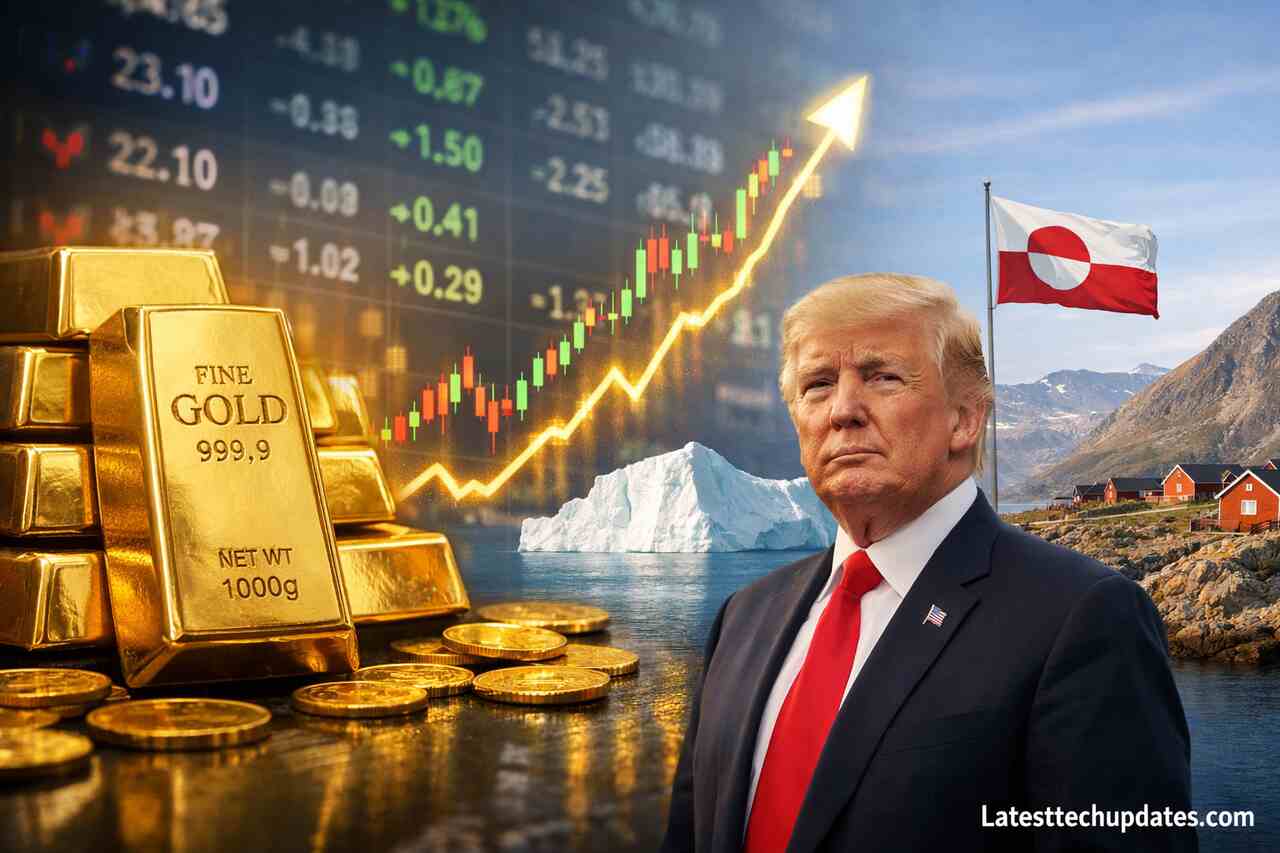
- Trump heads to Davos with a strategic focus on Greenland’s rare earth and gold reserves.
- Greenland’s mineral wealth gains global attention due to its deposits of gold, uranium, zinc, and rare earth elements.
- U.S.–China resource rivalry intensifies, making Greenland central to rare earth independence and defense strategy.
- Davos becomes Arctic diplomacy stage, where soft power and private capital influence Greenland’s mining future.
- Environmental concerns and indigenous rights complicate U.S. efforts for resource access in Greenland.
- ETF inflows surge, retail and institutional investors increase gold holdings linked to Arctic resource speculation.
- Melting Arctic ice accelerates access to Greenland’s mineral zones, driving mining interest and defense infrastructure plans.
- NATO and U.S. defense objectives intersect with Greenland’s strategic geography near Thule Air Base.
Why Did Gold Prices Hit a Record High Recently?
Gold price surge driven by geopolitical instability and strategic mineral speculation
Gold prices have reached historic levels due to heightened geopolitical tensions, global economic uncertainty, and increased investor interest in strategic assets like rare earth minerals. The renewed focus on Greenland’s untapped mineral reserves, especially in the context of U.S. interest, has intensified gold’s perceived value as a hedge asset. Market speculators have linked Greenland’s vast underground wealth, including gold, uranium, and rare earth elements, with global power plays. This has increased the speculative investment volume in precious metals.
Macroeconomic conditions elevate gold as a safe-haven asset
Stagnant global growth, inflationary pressures, and central bank rate cuts have collectively pushed institutional investors towards traditionally safe-haven assets. As bond yields shrink and fiat currency values fluctuate, gold stands out as a secure store of value. The current macroeconomic indicators, including slowing GDP across the Eurozone and volatile U.S. inflation trends, have created optimal conditions for bullish gold positions.
Mining forecasts in Arctic regions influence commodity markets
Forecasts from geological surveys suggest that Greenland contains rich veins of gold and other strategic minerals. This has elevated global market anticipation. Announcements from mining firms with concessions in Greenland, such as Bluejay Mining and AEX Gold, have hinted at large-scale operations. These projections create speculation-driven demand. Commodity traders interpret these developments as signals for supply expansion, which paradoxically spikes short-term price movements.
U.S.-China competition over rare earth control boosts gold indirectly
Geopolitical competition between the United States and China has intensified over control of rare earths and related mineral supply chains. Greenland has become a critical focus in this rivalry. Gold’s price benefits from association through mining co-location and shared exploration zones. American strategic interest in mineral independence enhances gold’s desirability among defense-oriented investors and sovereign wealth funds.
ETF inflows and retail demand push gold prices higher
Exchange-Traded Funds such as SPDR Gold Shares have recorded significant inflows as retail and institutional investors increase holdings. These movements indicate broad-based trust in gold as a resilient long-term asset. They reflect both inflation hedging strategies and interest sparked by political rhetoric surrounding Greenland. As digital brokerage platforms simplify access to gold instruments, retail investor participation contributes meaningfully to price momentum.
What Is Trump’s Strategic Interest in Greenland During Davos Talks?
Greenland’s mineral reserves align with U.S. economic security objectives
Former U.S. President Donald Trump’s renewed engagement with Greenland is directly linked to the territory’s potential in supplying rare earth elements and strategic minerals. These resources are essential for defense technologies, green energy applications, and digital infrastructure. The U.S. Department of Defense has previously highlighted Greenland as a future supply chain anchor for rare earth elements. This positions Trump’s interest within a broader national security framework.
Davos meetings serve as backchannel negotiations for Arctic influence
The World Economic Forum in Davos provides a discreet diplomatic venue for high-level negotiations regarding Arctic sovereignty and resource access. Trump’s presence signals intent to forge economic or exploratory partnerships, possibly through public-private investment frameworks. The choice of Davos, with its emphasis on global cooperation, suggests an attempt to normalize U.S. interest in Greenland amid European scrutiny.
Geostrategic positioning of Greenland aligns with NATO and Arctic defense agendas
Greenland’s location between North America and Europe makes it a keystone for NATO surveillance and missile defense systems. Trump’s policy advisors have historically advocated expanding Thule Air Base operations and deploying advanced radar technologies. The Greenland dialogue in Davos may touch on dual-use infrastructure development that enhances both military and economic integration of the Arctic territory.
Climate change accelerates resource access, attracting U.S. attention
Melting Arctic ice has made previously inaccessible Greenlandic regions open to mining and transport. Trump’s prior overtures to purchase Greenland can be interpreted as early recognition of this opportunity. The Davos agenda likely includes discussions on climate-driven economic shifts where the U.S. aims to position itself as a primary stakeholder in emergent Arctic logistics and mineral extraction.
Trump seeks legacy in energy independence and anti-China supply chains
By anchoring U.S. interest in Greenland, Trump reinforces his legacy around energy security, technological independence, and decoupling from Chinese mineral dominance. Collaborations with Greenlandic authorities or Danish representatives could lay groundwork for mining ventures. These initiatives support American semiconductor, electric vehicle battery, and defense industries, which he has consistently prioritized.
How Does Greenland Fit Into the Global Resource and Geopolitical Matrix?
Greenland holds untapped reserves of rare earths, uranium, gold, and zinc
Greenland’s geology contains an abundance of critical raw materials essential for modern technologies. The Kvanefjeld project in southern Greenland is particularly rich in neodymium and dysprosium, which are key elements in wind turbines and electric vehicles. Interest in Greenland is rising due to supply chain constraints elsewhere, notably in Africa and China. Its mineral wealth positions it as a potential alternative hub.
Chinese and European firms have already established footholds in Greenland
Companies such as Shenghe Resources of China and Greenland Minerals Ltd. have shown active interest in local mining operations. The European Union has also expressed intent to source raw materials from Greenland to reduce dependence on Chinese supply. Trump’s renewed diplomatic interest signals an American attempt to catch up and counterbalance these existing influences. This could happen through U.S.-based investments or bilateral trade agreements.
Greenland’s governance structure influences foreign access to resources
As an autonomous territory under the Kingdom of Denmark, Greenland maintains self-rule over mineral rights and economic development. However, Danish foreign policy oversight complicates bilateral arrangements. The U.S. must navigate a tri-party diplomatic structure involving Greenlandic officials, Danish authorities, and local Inuit stakeholders. These parties hold divergent perspectives on mining, sovereignty, and environmental protection.
Environmental regulations may slow or shape mining developments
Greenland’s parliament has passed laws banning uranium mining. This move affects several multi-mineral projects. The global community, especially Nordic states, watches Arctic environmental impacts closely. Trump’s Davos efforts must align with sustainable development narratives to gain legitimacy and local cooperation. Environmental, Social, and Governance investment standards are expected to influence any future U.S.-Greenland ventures.
Local opposition and indigenous rights play a critical role in project feasibility
Greenlandic communities, especially Inuit populations, have voiced concerns over environmental degradation and social disruption due to foreign mining interests. Political leaders in Nuuk have emphasized the need for inclusive development and long-term benefit-sharing. Trump’s diplomatic team may need to incorporate indigenous consultation frameworks to ensure any strategic agreements are both ethical and viable.
How Does Davos Function as a Catalyst for Arctic Diplomacy?
Davos enables soft power signaling through global business forums
The World Economic Forum acts as a convergence point for political leaders, corporate executives, and climate policymakers. For Trump, attending Davos serves as a calculated move to insert Greenland into global strategic conversations beyond military channels. Soft diplomacy through economic panels and resource-focused roundtables allows the U.S. to promote Arctic interests without triggering overt territorial disputes.
Arctic resource panels attract major energy and tech stakeholders
Sessions at Davos concerning clean energy transitions and mineral independence attract corporations such as Tesla, BP, and Rio Tinto. Trump’s presence near these discussions allows backroom lobbying for U.S. involvement in Greenland’s supply chains. By aligning Greenland’s rare earth narrative with Western energy independence, Davos helps frame strategic acquisition as climate-positive.
Climate change discourse reframes Arctic exploitation as necessity
Davos attendees increasingly view Arctic development not just as opportunistic but essential for enabling green transitions. Greenland becomes a linchpin in this emerging narrative. Trump’s participation positions the U.S. as a key player in managing ethical resource extraction under the guise of global decarbonization. This reinforces both climate and defense arguments.
Private capital mobilization at Davos shapes Arctic investment patterns
Private equity funds, sovereign wealth investors, and ESG portfolios gather at Davos to scout frontier investments. Trump’s Greenland rhetoric may be intended to spark interest among U.S.-aligned funds. This would help secure capital flows into American-favored Arctic projects. Davos serves as a marketplace for such political-financial matchmaking.
Multilateral cooperation on Arctic standards is brokered informally
While official Arctic Council meetings remain formal diplomatic channels, Davos allows informal consensus-building among Arctic stakeholders. Trump’s strategy could involve influencing these soft agreements to favor U.S. participation or extract concessions from Nordic governments. Integrating Greenland into broader Arctic multilateralism, Davos acts as a backstage accelerator for regional alignments.
