
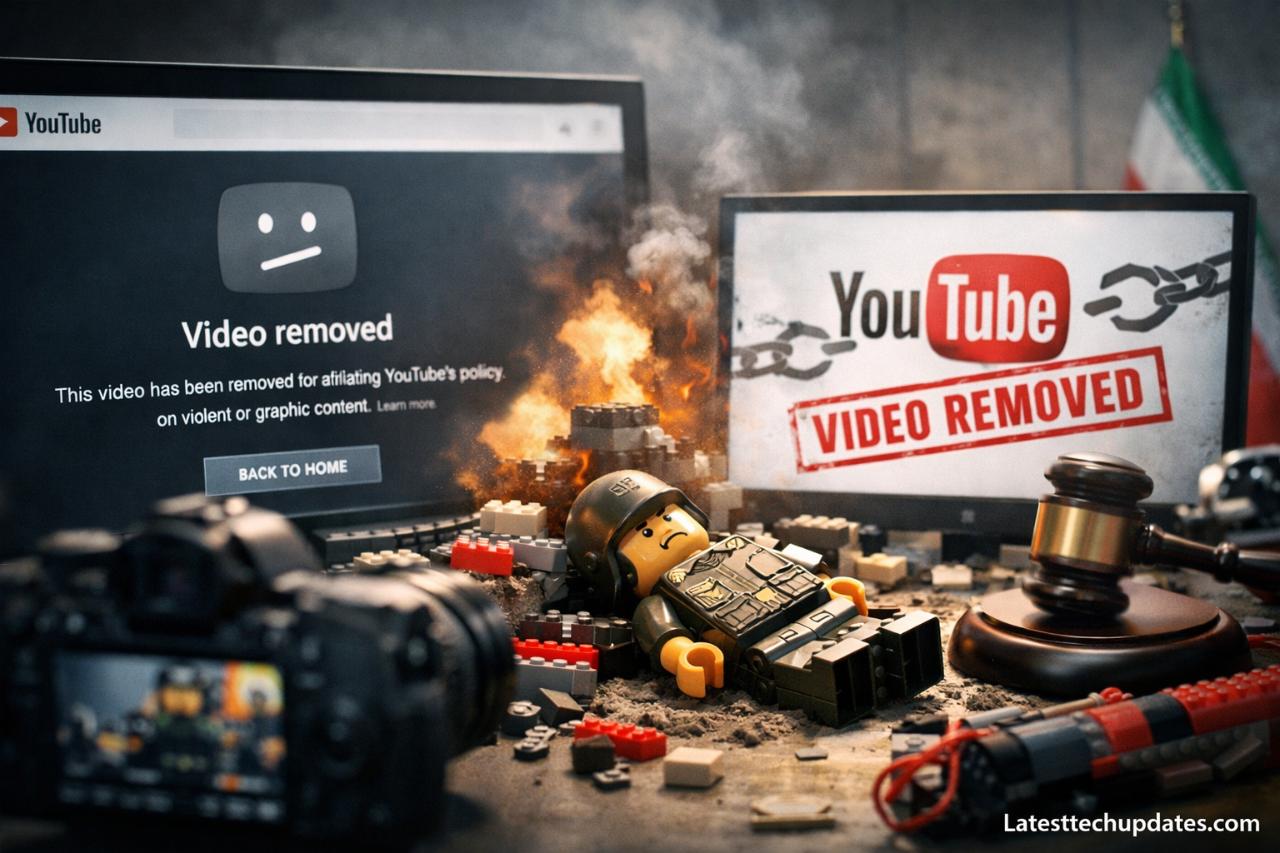
Iran has condemned the removal of a YouTube channel linked to viral pro-Iran, Lego-style AI animations, framing the takedown as narrative suppression during a wider information conflict involving Iran, the United States, and Israel. Reports identify the group as Explosive Media, a channel known for anti-Western and politically charged AI videos that gained significant traction across social media before being removed. Iranian officials described the move as an attempt to silence an alternative geopolitical narrative, while analysts associate the channel’s rise with a broader pro-Iran digital influence strategy.
Why Did Iran Condemn YouTube’s Ban on Explosive Media?
Iran condemned the ban because Iranian officials positioned the YouTube action as political censorship instead of standard content moderation. Foreign Ministry narratives framed the removal as an intervention against a rapidly growing media outlet that had attracted global attention through AI-driven storytelling. That framing connects platform moderation to a broader geopolitical struggle over narrative dominance, legitimacy, and perception management.
The geopolitical dimension matters because digital platforms operate as modern distribution infrastructures for state-aligned messaging, activist narratives, and algorithm-driven persuasion. Persuasion mechanisms now rely on high-retention formats, emotional triggers, and culturally adaptive storytelling rather than formal diplomatic communication. Explosive Media’s Lego-style animations aligned with those mechanisms by combining satire, symbolism, and simplified visual narratives that resonate across linguistic and cultural boundaries.
Narrative control explains Tehran’s strong response. Removal of a YouTube channel reduces discoverability, weakens archival presence, and limits algorithmic amplification. Algorithmic amplification determines how widely a message spreads across global audiences. Iran’s criticism therefore targets not only a single takedown but also the structural loss of a distribution channel that enabled pro-Iran narratives to penetrate global digital ecosystems.
What is Explosive Media and Why Did the AI Lego Videos Go Viral?
Explosive Media represents a pro-Iran digital content initiative centered on AI-generated animations that mimic Lego-style visuals while delivering political satire. The content blends humor, geopolitical commentary, and symbolic storytelling into short-form videos optimized for social media engagement. Symbolic storytelling increases retention because audiences process visual metaphors faster than complex ideological arguments.
Virality emerged from strategic format design. The videos incorporated references to global political figures, dramatized geopolitical tensions, and used humor to simplify complex conflicts into emotionally engaging narratives. Emotional engagement drives shares, and shares expand reach across platforms. That expansion transforms niche political messaging into mainstream digital discourse.
Western audience accessibility amplified the channel’s impact. Traditional propaganda models often struggled to resonate outside domestic contexts due to cultural and linguistic barriers. Explosive Media used globally recognizable formats such as memes, satire, and animation to bridge that gap. That approach enabled the content to circulate within international audiences without requiring deep contextual knowledge.
Narrative construction followed an entity-attribute structure. Political figures were associated with simplified traits, while nations were framed through symbolic roles such as resistance or dominance. That structure enhances memorability and encourages repeated sharing. Visual identity combined with emotional messaging created a feedback loop between engagement and visibility.
Why Did YouTube Remove the Channel and What Does the Takedown Signal?
YouTube removed the channel under policy frameworks related to harmful or sensitive content, particularly in the context of conflict-related media. Platform governance requires balancing free expression with the responsibility to prevent harmful narratives, misinformation, or content that could escalate tensions.
The takedown signals a broader shift in platform responsibility. Digital platforms now function as gatekeepers of global information flows, determining which narratives gain visibility and which are restricted. That gatekeeping role introduces tensions between corporate policy enforcement and geopolitical interpretation.
Content removal also demonstrates the complexity of moderating AI-generated media. AI content blurs boundaries between satire, propaganda, and misinformation. That ambiguity complicates enforcement decisions because the same content can be interpreted as humor, influence operation, or harmful narrative depending on context.
The removal further highlights the resilience of distributed content ecosystems. Even after a channel is removed, content often continues circulating through reposts, edits, and cross-platform sharing. That decentralized distribution model reduces the effectiveness of single-platform enforcement actions.
How Do AI Propaganda Videos Reshape the Iran-u.s. Information War?
AI-generated propaganda reshapes the information war by reducing production costs and increasing content velocity. Lower production barriers allow rapid response to geopolitical events, enabling narrative adaptation in near real-time. Speed enhances relevance, and relevance increases engagement.
Stylistic flexibility plays a central role in this transformation. AI enables the blending of animation, satire, music, and cultural references into cohesive narratives. Those hybrid formats resonate strongly with younger audiences who prefer informal and visually driven communication styles.
Participatory engagement further amplifies reach. Social media platforms encourage reactions, remixes, and commentary, turning viewers into active participants in content distribution. Participation expands narrative reach beyond the original publisher and increases message longevity.
Emotional framing becomes a dominant strategy. AI-generated content often prioritizes emotional impact over factual depth, creating memorable but simplified narratives. Simplification enhances shareability but can distort complex geopolitical realities.
What Does the Controversy Mean for Free Speech, Platform Moderation, and Digital Sovereignty?
The controversy reflects a deeper conflict over authority in digital communication. Technology companies control infrastructure, while states seek to protect narrative sovereignty. That tension creates ongoing disputes over moderation decisions and perceived bias.
Free speech debates intensify when removed content carries political significance and attracts large audiences. Governments may interpret moderation actions as external interference in national narratives. That interpretation transforms platform policies into geopolitical issues.
Moderation challenges increase during periods of conflict. Platforms must navigate risks associated with misinformation, incitement, and propaganda while maintaining open communication environments. Balancing those priorities remains a complex and evolving task.
Digital sovereignty emerges as a key concept in this context. Nations increasingly view control over digital narratives as an extension of political power. Platform decisions therefore influence not only online discourse but also international perception and diplomatic dynamics.
