
Highlights
- AI tools for podcast creation and editing automate scripting, recording, transcription, audio cleanup, and marketing, which significantly reduce production time while improving professional sound quality.
- AI-powered transcription converts speech into editable text, allowing you to edit audio like a document and remove filler words quickly without technical waveform expertise.
- AI recording platforms enhance voice clarity in real time, balance volume levels, and preserve high-resolution audio for remote interviews.
- AI script generators help structure episodes, generate topic ideas, and align content with audience search intent for better engagement.
- AI marketing tools create short social clips, SEO-optimized show notes, and promotional captions to increase visibility and audience growth.
- AI improves workflow efficiency but still requires human creativity, emotional intelligence, and editorial judgment for authentic storytelling.
- Future AI developments will include personalized listening experiences, multilingual podcast production, and adaptive content delivery.
Introduction
AI tools for podcast creation and editing automate scripting, recording, transcription, enhancement, and distribution through machine learning and natural language processing. Podcast production traditionally requires multiple technical stages including planning, voice capture, waveform editing, noise reduction, metadata writing, and marketing repurposing. Artificial intelligence reduces manual workload by converting speech into editable text, enhancing vocal clarity automatically, and generating structured outlines aligned with audience intent. When I started integrating AI into my podcast workflow, production time decreased dramatically while audio quality and consistency improved. You can use AI-powered systems whether you are launching your first episode or managing a growing podcast brand, because artificial intelligence supports creativity rather than replacing human storytelling.
How Do AI Tools Improve Podcast Production Workflow?
AI tools improve podcast production workflow by automating repetitive tasks such as transcription, noise reduction, filler-word removal, and content structuring. Automation increases efficiency, while intelligent algorithms enhance precision.
AI-driven workflow systems analyze speech patterns and convert audio into editable text. Text-based editing allows creators to delete words directly from transcripts, which simultaneously removes the corresponding audio segment. Such systems reduce editing time significantly compared to traditional waveform editing. I personally reduced my editing process from three hours per episode to less than forty minutes after switching to AI-based transcript editing.
AI also optimizes file organization and export formats. Automated tagging, metadata suggestions, and loudness normalization ensure distribution-ready audio. You benefit from reduced technical friction and improved consistency across episodes.
Automated Transcription
Automated transcription converts spoken audio into searchable text using speech recognition models. Speech recognition models improve accuracy through contextual language prediction. Accurate transcripts support accessibility, SEO indexing, and content repurposing. You can transform one podcast episode into blog posts, newsletters, or social captions using transcript-based extraction.
Intelligent Audio Cleanup
Intelligent audio cleanup uses machine learning to isolate voice frequencies and suppress background noise. Voice isolation algorithms identify human vocal patterns and remove hums, echoes, and environmental distractions. Cleaner audio increases listener retention because clarity improves comprehension and perceived professionalism.
What Role Do AI Script Generators Play in Podcast Planning?
AI script generators assist with brainstorming, outlining, topic clustering, and question development. Structured preparation improves episode clarity and audience engagement.
AI writing systems analyze prompts and generate episode outlines aligned with audience intent. Audience intent determines keyword structure, content depth, and tone selection.
When I prepare an episode, I often start with AI-generated topic clusters and then personalize each section with my own perspective. Structured outlines prevent rambling and maintain narrative coherence.
AI script assistants also help with intro hooks, transitions, and call-to-action lines. Strategic framing increases listener retention. You gain confidence during recording because structured guidance reduces improvisational stress.
Topic Ideation
Topic ideation systems analyze trends, search queries, and audience interests. Trend analysis aligns content with real demand. Relevant topics increase discoverability across podcast platforms and search engines. You can quickly validate episode ideas before investing time in production.
Episode Structuring
Episode structuring tools organize segments into logical progression. Logical sequencing improves comprehension and storytelling flow. Clear segment divisions also make editing easier since you can identify natural cut points during post-production.
How Do AI Recording Platforms Enhance Audio Quality?
AI recording platforms enhance audio quality by optimizing microphone input, reducing latency, and applying real-time voice processing. Real-time enhancement improves raw audio before editing begins.
Cloud-based recording tools capture high-resolution audio tracks separately for each participant. Separate track recording allows individual adjustments during editing. I have noticed significant improvement in interview clarity when using AI-powered remote recording platforms compared to traditional conferencing software.
Adaptive audio processing automatically balances volume levels. Volume normalization prevents sudden spikes or drops in loudness. Consistent audio quality builds audience trust and strengthens brand perception.
Remote Recording Optimization
Remote recording optimization uses local recording rather than internet-stream compression. Local recording preserves full audio quality regardless of connection fluctuations. Clear audio enhances listener satisfaction, especially during multi-speaker interviews.
Real-Time Voice Enhancement
Real-time voice enhancement applies EQ adjustments and background suppression during recording. Balanced frequency levels reduce post-production workload. You can focus on conversation quality rather than technical settings.
Why Is Text-Based Editing Transforming Podcast Post-Production?
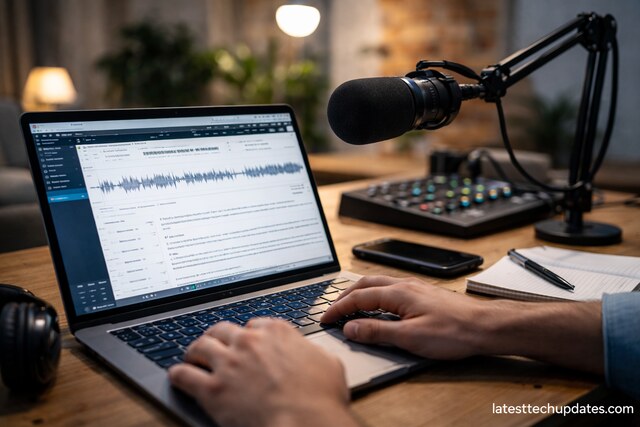
Text-based editing transforms podcast post-production because editors manipulate transcripts rather than complex audio waveforms. Transcript-based workflows simplify technical processes.
Speech-to-text alignment connects written words directly to audio timestamps. Timestamp synchronization ensures accurate edits without manual waveform scanning. When I first used text-based editing, I felt immediate relief because editing became similar to revising a document instead of engineering audio files.
Text-based systems also detect filler words automatically. Automated filler detection highlights repeated phrases such as “um” or “you know.” Cleaner speech improves perceived authority and professionalism.
Filler Word Detection
Filler word detection uses pattern recognition algorithms. Pattern recognition identifies common verbal pauses and unnecessary repetitions. Removing such words tightens pacing and increases clarity.
Multi-Track Alignment
Multi-track alignment synchronizes multiple speaker recordings. Synchronized tracks allow seamless transitions between speakers. Accurate alignment reduces manual timing adjustments during editing.
How Can AI Tools Help with Podcast Marketing and Repurposing?
AI tools support podcast marketing by generating social clips, show notes, and promotional captions automatically. Automated marketing expands reach with minimal additional effort.
AI clip generators identify engaging moments using sentiment analysis and keyword emphasis. Sentiment detection locates high-energy segments suitable for short-form platforms. I often create promotional reels directly from AI-suggested highlights, and engagement metrics consistently improve when clips focus on emotionally charged insights.
AI also writes episode descriptions optimized for search engines. Search-optimized metadata increases visibility on podcast directories and web search platforms.
Social Media Clip Generation
Social clip generation extracts short video or audio snippets from long episodes. Short-form distribution increases exposure among new audiences. Consistent posting strengthens brand presence across platforms.
SEO-Optimized Show Notes
SEO-optimized show notes incorporate keywords, summaries, and structured headings. Structured metadata improves indexing and discoverability. Search visibility drives long-term organic growth.
What Are the Advantages and Limitations of AI in Podcast Editing?
AI in podcast editing offers efficiency, scalability, and accessibility. Automation reduces technical barriers for beginners while enhancing productivity for professionals.
Advantages include faster editing, consistent sound quality, and simplified collaboration. Reduced editing time allows creators to focus on storytelling and audience engagement. My personal workflow improved significantly after integrating AI systems because repetitive technical tasks no longer consumed creative energy.
Limitations include dependency on algorithm accuracy and occasional transcription errors. Speech recognition systems may struggle with accents or background noise. Manual review remains essential to maintain accuracy and authenticity.
Advantages
Efficiency increases productivity. Automation reduces time investment. Accessibility empowers creators without technical expertise. Scalability supports growing podcast networks.
Limitations
Algorithmic errors may require manual correction. Over-reliance on automation may reduce personal editing style. Creative judgment remains essential for storytelling depth.
What Is the Future Scope of AI Tools for Podcast Creation?
AI tools for podcast creation will evolve toward deeper personalization, real-time translation, and voice cloning capabilities. Advanced personalization will tailor content for specific listener segments.
Real-time translation will enable global audience expansion. Multilingual adaptation increases reach across international markets. I believe future podcast systems will automatically create localized versions of episodes without additional recording sessions.
Voice synthesis will allow dynamic content updates. Synthetic voice models may enable automated episode summaries or adaptive advertising segments. Podcasting will become more interactive and data-driven as AI analytics refine audience insights.
Personalized Listening Experiences
Personalization algorithms analyze listening behavior. Behavior analysis recommends relevant episodes and targeted segments. Tailored recommendations increase engagement and loyalty.
Multilingual AI Production
Multilingual production tools translate and synthesize speech across languages. Global accessibility expands audience demographics. Cross-border content distribution strengthens brand authority.
Conclusion
AI tools for podcast creation and editing redefine audio production through automation, enhancement, and intelligent structuring. Workflow efficiency increases, sound quality improves, and marketing becomes scalable through algorithmic support. Human creativity remains central, while artificial intelligence strengthens execution and distribution. You can start small with script assistance or adopt full AI-driven production pipelines depending on your goals. Personal experience confirms that combining human storytelling with AI optimization produces consistent, professional, and scalable podcast content.
FAQ’s
Are AI podcast tools suitable for beginners?
AI podcast tools simplify recording, editing, and publishing. Beginner creators benefit from automated guidance and reduced technical complexity.
Can AI fully replace human podcast editors?
AI enhances efficiency but does not replace creative decision-making. Human judgment ensures storytelling authenticity and emotional depth.
Do AI tools improve podcast SEO?
AI generates optimized titles, descriptions, and transcripts. Structured metadata improves discoverability across search engines and podcast directories.
Is audio quality better with AI enhancement?
AI-based noise reduction and voice balancing improve clarity significantly. Professional-level sound becomes achievable without advanced engineering skills.
How should creators start using AI in podcasting?
Creators should begin with transcription and script generation tools. Gradual integration allows smoother workflow adaptation and measurable productivity gains.
