
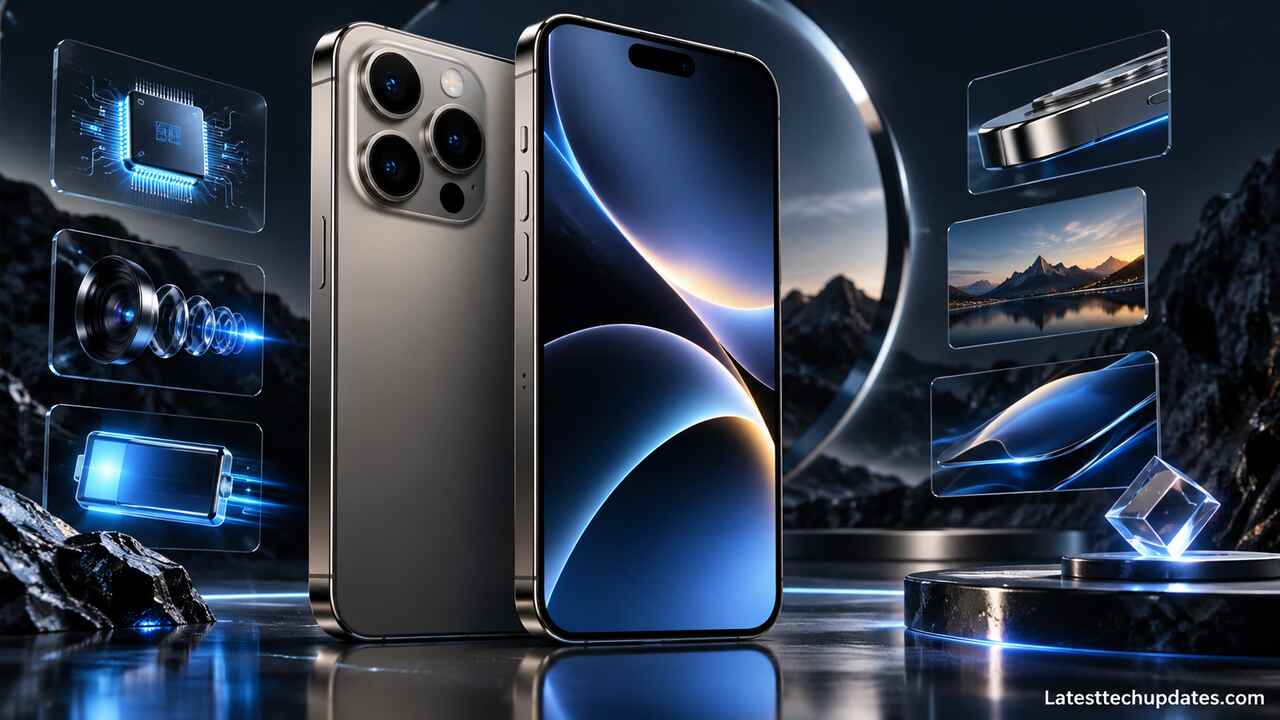
The iPhone 18 Pro Max is Apple’s largest conventional flagship iPhone for 2026. It officially went on sale on September 18, 2026, with a $1,299 starting price in the United States. Its main upgrades include the A20 Pro chip, a new 48MP main camera with a physical variable aperture, improved cooling, longer battery life, faster charging, a smaller Dynamic Island, and storage options reaching 2TB.
The biggest change is not simply that Apple has made another faster iPhone. The iPhone 18 Pro Max gives photographers more direct control over how the camera captures an image, while the larger battery and redesigned thermal system target two practical issues that matter to heavy users: how long the phone lasts and how well it maintains performance during demanding workloads.
iPhone 18 Pro Max specifications at a glance
| Specification | iPhone 18 Pro Max |
| Display | 6.9-inch Super Retina XDR OLED |
| Resolution | 2868 x 1320 pixels, 460 ppi |
| Refresh rate | ProMotion adaptive refresh rate up to 120Hz |
| Processor | Apple A20 Pro |
| CPU | 6-core |
| GPU | 7-core with Neural Accelerators |
| AI hardware | Dual 16-core Neural Engine |
| Rear cameras | 48MP Main + 48MP Ultra Wide + 48MP Telephoto |
| Main camera | Variable aperture: f/1.48, f/1.8, f/2.8, f/4.0 |
| Telephoto | 4x optical, 8x optical-quality |
| Front camera | 18MP Center Stage |
| Storage | 256GB, 512GB, 1TB, 2TB |
| Battery rating | Up to 45 hours video playback on applicable eSIM-only models |
| Wired charging | Up to 50% in around 15 minutes with compatible 60W or higher adapter |
| Wireless charging | MagSafe and Qi2 up to 25W |
| Connectivity | 5G, Wi-Fi 7, Bluetooth 6, Thread, Ultra Wideband |
| Port | USB-C, USB 3 up to 10Gb/s, DisplayPort |
| Water resistance | IP68 |
| Software | iOS 27 |
| Dimensions | 163.4 x 78.0 x 8.75 mm |
| Weight | 249 g |
| Colors | Black, Silver, Glacier, Burgundy |
| US starting price | $1,299 |
Apple’s specifications confirm the 6.9-inch OLED display, A20 Pro processor, triple 48MP camera system, USB 3 connectivity, four storage capacities, and the 249-gram weight.
iPhone 18 Pro Max design
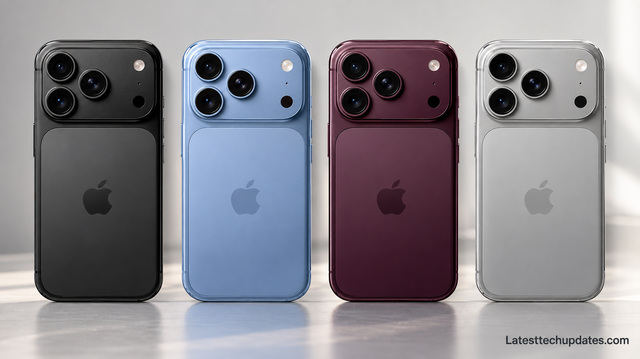
Apple has kept the broad design language introduced with the previous Pro generation rather than completely redesigning the phone. The iPhone 18 Pro Max uses an aluminum unibody, Ceramic Shield 2 on the front, and Ceramic Shield on the back. It is available in Black, Silver, Glacier, and Burgundy.
The phone measures 163.4 mm tall, 78.0 mm wide, and 8.75 mm thick, and weighs 249 grams. That weight is worth considering before buying. This is a large phone designed around screen space, battery capacity, camera hardware, and sustained performance rather than minimum size or weight.
Apple has also made the Dynamic Island smaller. It remains part of the Face ID system, but the reduced footprint gives the display a slightly cleaner appearance. The updated Dynamic Island can display information from as many as three Live Activities at the same time.
The familiar Action button and Camera Control remain. Camera Control can handle options including exposure, depth, zoom, camera selection, Photographic Styles, and tone.
Durability is rated at IP68, which Apple specifies as resistance to a maximum depth of 6 meters of water for up to 30 minutes under IEC 60529 testing. Water resistance should still be viewed as protection against accidents rather than permission to use the phone regularly underwater.
Display: a large 6.9-inch ProMotion OLED
The iPhone 18 Pro Max has a 6.9-inch Super Retina XDR OLED display with a resolution of 2868 x 1320 pixels at 460 pixels per inch. The actual viewable diagonal is slightly smaller because of the rounded corners.
It supports Apple’s ProMotion technology with an adaptive refresh rate of up to 120Hz. A higher refresh rate makes scrolling, animations, gaming, and interface movement look smoother than they do on a conventional 60Hz screen. Because the refresh rate can change according to the content, the display does not need to operate at 120Hz constantly.
Apple lists 1,000 nits typical maximum brightness, 1,600 nits peak HDR brightness, and up to 3,000 nits outdoors. The display can also reduce brightness to 1 nit. An anti-reflective coating is included.
For practical use, the size is both the phone’s advantage and one of its limitations. A 6.9-inch screen gives games, movies, photo editing, document viewing, maps, and video timelines more room. It also makes the device less comfortable for people who prefer one-handed operation or regularly carry a phone in a small pocket.
A20 Pro performance
The iPhone 18 Pro Max uses Apple’s A20 Pro, manufactured using a 2-nanometer process. It has a 6-core CPU, 7-core GPU with Neural Accelerators, hardware-accelerated ray tracing, and a Dual 16-core Neural Engine.
Apple says A20 Pro provides 50 percent more memory bandwidth than A19 Pro and that its GPU can be up to 40 percent faster. These are manufacturer claims, so they should not be interpreted as meaning every app will run 40 percent faster. The improvement matters most in workloads that can actually use the additional graphics, memory, and AI processing capacity.
Those workloads include demanding games, video processing, computational photography, professional camera features, and increasingly complex on-device AI operations.
Independent testing from Tom’s Guide also found strong performance from the new chip, while Apple’s redesigned thermal system helps the phone maintain performance during longer workloads.
A larger vapor chamber matters more than benchmark numbers
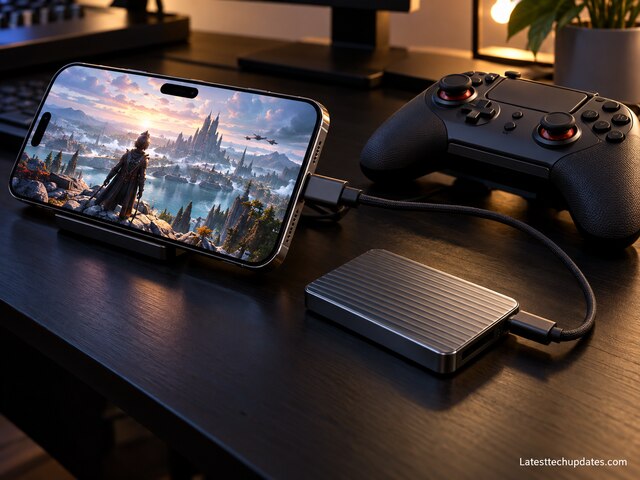
Apple redesigned the cooling system around a next-generation vapor chamber with roughly three times the surface area of the previous generation’s solution. Apple claims this can deliver up to a 40 percent improvement in sustained performance compared with the iPhone 17 Pro generation.
Sustained performance is important because a processor can be extremely fast for a short benchmark but slow down as heat builds. Better cooling is most useful during long gaming sessions, video exports, intensive camera processing, and other continuous workloads.
The camera is the biggest hardware upgrade
The iPhone 18 Pro Max has three 48MP rear cameras, but the most important change is the new variable aperture system on the main camera.
48MP Fusion Main camera with variable aperture
The 24 mm-equivalent main camera can physically switch between f/1.48, f/1.8, f/2.8, and f/4.0 apertures. It also uses second-generation sensor-shift optical image stabilization.
Aperture controls how much light reaches the camera sensor and influences depth of field.
A wider opening such as f/1.48 allows more light into the camera and can help in darker environments. A narrower setting such as f/4.0 can keep more of a scene in focus, which can be useful for groups, landscapes, products, and situations where you do not want only one subject plane to appear sharp.
This is different from simply applying simulated Portrait mode blur after taking the photograph. The aperture itself is physically changing. A teardown examined by The Verge showed that the mechanism uses six extremely thin moving blades.
Early independent camera testing also suggests the feature is especially useful to photographers who understand and want direct control over aperture, while casual users may notice a smaller difference when leaving the camera in automatic mode.
48MP Ultra Wide camera
The Ultra Wide uses a 13 mm-equivalent lens with an f/2.2 aperture and 120-degree field of view. It also handles 48MP macro photography.
The wider field of view is useful for architecture, landscapes, interiors, large groups, and very close macro subjects.
48MP Telephoto camera
The telephoto camera has a 100 mm-equivalent 4x optical focal length with an f/2.8 aperture. Apple also provides an 8x optical-quality 200 mm-equivalent option, produced using sensor cropping from the 48MP telephoto hardware. Digital zoom extends to 40x.
The distinction between “optical” and “optical-quality” matters. The 4x setting corresponds to the physical telephoto lens. The 8x mode uses the high-resolution sensor to produce a 12MP crop rather than switching to a separate 8x optical lens.
Pro camera controls
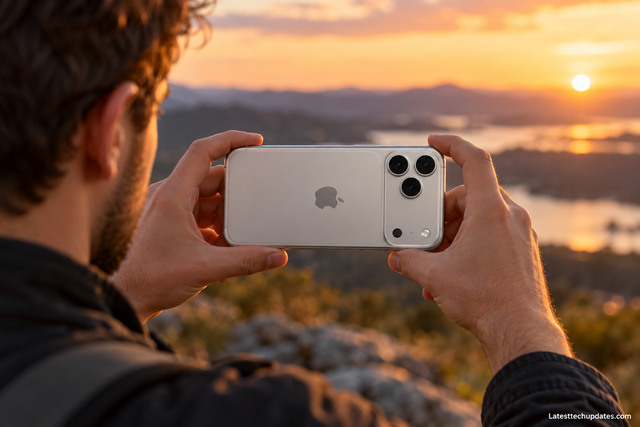
Apple has expanded manual camera controls substantially. The Camera app can provide direct control over aperture, shutter speed, white balance, and a histogram.
For an everyday user, automatic mode remains easier. For photographers and creators, however, these controls can matter more than another increase in megapixels. Shutter speed affects motion, white balance controls color temperature, aperture changes light and depth of field, and the histogram helps judge exposure.
This makes the Pro models better suited to users who want the iPhone to behave more like a dedicated camera rather than only a point-and-shoot smartphone.
Front camera and video features
The front camera is an 18MP Center Stage camera with an f/1.9 aperture and autofocus. Center Stage can adjust framing for photos and video calls, while the camera can also record 4K Dolby Vision video at up to 60 fps.
Rear-camera video capabilities are significantly broader. The main camera can record 4K Dolby Vision at up to 120 fps, while Apple also supports ProRes, ProRes RAW, Apple Log 2, Genlock, and external 4K ProRes recording at up to 120 fps. Dual Capture can record using front and rear cameras simultaneously at up to 4K Dolby Vision 30 fps.
These professional formats can produce extremely large files. Someone planning frequent ProRes or ProRes RAW recording therefore has a stronger reason to consider 512GB, 1TB, or 2TB storage than an ordinary user does.
USB-C also supports USB 3 transfers at up to 10Gb/s, making it possible to transfer large media files to compatible external storage much more quickly than with slower USB implementations.
Battery life
Battery life is one of the strongest reasons to choose the Pro Max rather than the smaller Pro.
There is an important regional difference. Apple’s U.S. specification for the eSIM-only iPhone 18 Pro Max lists up to 30 hours of typical use, 45 hours of video playback, and 40 hours of streamed video playback. Apple says removing the physical SIM hardware creates additional space for a larger battery.
In markets where the phone retains a physical SIM tray, such as India and the UK, Apple rates the Pro Max at up to 29 hours of typical use, 43 hours of video playback, and 38 hours of streamed video playback.
That regional difference is easy to miss when comparing specifications online.
Apple’s battery figures are controlled manufacturer ratings rather than guarantees for daily use. Screen brightness, cellular signal quality, gaming, camera use, background apps, navigation, and other factors can change real-world endurance substantially.
In Tom’s Guide’s independent web-surfing battery test, the iPhone 18 Pro Max ran for 18 hours and 27 minutes, compared with 17 hours and 54 minutes for the previous Pro Max under the publication’s test conditions.
Faster charging
Apple says the iPhone 18 Pro Max can charge to 50 percent in around 15 minutes when used with a 60W-capable or higher USB-C power adapter supporting Adjustable Voltage Supply. The charger is sold separately.
MagSafe and Qi2 wireless charging support reaches 25W. Apple rates compatible MagSafe charging at up to 50 percent in 30 minutes when paired with a 35W or higher adapter.
This does not mean the phone continuously charges at 60W. The adapter rating and the actual power accepted by the battery are different concepts. Charging power changes during the charging cycle to manage heat and battery health.
iOS 27, Apple Intelligence, and Siri AI
The iPhone 18 Pro Max ships with iOS 27. Apple has also positioned A20 Pro heavily around Apple Intelligence and the new Siri AI system.
Siri AI is designed to use personal context, information displayed on the screen, and broader knowledge to provide more useful answers and actions. Apple launched Siri AI as a beta feature, so buyers should not treat every advertised AI capability as equally mature or universally available.
Availability can also differ by language and country. For example, Apple states that Siri AI is not initially available in the European Union on iOS.
That regional limitation is important if AI features are one of the main reasons you are considering the phone.
Connectivity
The iPhone 18 Pro Max supports 5G, Wi-Fi 7, Bluetooth 6, Thread, NFC, and Apple’s second-generation Ultra Wideband technology. Apple also uses its N1 wireless networking chip.
The USB-C port supports charging, DisplayPort video output, and USB 3 data speeds of up to 10Gb/s. This is particularly useful for creators connecting external SSDs, cameras, displays, and other professional equipment.
Cellular hardware can vary by region, so buyers who regularly travel internationally should check the exact model and supported bands rather than assuming every iPhone 18 Pro Max is identical.
SIM support also differs. U.S. models use dual eSIM without a physical SIM slot, while markets including India support nano-SIM plus eSIM and dual eSIM configurations.
iPhone 18 Pro Max price
The 256GB iPhone 18 Pro Max starts at $1,299 in the United States. Apple offers 256GB, 512GB, 1TB, and 2TB capacities.
Current U.S. Apple Store pricing for the storage configurations is:
| Storage | US price |
| 256GB | $1,299 |
| 512GB | $1,499 |
| 1TB | $1,899 |
| 2TB | $2,499 |
The storage pricing has an unusual progression. Moving to 512GB costs $200 more, moving from 512GB to 1TB costs another $400, and moving from 1TB to 2TB costs another $600.
For most users, 256GB or 512GB makes the most practical sense. The 1TB and especially 2TB configurations are easier to justify for people recording large volumes of ProRes or ProRes RAW video, keeping extensive offline media, or using the iPhone as part of a professional production workflow.
Prices outside the U.S. vary because of taxes, exchange rates, regional Apple pricing, carrier offers, and local import costs.
Which storage size should you choose?
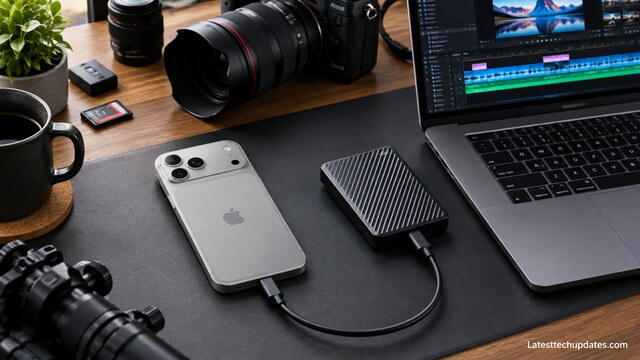
The 256GB model provides plenty of room for many everyday users, especially those who store photographs in iCloud and stream most music and video.
The 512GB version gives considerably more flexibility for large games, years of photos, downloaded media, and frequent 4K video without requiring constant storage management.
The 1TB configuration is primarily useful for heavy content creation. The 2TB model is much more specialized. Its camera, processor, display, and normal performance are the same as the lower-capacity models, so paying $2,499 makes sense only when that extra local storage directly supports your workflow.
What stands out most about the iPhone 18 Pro Max?
The variable-aperture camera is the most technically interesting upgrade because it changes the physical camera hardware rather than relying only on computational photography.
Battery life is likely to matter to more people every day. The Pro Max combines a larger battery with an efficient A20 Pro chip and revised cooling, making it better suited to long days of navigation, photography, video, gaming, and mobile work.
The A20 Pro and larger vapor chamber should matter most to gamers and professionals performing sustained workloads. Someone mainly using messaging, social media, email, and web browsing will receive less practical benefit from the additional processing headroom.
The 6.9-inch display remains one of the main reasons to buy the Max model, but it also creates the most obvious compromise. At 249 grams, this is not a light or compact phone.
iPhone 18 Pro Max vs iPhone 18 Pro
The two Pro phones share the A20 Pro processor and the same core rear-camera system. Choosing the Pro Max is therefore mainly about screen size and battery life, rather than getting a better camera or faster processor.
The iPhone 18 Pro has a 6.3-inch screen and weighs 211 grams, while the Pro Max has a 6.9-inch display and weighs 249 grams. The Pro starts at $1,199, while the Pro Max starts at $1,299.
People who watch a lot of video, play games, edit photographs, read documents, or want maximum battery endurance are more likely to appreciate the Max. Users who want the same basic Pro performance and camera capabilities in a device that is easier to hold should look at the standard iPhone 18 Pro.
Should you upgrade from an iPhone 17 Pro Max?
The move from an iPhone 17 Pro Max is more of a refinement than a complete transformation. The most relevant improvements are the A20 Pro processor, variable-aperture camera, Pro camera controls, increased battery life, faster charging, improved thermal management, smaller Dynamic Island, and 2TB storage option.
Independent reviewers have generally described the new generation as a meaningful refinement rather than a radical redesign.
For someone already using an iPhone 17 Pro Max and satisfied with its camera and battery, upgrading after one year may provide limited value. The case becomes stronger for photographers who specifically want variable aperture and manual camera controls, users who regularly push the phone under sustained workloads, or people who need the improved battery endurance.
Users coming from considerably older iPhones will notice a much larger overall change across performance, cameras, display technology, USB-C connectivity, battery life, and Apple Intelligence support.
Important limitations to know before buying
The most obvious limitation is price. The phone starts at $1,299, and high-capacity versions become dramatically more expensive. A 2TB model costs almost twice as much as the base version.
Size and weight are the next consideration. A 249-gram phone can become tiring during prolonged one-handed use, and the 6.9-inch body will not suit everyone.
Some of the most advanced camera capabilities are also specialized. Variable aperture, ProRes RAW, Apple Log 2, histograms, Genlock, and manual shutter controls are valuable tools for experienced creators, but they should not be treated as essential features for an ordinary smartphone user.
Siri AI also remains dependent on software maturity, language, and regional availability. AI features should therefore be considered part of an evolving software platform rather than a reason to assume every promised workflow will work perfectly from day one.
Finally, the mechanical variable-aperture camera introduces additional complexity. An iFixit teardown reported by The Verge found that the extremely small aperture mechanism would be difficult to repair independently if it failed.
Who is the iPhone 18 Pro Max for?
The iPhone 18 Pro Max makes the most sense for users who specifically want Apple’s largest display, longest available iPhone battery life, strongest conventional iPhone performance, and most advanced camera controls.
It is particularly relevant to photographers, mobile videographers, gamers, content creators, heavy travelers, and people who use their phone as their primary computing and entertainment device.
For lighter everyday use, the standard iPhone 18 Pro provides the same A20 Pro chip and camera platform in a smaller body. Buyers who do not need Pro-level camera controls or maximum performance should also compare Apple’s less expensive iPhones before paying the Pro Max premium.
Frequently asked questions
When was the iPhone 18 Pro Max released?
The iPhone 18 Pro Max became available on September 18, 2026, after pre-orders began on September 12.
How much does the iPhone 18 Pro Max cost?
It starts at $1,299 in the U.S. for 256GB. The 512GB model is $1,499, the 1TB version is $1,899, and the 2TB configuration is $2,499.
Does the iPhone 18 Pro Max have a 120Hz display?
Yes. Its 6.9-inch OLED display uses ProMotion with an adaptive refresh rate of up to 120Hz.
Does the iPhone 18 Pro Max have a variable-aperture camera?
Yes. The 48MP main camera can physically operate at f/1.48, f/1.8, f/2.8, or f/4.0. This allows greater control over light and depth of field.
Does the iPhone 18 Pro Max support a physical SIM card?
It depends on the country. U.S. models are eSIM-only, while some international versions, including the Indian model, support a nano-SIM and eSIM.
Is the iPhone 18 Pro Max battery life the same worldwide?
No. Apple’s eSIM-only U.S. specification reaches up to 45 hours of video playback, while models with a physical SIM tray in markets such as India and the UK are rated for up to 43 hours.
Final assessment
The iPhone 18 Pro Max is a focused upgrade built around four areas: camera control, battery life, sustained performance, and AI processing.
The variable-aperture 48MP camera is its most distinctive technical feature, while the longer battery life and improved thermal management are likely to produce the biggest benefits during ordinary long-term use. A20 Pro provides substantial performance headroom, and the 6.9-inch 120Hz OLED remains well suited to gaming, photography, video, and media consumption.
Its tradeoffs are equally clear. The phone is large and heavy, the $1,299 starting price is high, and the 1TB and 2TB versions become particularly costly. Several advanced camera and AI capabilities will also matter much more to specialized users than to someone who simply wants a fast everyday iPhone.
For buyers coming from an older iPhone who want the largest screen, strongest battery endurance, advanced cameras, and maximum performance Apple offers in a traditional smartphone design, the iPhone 18 Pro Max is a substantial upgrade. For an iPhone 17 Pro Max owner, the decision depends much more on whether the new camera controls, battery gains, and A20 Pro performance solve a problem you actually have.
Read Also: Expected Display Sizes for Apple’s Foldable iPhone Revealed
