
How Does Google’s User-Linked Knowledge Graph Strengthen AI Advantage?
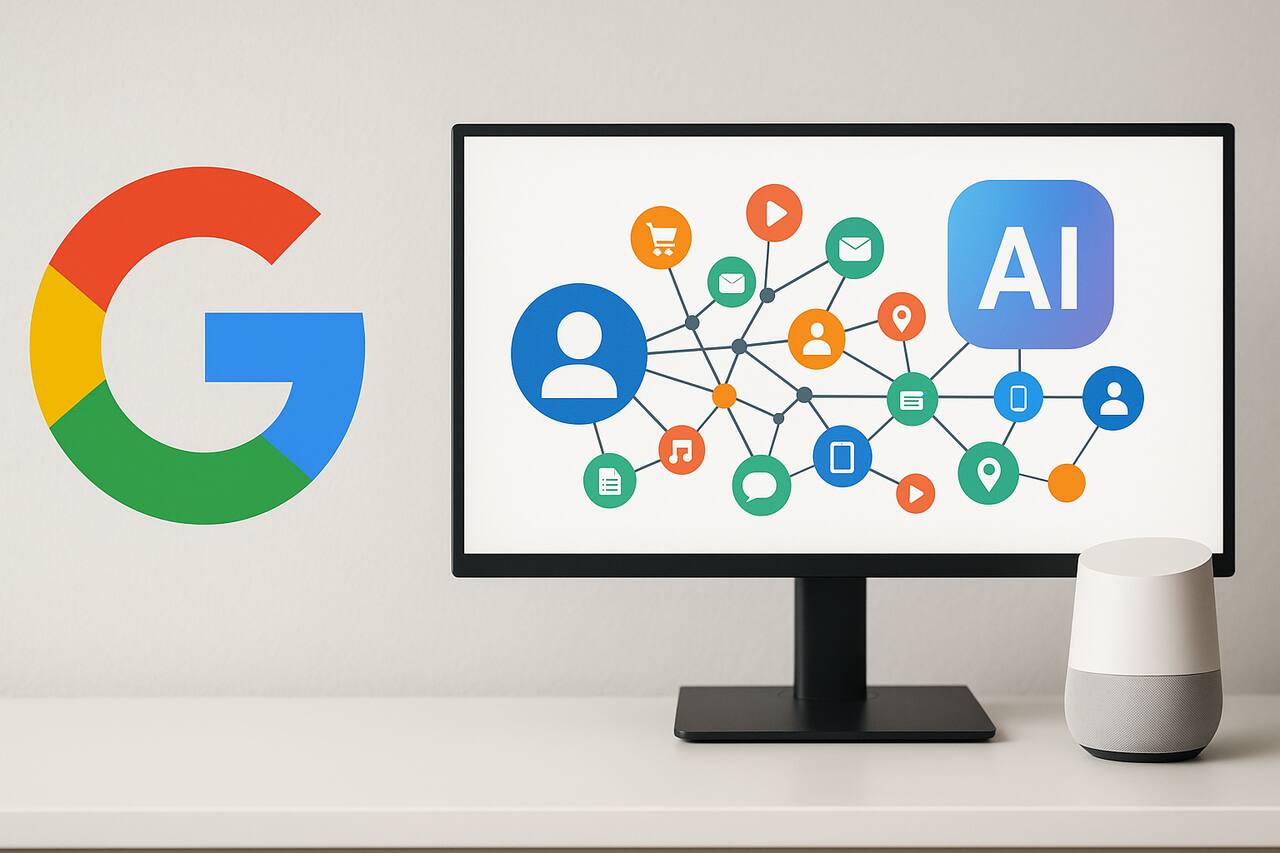
Google’s user-linked Knowledge Graph strengthens AI advantage through high-resolution entity recognition connected to long-term behavioral signals. Google’s AI models analyze search logs, location patterns, YouTube interaction data, Android device telemetry, and Chrome browsing behavior to build an entity-rich profile for every user. Google’s AI then aligns this profile with embeddings derived from billions of queries, producing hyper-personalized rankings, recommendations, and responses that outperform less-contextual models.
Which Behavioral Signals Shape Google’s AI Understanding?
Google’s AI uses behavioral signals such as query reformulations, dwell duration, navigational click chains, and task-driven browsing sequences to understand user preferences. Google’s systems map every behavioral signal to entity clusters within a Knowledge Graph, creating a semantic profile that evolves with every search session. Google’s AI then predicts future informational needs by correlating past goal pathways with global population behavior patterns.
How Do Google Services Enrich Personal Semantic Context?
Google services enrich personal semantic context through cross-platform entity convergence. Android generates environmental context, Gmail generates communication context, YouTube produces media affinity context, and Maps produces spatiotemporal context. Every platform contributes structured attributes that feed Google’s ranking systems, enabling more accurate query interpretation and more precise intent classification across billions of queries.
How Does Google Use Semantic Matching for Personalized Ranking?
Google uses semantic matching through large-scale embedding comparison between user-linked vectors and document vectors. Google’s models convert every user preference into weighted entity embeddings, allowing ranking systems to deliver results aligned with personal history. Personalized weighting influences query understanding, passage relevance scoring, and result diversity reduction to deliver a more goal-aligned SERP for every user.
Why Does Long-Term Data Memory Increase Google’s AI Lead?
Long-term data memory increases Google’s AI lead by allowing deep temporal modeling. User-linked profiles reveal multi-year preference patterns, seasonal behavioral cycles, and long-term interest trajectories. Google’s AI leverages these temporal signatures to predict future tasks, reducing friction across search journeys. Deep memory also strengthens context carryover, enabling more accurate interpretation of vague or truncated queries.
How Does Google’s AI Leverage Cross-Device Integration for Stronger Semantic Precision?

Google’s AI leverages cross-device integration through synchronized entity tracking across smartphones, desktops, smart speakers, connected cars, televisions, and wearables. Cross-device tracking forms a unified behavioral layer that enhances intent interpretation models, allowing semantic systems to align user goals with contextual cues observed across different environments.
How Does Android Telemetry Influence AI Decision-Making?
Android telemetry supplies contextual data such as app usage frequency, notification interaction patterns, and background system behaviors. Telemetry signals reveal personal routines, productivity rhythms, entertainment habits, and navigational tendencies. Every pattern strengthens Google’s ability to map daily tasks to entity relationships, enabling more accurate predictions for search, recommendations, and suggestions.
How Does Chrome Browsing Behavior Add Granular Entity Data?
Chrome browsing behavior adds granular entity data by tracking reading duration, scroll progression, interaction zones, and tab-switching behavior. Browsing signals indicate topical depth, comparative intent, research stages, and commercial evaluation steps. Chrome enriches Google’s AI with domain-level interest mapping, enhancing ranking models that require detailed understanding of topical expertise.
How Do Google Home Devices Strengthen Contextual Understanding?
Google Home devices strengthen contextual understanding by capturing household-level behavior patterns such as music preferences, recurring queries, scheduling habits, and environmental controls. Home devices reveal multi-user patterns, temporal routines, and ambient context signals. These attributes feed Google’s AI models that require shared-environment interpretation for more accurate voice search understanding.
How Does YouTube Consumption Guide Predictive Modeling?
YouTube consumption guides predictive modeling through deep user affinity embeddings derived from watched categories, paused moments, skipped segments, and comment interactions. Video consumption signals reveal micro-level preferences such as instructional learning habits, entertainment genres, emotional response patterns, and creator affinity. These embeddings significantly influence search predictions because video behavior reflects high-intent interest patterns.
Why Does Google’s First-Party Data Ecosystem Create a Competitive AI Moat?
Google’s first-party data ecosystem creates a competitive AI moat through exclusive access to large, diverse, longitudinal datasets that no external competitor can replicate. Google controls platforms across communication, navigation, entertainment, productivity, and commerce. Cross-platform dominance forms a multi-layered semantic network anchored to billions of active users, enabling AI models to outperform in personalization, prediction, and contextual intelligence.
How Does Data Exclusivity Strengthen AI Performance?
Data exclusivity strengthens AI performance through training advantages unavailable to competing platforms. Google processes global-scale queries connected to demographic metadata, device signals, and regional behavioral patterns. This depth enables more accurate embeddings, stronger intent classification, and superior multilingual comprehension. Exclusive data also improves algorithm robustness through exposure to rare, emerging, or niche query patterns.
How Do Privacy-Focused Frameworks Still Enable Strong Semantic Learning?
Privacy-focused frameworks still enable strong semantic learning through anonymized aggregation, differential privacy techniques, and on-device learning. Google’s architecture uses model updates processed locally, allowing personal data to shape learning without leaving devices. Aggregated signals then form global models that retain population-level insights while protecting individual identity.
How Does Commercial Intent Data Strengthen Predictive Models?
Commercial intent data strengthens predictive models through shopping behavior patterns captured across Google Shopping, YouTube product reviews, Gmail promotional interactions, and Chrome ecommerce visits. These signals map user journeys from awareness to purchase. Predictive systems then learn product affinities, budget ranges, longevity expectations, and cross-category correlations. These insights flow back into search and recommendation engines.
How Does Google’s Multi-Modal Data Layer Drive AI Superiority?
Google’s multi-modal data layer drives AI superiority through unified learning across text, audio, video, geographic signals, and sensor outputs. Multi-modal ingestion increases contextual precision, enabling models to interpret complex real-world tasks with fewer errors. This ecosystem benefits from synchronous reinforcement across data types, creating a semantic environment competitors cannot match without similar platform reach.
