
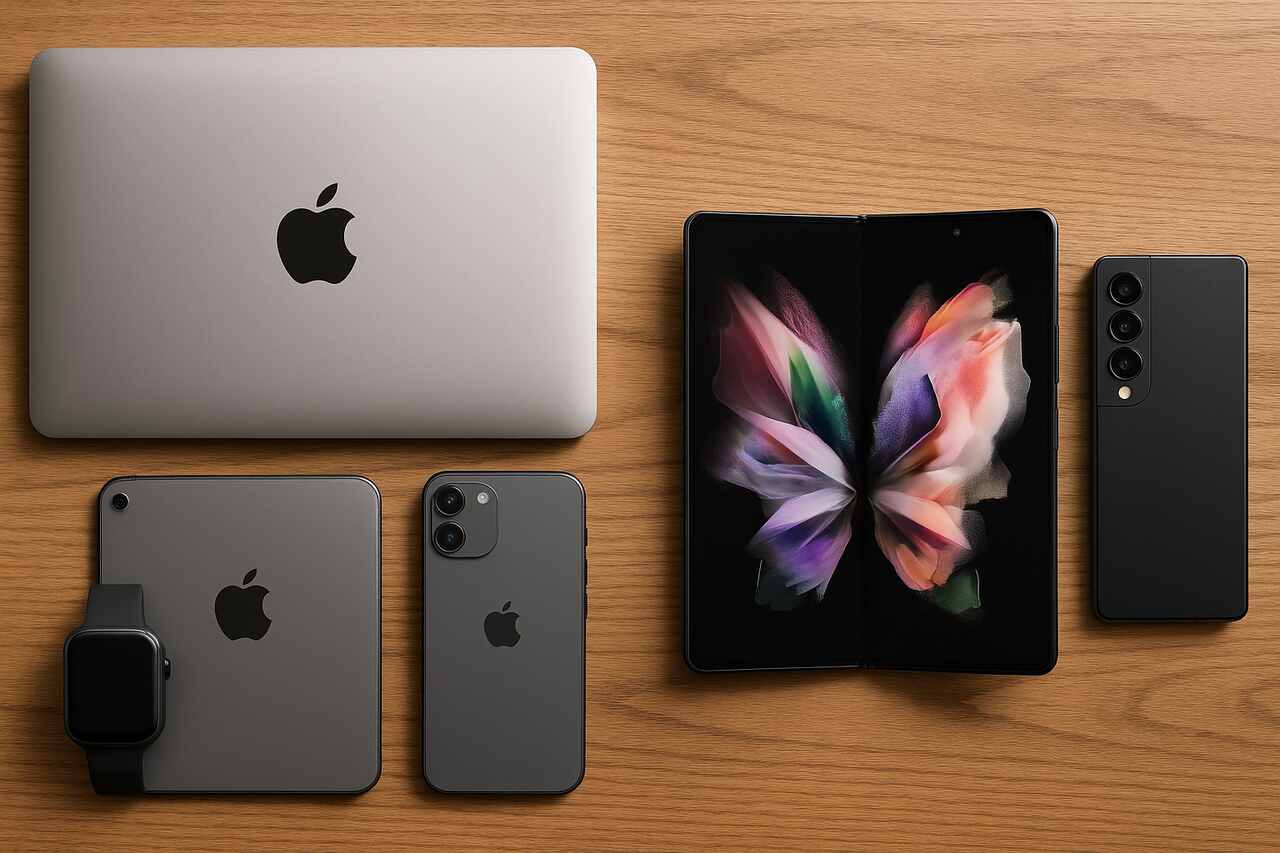
Why Is Apple’s Conservative Product Strategy Outperforming Samsung’s Foldable Innovation in 2025?
Apple’s Market Leadership in 2025 Is Driven by Ecosystem Cohesion, Not Hardware Experimentation
Apple’s dominance in 2025 is directly linked to its robust vertical integration across hardware, software, and services. Instead of chasing radical form factors, Apple has deepened value in its iOS ecosystem through refined interoperability among iPhone, Apple Watch, iPad, and Vision Pro. Users remain loyal due to synchronized services such as iCloud, Apple Pay, HealthKit, and AirDrop, which enhance device retention rates and average revenue per user (ARPU). This strategic depth in user experience contrasts Samsung’s hardware-centric innovation cycle, which has higher switching friction and fragmented service layers.
User Experience Stability Has More Value Than Radical Hardware Change in Buyer Psychology
Consumers prioritize reliability, battery optimization, intuitive interface continuity, and app ecosystem consistency over foldable aesthetics. Apple’s yearly iterative updates, like the A19 Bionic’s AI co-processor or iOS 19’s intent-based multitasking, address long-term behavioral patterns. In contrast, Samsung’s Galaxy Z Fold6 and Flip6, despite OLED hinge advancements, introduce friction in app compatibility, weight balance, and durability concerns. Psychological inertia toward change suppresses mass adoption of foldables, despite their visual novelty.
Apple’s AI Personalization Is Quietly Outpacing Samsung’s Visual Disruption Strategy
Rather than launching bold designs, Apple embeds on-device AI like SiriGPT for predictive behavioral mapping, contextual UI adaptation, and local data modeling. Personalized notification prioritization, app layout reshaping, and neural-based Focus Modes serve productivity-driven users. Samsung’s Galaxy AI, while visually integrated via OneUI 7.0, remains cloud-dependent and less privacy-centric, diminishing trust in sensitive sectors like finance and health.
Brand Trust and Functional Familiarity Are Outweighing Cutting-Edge Design in Consumer Loyalty
The iPhone 17 Pro Max saw record retention because users are conditioned to Apple’s semantic consistency in UX patterns, gesture control, and device-to-device language. Samsung’s dynamic UI challenges muscle memory and cognitive ergonomics, especially with inner-outer screen shifts in foldables. User journey stability across generations feeds emotional loyalty, which trumps experimental curiosity.
Platform Lock-in and Subscription Stack Solidify Apple’s Dominance Despite Samsung’s Innovation Pace
Apple One’s bundled ecosystem with Fitness+, Music, Arcade, and TV+ increases user dependency on the Apple ID-linked ecosystem. Foldable adopters still struggle with app scaling issues and third-party subscription syncing across Samsung’s multi-screen environment. This disparity in digital service maturity solidifies Apple’s grip over cross-device digital consumption.
How Do Samsung’s Foldables Represent Boldness in Product Innovation?
Samsung’s Industrial Design Innovation Focuses on Form Factor Transformation
Samsung’s Galaxy Z series has redefined mobile design language by folding large displays into pocket-sized devices. The Z Fold6 features a slimmer hinge, titanium armor, and water-resistant foldable OLED, making it structurally advanced. Foldables aim to provide both smartphone portability and tablet productivity in a single device. Yet, such innovation exists in hardware abstraction layers, not daily user outcomes.
Multi-Modal Interaction Capabilities Add Complexity Rather Than Simplifying Workflows
The Flex Mode, App Continuity, and Taskbar multitasking on foldables showcase Samsung’s ambition for versatile workflows. However, these functionalities demand app-level optimization that remains inconsistent across Android developers. Users face latency in drag-and-drop functions or unscaled UI in non-optimized apps, resulting in a perceived gap between potential and delivery.
Innovation Fatigue Among Mainstream Consumers Limits Foldable Adoption Rates
Tech-savvy early adopters champion foldables, but mainstream users perceive high price tags, shorter battery life, and repairability concerns as barriers. In regions like North America and Europe, foldables still occupy less than 6% of premium smartphone sales due to these friction points. Brand ambition doesn’t always translate to user behavior evolution.
Durability Constraints Continue to Undermine Foldables in Real-World Use Cases
Despite UTG (Ultra-Thin Glass) and Gorilla Glass Victus layering, foldables encounter issues in crease visibility, screen delamination, and hinge degradation over time. Apple’s monolithic glass design, meanwhile, has reached peak structural integrity, influencing buyers who prioritize longevity and resale value. Physical innovation must match psychological security, something foldables haven’t achieved at scale.
Samsung’s Foldable Differentiation Lacks Supporting Service Ecosystem
Unlike Apple’s continuity between hardware and services, Samsung’s SmartThings, Bixby, and Galaxy Store remain less integrated across its product line. Users struggle to extract full utility from foldables when apps, wearables, and smart home integrations lack seamlessness. Innovation, in the absence of services that contextualize its value, feels fragmented.
What Does Consumer Behavior in 2025 Reveal About Tech Market Trends?
Predictability and Continuity Drive Purchasing Decisions in Saturated Markets
In mature markets like the U.S., Japan, and Western Europe, device fatigue has led to preference for stable, predictable upgrades rather than radical innovation. Consumers favor incremental improvements that retain data continuity, accessory compatibility, and interface familiarity, an area where Apple excels.
Users Prefer Service Utility Over Hardware Novelty
A16 to A19 chip jumps mattered less to users than better Siri command interpretation, Health dashboard suggestions, and ecosystem sync. Apple’s invisible improvements like neural latency reduction and context-aware suggestions drive more loyalty than visible hardware changes. Foldables, despite their physical transformation, struggle to offer equivalent functional breakthroughs.
Digital Habits Reinforce Platform Dependence, Slowing Tech Migration
Users embedded in Apple’s service loops (iMessage groups, AirPods syncing, Find My Network, Screen Time limits) rarely defect to alternatives. Migrating to foldables means forfeiting tightly integrated digital routines, a cost many are unwilling to pay. Platform inertia supports Apple’s present-day dominance.
Bold Innovation Needs Timing Alignment with User Readiness
Samsung’s future-facing hardware is often ahead of software and consumer mental models. Apple aligns hardware maturity with user demand, launching features only when behavioral adoption is probable. Foldables might define the future form, but Apple defines the present function, more aligned with user readiness.
Tech Trust and Familiarity Remain Core Drivers in Adoption Rates
Consumer confidence is anchored in consistent UX, predictable OS behavior, and secure data practices. Apple’s narrative around privacy, carbon-neutral manufacturing, and repair transparency creates more brand resonance than Samsung’s device experimentation. Trust compounds annually through familiar interactions.
Will Foldables Eventually Replace Slab Phones or Remain a Niche?
Foldables Require Paradigm Shift in User Interaction Models to Achieve Mass Adoption
Mass-market acceptance of foldables will only occur when use cases align with daily interaction habits like content creation, note-taking, and remote productivity without friction. Until then, slab phones dominate due to ergonomic simplicity and app ecosystem maturity.
Cost-Parity and Durability Must Match Slab Devices for Foldables to Scale
Foldables must reach pricing parity with flagship slabs while ensuring equivalent lifecycle durability. Price-sensitive segments like education, enterprise, and healthcare are unlikely to invest in form-first devices unless ROI in workflow efficiency is clear.
Developer Ecosystem Needs to Embrace Foldable-First Design Principles
Foldables demand apps that adapt dynamically to screen ratios, hinge angles, and context states. Unless Android developers pivot to foldable-first frameworks, similar to Apple’s SwiftUI adoption, software lag will continue to undermine foldable UX.
Foldables Will Lead in Niche Productivity Segments Before Entering Mass Market
Professionals in finance, logistics, and creative industries might adopt foldables for multi-window multitasking and note folding. However, these remain edge cases. Mass market users want devices that ‘just work’ which is Apple’s core value proposition.
Foldables Are the Future, But Present Belongs to Iterative Excellence
While foldables symbolize innovation leadership and form disruption, Apple’s slow-burn mastery of iteration, optimization, and behavioral design secures the present. The future might fold, but the now is flat and functional.
