
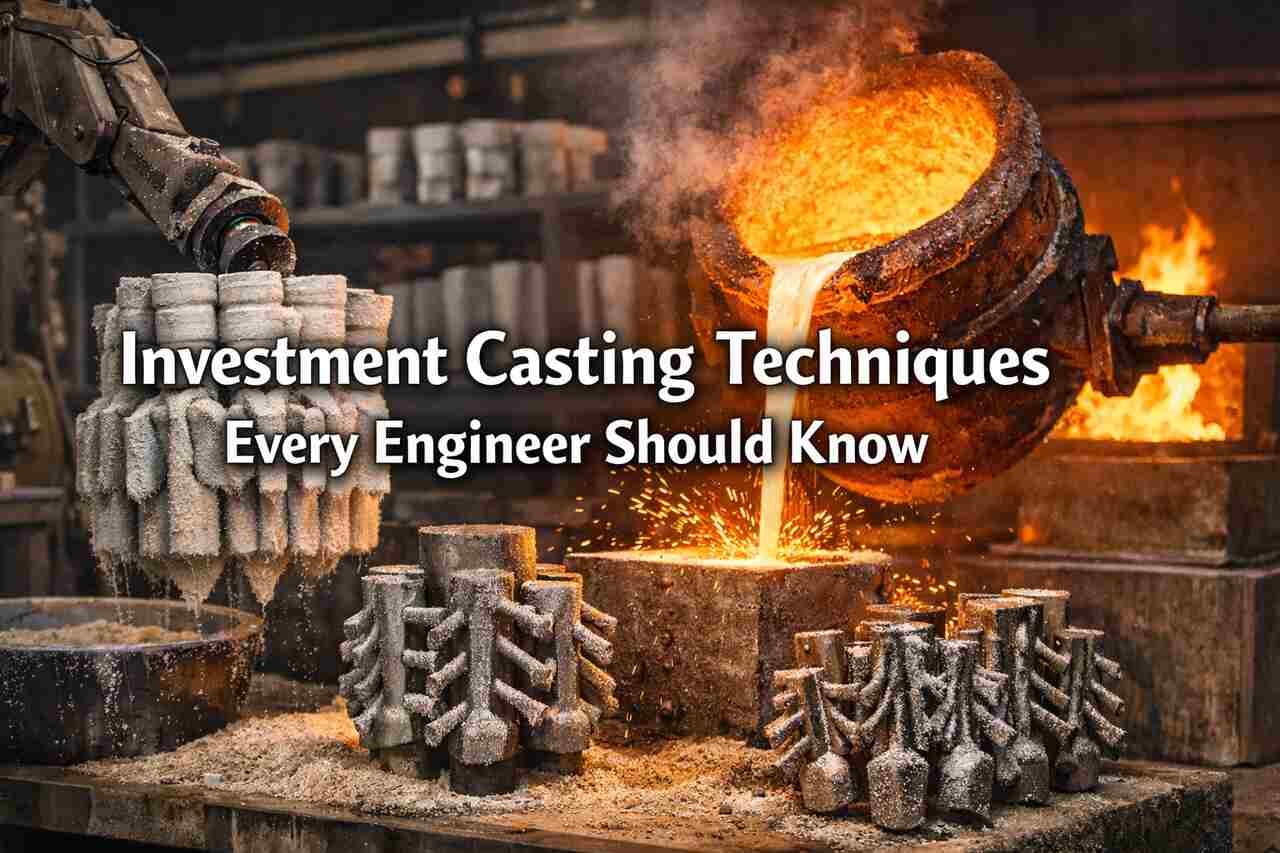
Investment Casting remains one of the most reliable and precise manufacturing methods used across engineering, aerospace, automotive, and energy sectors. As modern industries demand lighter, stronger, and more complex components, engineers must understand how this technique works and the latest innovations shaping its future.
This guide breaks down the essential techniques, recent developments, and practical considerations every engineer should know. It uses short paragraphs, avoids unnecessary jargon, and focuses on clear, up-to-date facts.
Why Investment Casting Still Matters
Investment casting is valued for its accuracy and ability to produce intricate shapes with minimal machining. Engineers use it when they need components with excellent surface quality and tight tolerances.
Recent industry reports show that demand for precision cast components continues to grow as manufacturers seek improved efficiency, better fuel performance, and reduced material waste. Sectors like aerospace and renewable energy rely on this process for turbine blades, structural brackets, and heat-resistant parts.
The flexibility of this method makes it suitable for both small-batch production and larger manufacturing runs, giving companies more control over cost and performance.
The Wax Pattern Technique
The first stage of investment casting involves creating a wax pattern. This pattern is an exact replica of the final component.
Today, engineers use two main methods:
- Injection moulding for high-volume production
- Additive manufacturing (3D printing) for complex designs and prototype parts
The rise of 3D printing has significantly improved pattern creation. It allows for faster development, reduced tooling costs, and more design freedom. Many UK manufacturers now integrate printed wax or resin patterns into casting workflows to shorten lead times.
Shorter development cycles help companies respond quickly to market demands and adapt designs without lengthy delays.
Shell Building and Ceramic Coating
Once the wax pattern is ready, it is dipped into a ceramic slurry and coated with fine sand. This process is repeated several times to create a strong, heat-resistant shell.
Recent improvements in ceramic materials have increased shell strength, reduced cracking, and enhanced surface finish. Modern shell systems cure faster, helping foundries speed up production without compromising quality.
Engineers should note that shell thickness plays a crucial role in the final outcome. A thicker shell handles heavy alloys well, while a thinner shell supports more delicate castings. Understanding this balance is key to avoiding defects and ensuring consistency.
De-Waxing and Firing
The next stage involves melting the wax out of the ceramic shell. Steam autoclaves are commonly used because they maintain pattern integrity and reduce thermal stress.
After de-waxing, the shell is fired in a high-temperature furnace. This critical step strengthens the ceramic structure, making it capable of withstanding molten metal.
Recent updates in furnace technology allow for more precise temperature control. Better heat distribution improves shell performance and reduces the risk of deformation. These upgrades have become more widespread across UK foundries that aim to maintain competitive standards.
Metal Pouring: Choosing the Right Alloy
Metal pouring remains a defining moment in the Investment Casting process. Alloys such as stainless steel, aluminium, cobalt, titanium, and nickel are commonly used, each chosen for performance, weight, and temperature requirements.
Modern industries, particularly aviation and renewable energy, rely on high-temperature superalloys. These materials support extreme conditions and help improve fuel efficiency in turbines and engines.
Automated pouring systems are becoming more common, offering:
- Improved temperature accuracy
- Reduced contamination
- Faster production cycles
Controlled pouring also minimizes turbulence, which reduces gas defects and improves surface quality.
Cooling and Solidification Control
Cooling is not just a waiting process—it directly influences the mechanical properties of the final part.
Engineers now have more tools to manage cooling rates. Advanced simulation software models how metal solidifies inside the shell. This helps predict issues like shrinkage or porosity before production even begins.
By adjusting mould design, shell thickness, or alloy composition, engineers can correct problems early and reduce waste. This digital approach has become an essential part of modern casting, helping teams meet tight tolerances and high performance demands.
Knockout, Cutting, and Finishing
Once the metal has cooled, the ceramic shell is broken away. The cast component is then removed from the gating system and prepared for final treatment.
Finishing steps usually include:
- Grinding
- Polishing
- Heat treatment
- Non-destructive testing
Recent developments in robotic finishing systems have improved speed and accuracy. Automated polishing and cutting reduce human error and boost consistency—important for safety-critical industries like aerospace and medical devices.
Engineers should also consider the role of heat treatment. Processes such as solution treating or age hardening improve strength, corrosion resistance, and fatigue life.
Quality Testing and Inspection
Inspection is a vital part of ensuring each part meets design requirements. Engineers use several modern testing techniques, such as:
- X-ray inspection
- Ultrasonic testing
- CT scanning
- Dye penetrant testing
CT scanning, in particular, has become more accessible in recent years. It offers detailed internal images, allowing engineers to identify hidden defects before the component enters service.
Data from these inspections helps refine casting methods and improve future production batches. This continuous improvement cycle supports better performance and long-term reliability.
Sustainability in Modern Investment Casting
Sustainability has become an important focus in manufacturing. The investment casting process has adapted with improvements such as:
- Recyclable wax systems
- Reduced ceramic waste
- More efficient furnaces
- Low-emission alloys
Foundries are also exploring closed-loop systems to recover materials and lower environmental impact. These changes align with wider industrial goals to cut energy use and support responsible production.
Final Thoughts
Investment casting continues to evolve with better materials, smarter tools, and greater digital integration. Engineers who understand these techniques are better equipped to design efficient, durable, and precise components for today’s demanding applications.
By staying informed about new technologies and improved methods, professionals can make the most of the opportunities this casting process offers. From pattern creation to inspection, each stage plays a vital role in ensuring high-quality results, making Investment Casting an essential technique every modern engineer should know.
