
What Cognitive Changes Are Linked to AI Chatbot Usage?
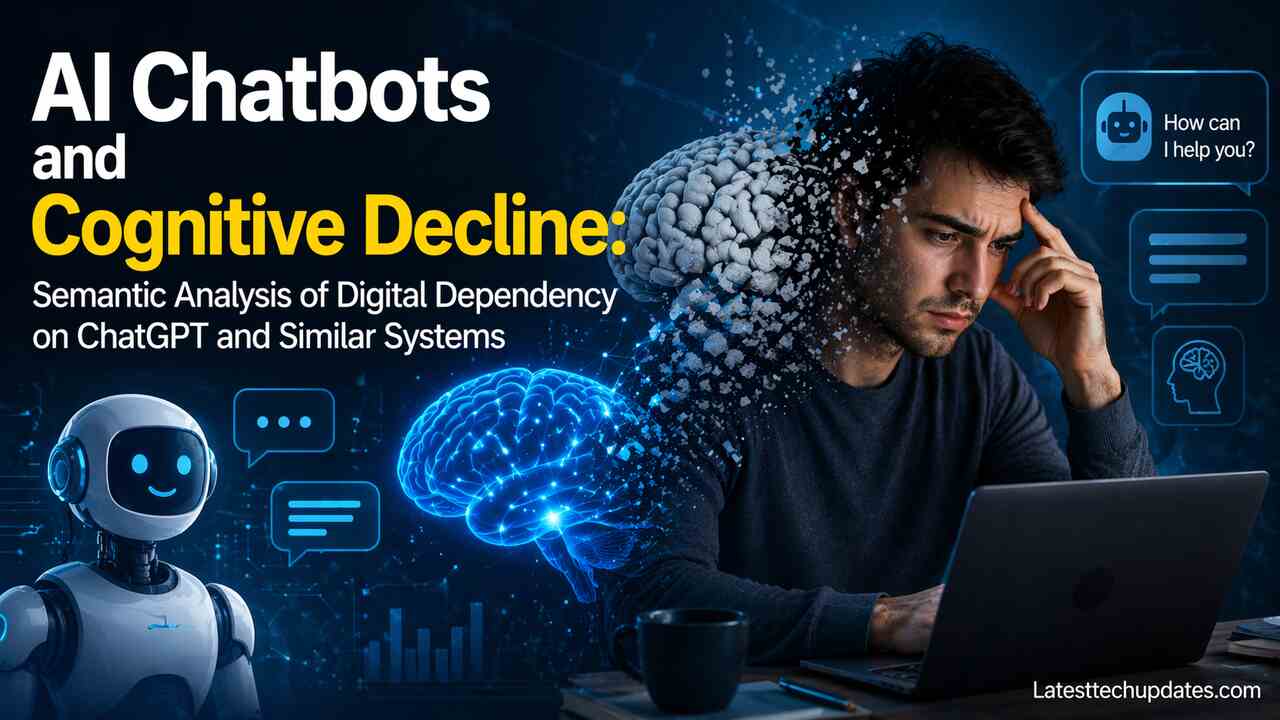
Frequent interaction with AI chatbots correlates with measurable shifts in cognitive processing patterns, especially in memory retention, critical thinking, and problem-solving autonomy. Human cognition relies on repetition and effortful recall, while AI-assisted responses reduce the need for internal knowledge retrieval. Reduced retrieval effort leads to weaker neural reinforcement, a phenomenon studied in Cognitive Offloading.
Cognitive offloading describes the delegation of mental tasks to external systems such as smartphones, search engines, and AI assistants. Delegation reduces cognitive load but simultaneously weakens long-term retention pathways. Neural plasticity adapts to reduced demand, causing the brain to prioritize efficiency over depth. Efficiency, in turn, reshapes learning habits toward dependency rather than mastery.
Analytical thinking also shows decline when AI provides instant answers without requiring reasoning steps. Step-by-step reasoning strengthens executive function, while shortcut-based answers weaken logical structuring ability. Logical structuring ability directly affects academic performance, workplace decision-making, and problem-solving resilience.
Attention span represents another impacted attribute. Rapid-response AI environments condition users to expect immediate answers, reducing tolerance for complex, time-consuming tasks. Reduced tolerance leads to fragmented focus, a condition associated with digital multitasking environments.
How Do AI Chatbots Influence Learning Behavior?
AI chatbots reshape learning behavior by transforming active learning into passive consumption. Active learning requires questioning, hypothesizing, and testing, while chatbot interactions often provide finalized answers without intermediate reasoning. Removal of intermediate reasoning reduces engagement with foundational concepts.
Educational psychology identifies deeper learning when learners struggle productively. Productive struggle strengthens neural encoding and improves concept transfer. AI-generated answers eliminate struggle, which reduces knowledge durability and adaptability in new contexts.
Language models like ChatGPT also influence writing and communication patterns. Users increasingly rely on generated text for emails, essays, and reports. Reliance reduces individual linguistic creativity and weakens vocabulary development over time.
Information validation represents another affected behavior. Traditional research involves cross-referencing multiple sources, while chatbot responses often appear authoritative without visible sourcing. Perceived authority reduces skepticism, which weakens critical evaluation skills essential in media literacy.
Learning autonomy declines when users default to AI assistance instead of independent exploration. Exploration fosters curiosity, while dependency fosters convenience-driven behavior. Convenience-driven behavior aligns with short-term efficiency but conflicts with long-term intellectual growth.
What Scientific Evidence Supports the “Stupidity” Claim?
Scientific research does not confirm literal intelligence reduction but supports changes in cognitive engagement patterns. Studies in Cognitive Psychology demonstrate that reliance on external tools alters memory strategies rather than eliminating intelligence. Intelligence remains stable, while usage patterns shift cognitive effort allocation.
Research on digital tools shows parallels with earlier technologies like GPS navigation. GPS reliance reduces spatial memory because users no longer mentally map routes. AI chatbots extend this effect into broader cognitive domains such as reasoning, writing, and knowledge recall.
Brain imaging studies reveal reduced activation in regions associated with deep processing when tasks are outsourced. Reduced activation does not indicate damage but indicates adaptation to lower cognitive demand. Adaptation reflects efficiency optimization, which can become detrimental when overused.
Educational studies highlight performance differences between students who use AI tools passively versus those who use them interactively. Interactive use where users question and refine outputs maintains cognitive engagement. Passive use where users accept answers reduces comprehension and retention.
Can AI Chatbots Enhance Intelligence Instead of Reducing It?
AI chatbots can enhance intelligence when used as cognitive amplifiers rather than replacements. Amplification occurs when users engage in dialogue, request explanations, and challenge outputs. Challenging outputs stimulates reasoning and reinforces learning pathways.
Guided learning represents a beneficial use case. AI can simulate tutoring by breaking down complex topics into structured explanations. Structured explanations support comprehension when paired with active questioning. Questioning maintains cognitive engagement and prevents passive consumption.
Creative thinking also benefits from AI collaboration. Brainstorming with AI introduces diverse perspectives and novel ideas. Exposure to diverse ideas expands associative thinking networks, which strengthens creativity rather than diminishing intelligence.
Skill augmentation occurs when AI assists with repetitive or time-consuming tasks, allowing users to focus on higher-level thinking. Higher-level thinking includes strategy, synthesis, and innovation. Innovation depends on cognitive resources that can be freed through selective AI use.
Balanced usage defines the boundary between enhancement and decline. Over-reliance shifts cognition toward dependency, while intentional use preserves autonomy. Autonomy ensures that human intelligence remains the primary driver of decision-making.
What Practical Strategies Prevent Cognitive Decline from AI Use?
Intentional interaction with AI preserves cognitive strength by maintaining active engagement. Active engagement includes verifying answers, asking follow-up questions, and reconstructing responses independently. Independent reconstruction reinforces learning pathways and improves retention.
Delayed AI usage represents another effective strategy. Attempting to solve a problem before consulting AI ensures that the brain engages in effortful thinking. Effortful thinking strengthens problem-solving skills and enhances long-term understanding.
Note-taking and summarization improve retention when using AI-generated information. Writing summaries in one’s own words activates deeper processing mechanisms. Deeper processing strengthens memory encoding and facilitates knowledge recall.
Critical evaluation should accompany every AI-generated response. Evaluation involves checking accuracy, identifying biases, and comparing alternative perspectives. Comparison builds analytical thinking and protects against misinformation.
Digital literacy education plays a crucial role in mitigating negative effects. Literacy includes understanding AI limitations, biases, and probabilistic outputs. Awareness of limitations encourages cautious and informed usage rather than blind reliance.
Conclusion
AI chatbots do not inherently reduce intelligence, but unstructured and excessive reliance reshapes cognitive habits toward dependency, reduced effort, and passive learning. Dependency weakens memory, attention, and reasoning when left unchecked. Balanced and intentional use transforms AI into a tool for cognitive enhancement rather than decline.
Human intelligence remains adaptable, and adaptability depends on how technology integrates into daily behavior. Behavior determines whether AI becomes a cognitive crutch or a cognitive partner.
