
Highlights
- AI tools for generating background music allow you to create custom soundtracks instantly by selecting mood, genre, and tempo without needing music production skills
- Platforms like OpenAI, AIVA, and Soundraw provide flexible solutions for creators, marketers, and developers
- AI-generated music reduces production time and cost while maintaining high-quality output suitable for videos, games, and ads
- Customization features help you match background music precisely with your content’s emotional tone and pacing
- Licensing options in most tools ensure safe commercial use without copyright concerns
- AI tools work best as creative assistants, helping you explore ideas quickly and refine results efficiently
- Future advancements will bring more realistic compositions and real-time adaptive soundtracks
AI tools for generating background music have transformed how creators approach sound design by combining automation with creative control. Modern platforms powered by advanced machine learning models analyze musical patterns, emotional tones, and structural elements to produce compositions that align closely with user intent. Creators no longer depend solely on traditional production methods because AI-driven systems provide instant results with customizable parameters such as mood, tempo, genre, and duration.
From my experience, this shift feels empowering because you move from searching endlessly for the right track to simply describing what you need and receiving multiple tailored options within seconds, which makes the entire creative process faster, more intuitive, and far more flexible.
What Are AI Tools for Generating Background Music?
AI tools for generating background music use algorithms, neural networks, and generative models to compose original soundtracks based on user inputs such as mood, tempo, genre, and duration. These systems analyze patterns from thousands of compositions, and those patterns allow machines to recreate human-like musical structures.
AI music generation simplifies the production process because users no longer need deep knowledge of music theory. That accessibility empowers content creators, game developers, and filmmakers to produce soundtracks without hiring composers. That transformation reshapes creative workflows and reduces production costs.
From my experience, working with these tools feels like collaborating with a silent composer who instantly understands your intent. You describe a mood, and within seconds, a usable track appears. That immediacy creates a powerful sense of creative freedom that traditional music production rarely offers.
How Do AI Music Generators Work?
AI music generators rely on deep learning architectures such as recurrent neural networks and transformers. These systems process large datasets of existing music and learn patterns like melody progression, rhythm structures, and harmonic relationships.
What Makes AI Music Tools Different from Traditional Composition?
AI tools differ because they automate composition and allow real-time adjustments. Traditional composition depends on manual effort, while AI systems provide instant iteration and customization without technical barriers.
Which Popular AI Music Tools Should You Use?
AI music tools vary in capability, pricing, and output quality, and choosing the right platform depends on your use case. Some tools specialize in cinematic scores, while others focus on short-form content or commercial usage.
Here is a comparison of widely used platforms:
| Tool Name | Key Feature | Best Use Case | Output Type |
| AIVA | Classical composition | Film scoring | MIDI and audio |
| Soundraw | Mood-based generation | YouTube videos | Audio |
| Amper Music | Custom tracks | Marketing content | Audio |
| Ecrett Music | Scene-based generation | Games and apps | Audio |
Each platform offers a unique workflow. Some prioritize automation, while others emphasize customization.
From my experience, trying multiple tools helped me understand their strengths. One tool might generate perfect ambient tracks, while another excels at upbeat commercial music. That variation makes experimentation essential.
Why Choose AIVA for Background Music?
AIVA provides structured compositions suitable for orchestral and cinematic use. AIVA’s strength lies in its ability to create emotionally rich scores that resemble human-composed music.
Why Use Soundraw for Content Creation?
Soundraw focuses on flexibility and speed. Soundraw allows quick edits to tempo, mood, and structure, making it ideal for social media creators.
How Do AI Tools Improve Content Creation Workflows?
AI tools improve workflows by reducing time, cost, and complexity in music production. Content creators can generate background music instantly, and that speed allows faster publishing cycles.
AI systems integrate directly into video editing pipelines, and that integration removes the need for external audio sourcing. As a result, creators maintain full control over sound design.
In my own workflow, using AI music tools removed the frustration of searching for royalty-free tracks. Instead of browsing endless libraries, I simply generate exactly what I need. That shift saves hours and keeps creative momentum intact.
How Do AI Tools Save Time?
AI tools eliminate manual composition and searching processes. Users generate music instantly by selecting parameters instead of building tracks from scratch.
How Do AI Tools Reduce Costs?
AI tools reduce costs by removing the need for professional composers or expensive licensing. Many platforms offer affordable subscriptions with unlimited generation.
What Features Should You Look for in AI Music Generators?
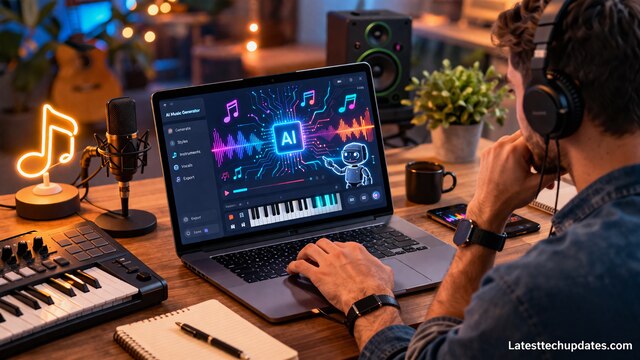
Choosing the right AI music generator requires understanding key features such as customization, output quality, and licensing. Each feature directly affects usability and final output.
Customization options allow users to control mood, tempo, instruments, and structure. Output quality determines how professional the generated music sounds. Licensing ensures safe commercial usage.
From my experience, flexibility matters more than anything else. A tool that allows small adjustments can completely change the final track, and that control makes a huge difference in real projects.
Why Is Customization Important?
Customization enables precise alignment with content. Users adjust parameters to match specific scenes or emotional tones.
Why Does Licensing Matter?
Licensing ensures legal usage of generated music. Proper licensing protects creators from copyright issues and supports commercial distribution.
What Are the Advantages and Limitations of AI Music Tools?
AI music tools offer several advantages, but limitations still exist. Understanding both sides helps users make informed decisions.
Advantages include speed, accessibility, cost efficiency, and scalability. Limitations include lack of deep emotional nuance and occasional repetitive patterns.
Here is a clear comparison:
| Aspect | Advantages | Limitations |
| Speed | Instant generation | Limited refinement |
| Cost | Affordable | Subscription required |
| Creativity | High variation | Less originality |
| Control | Easy customization | Limited advanced control |
What Are the Key Benefits?
Key benefits include fast production, reduced costs, and accessibility for non-musicians. These benefits make AI tools widely appealing.
What Are the Common Drawbacks?
Common drawbacks include repetitive patterns and limited emotional depth. Advanced compositions may still require human input.
How Can You Use AI Music Tools Effectively?
Effective use of AI music tools requires understanding input parameters, refining outputs, and integrating tracks into projects. Users achieve better results by experimenting with multiple variations.
Starting with clear goals improves outcomes. Selecting the right mood and tempo ensures alignment with content. Iterating multiple versions allows users to find the best match.
From my experience, generating several variations and comparing them side by side works best. The first result is rarely perfect, but small tweaks often lead to excellent results.
How Do You Choose the Right Mood?
Choosing the right mood depends on content context. Emotional alignment ensures the music enhances storytelling rather than distracting from it.
How Do You Refine AI-Generated Tracks?
Refinement involves adjusting tempo, structure, and instrumentation. Many tools allow edits after generation, which improves final quality.
What Is the Future of AI-Generated Background Music?
AI-generated background music continues to evolve with advancements in machine learning and generative models. Future systems will offer more realism, personalization, and integration with creative tools.
Real-time adaptive music represents a major development. AI systems will adjust soundtracks dynamically based on user interaction, especially in gaming and virtual environments.
From my perspective, AI music tools will become standard in creative workflows. The ability to generate personalized soundtracks instantly will redefine content production across industries.
Will AI Replace Human Composers?
AI will not fully replace human composers. Human creativity and emotional depth remain essential for complex compositions.
What Innovations Can Be Expected?
Future innovations include real-time music adaptation, voice-controlled composition, and deeper integration with editing software.
Conclusion
AI tools for generating background music transform how creators approach sound design by combining speed, accessibility, and customization. Platforms like OpenAI, AIVA, and Soundraw enable users to produce high-quality tracks without technical expertise, and that capability empowers individuals across industries.
From my experience, these tools feel like creative partners rather than replacements. The ability to generate, test, and refine music instantly changes the entire creative process. While limitations exist, the benefits outweigh the drawbacks, especially for content creators seeking efficiency and flexibility.
The future of AI music generation promises deeper personalization and smarter systems. As technology advances, creators will gain even more control over sound design, making AI an essential part of modern content creation.
FAQ’s
What are AI tools for generating background music?
AI tools are software platforms that use machine learning to create original music based on user-defined parameters such as mood, genre, and tempo.
Are AI-generated tracks copyright-free?
Most AI platforms provide royalty-free music with proper licensing. Users should always review licensing terms before commercial use.
Can beginners use AI music tools?
Beginners can easily use AI tools because interfaces are simple and require no prior music knowledge.
Which AI music tool is best?
The best tool depends on the use case. AIVA works well for cinematic music, while Soundraw suits content creators.
Do AI tools produce professional-quality music?
AI tools can produce high-quality tracks suitable for videos, games, and marketing, though complex compositions may still need human refinement.
