 update has sparked a debate on the safety of using a smartphone while driving.)
Highlights
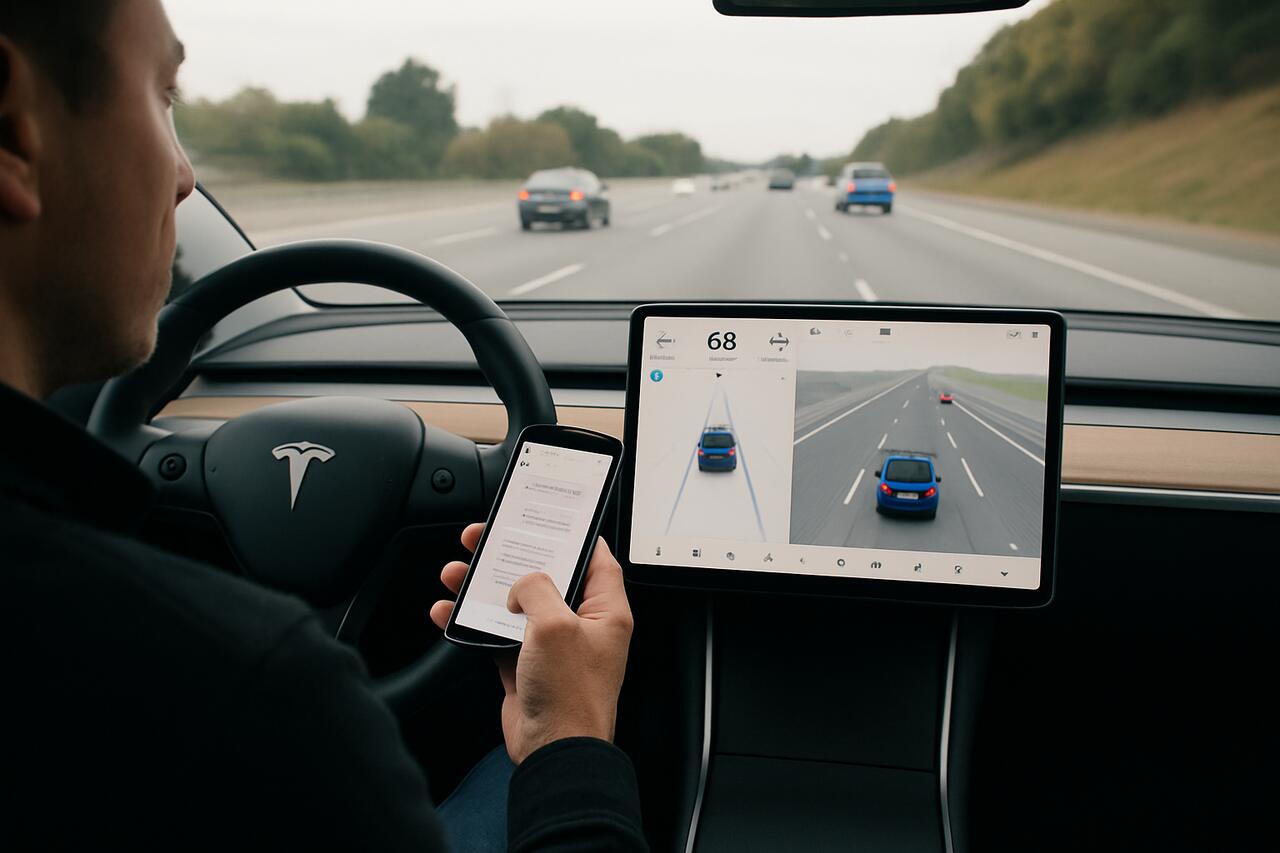
- Elon Musk announced that Tesla Full Self-Driving (FSD v14.2.1) may allow drivers to “text and drive” or use their phone under certain traffic conditions.
- The vehicles still rely on driver supervision and use an in-cabin camera to monitor alertness; after repeated inattentive behavior, FSD is disabled.
- Despite Tesla’s update, many U.S. jurisdictions (e.g. states such as Arizona, New York, and Illinois) explicitly ban handheld phone use while driving even when advanced driver-assistance systems are active.
- Law enforcement agencies and safety regulators warn that using a phone remains illegal except for emergencies, regardless of FSD.
Why does Elon Musk claim Tesla FSD will let you use your phone while driving?
Tesla’s FSD v14.2.1 now includes a modified driver-monitoring logic that, according to Musk, can permit limited phone use depending on “the context of surrounding traffic.”
“Context of surrounding traffic” refers to low-speed or light-traffic conditions, where FSD may judge the driving environment as simple enough such as cruising slowly or in a traffic jam to momentarily allow a driver to glance at their phone without triggering the internal alerts.
Tesla’s stance frames FSD as a “driver-assistance” system rather than full autonomy: the driver remains legally responsible for the vehicle’s control.
The built-in in-cabin camera continues to monitor eye gaze and head position; repeated diversion from the road triggers warnings and can disable FSD if inattentiveness persists.
Musk’s public statements including on social media reflect Tesla’s intention to gradually relax restrictions in the software, moving toward greater autonomy in perceived “safe” traffic contexts; FSD is still designated “Supervised.”
Why do police and regulators warn against using phone under FSD despite Tesla’s update?
Most U.S. states have laws explicitly prohibiting handheld phone use while driving many of those laws make no exception for vehicles using advanced driver-assist (ADAS) or semi-autonomous systems.
Law enforcement spokespersons from states such as Arizona, New York, and Illinois have confirmed no legal carve-outs exist for FSD-equipped cars; using a phone while the car is in motion remains illegal outside emergencies.
Regulatory oversight bodies, including the National Highway Traffic Safety Administration (NHTSA), are investigating FSD-related incidents where the system allegedly disobeyed traffic signals or drove against proper directions raising safety concerns even when FSD is used as intended.
Historical crash data indicate that vehicles using automated driving or driver-assist systems including previous versions of FSD / Tesla Autopilot have been involved in accidents when drivers became inattentive, such as looking at their phones or not keeping hands on the wheel.
Police warnings stress that, from a legal and safety standpoint, phone use while driving remains risky and potentially punishable regardless of Tesla’s software updates or marketing claims.
What happened when someone actually tested Tesla’s new FSD texting-while-driving feature?
A recent drive with FSD v14.2.1 tested by a journalist showed that under low to moderate traffic conditions, it was possible to glance at a phone briefly often up to five seconds without triggering warnings or interruptions.
During the test on narrow streets and even with oncoming traffic, the vehicle navigated smoothly and continued to function, although occasionally the system asked the driver to apply pressure to the steering wheel or issued alerts to re-focus on the road.
On return drive, the tester attempted texting again reportedly with no legal consequences that day illustrating how FSD can blur the boundary between “driver-assist” and perceived “hands-off” driving behavior for some users.
Despite the smooth test run, the journalist and Tesla-industry observers caution that FSD remains supervised automation: liability in case of accident still falls squarely on the driver.
What are the broader risks and implications legally and ethically around FSD allowing phone use?
Relaxed restrictions on phone use under FSD could encourage drivers to overestimate the system’s capabilities perceiving it as “autonomous enough” to safely divert attention. That misperception increases risk of accidents, especially when the system faces unexpected or complex traffic situations.
Allowing phone usage under FSD challenges existing distracted-driving laws built around human driver behavior. Without updates to legal frameworks, police enforcement may lag or become inconsistent leading to grey-area legal accountability if accidents occur.
Regulatory scrutiny such as from NHTSA or state-level safety agencies could intensify if misuse of FSD plus phone use leads to accidents, prompting stricter rules for ADAS systems and tougher compliance requirements for manufacturers.
Ethical concerns arise around marketing and consumer expectations: branding a system “Full Self-Driving” that still demands driver supervision yet simultaneously allowing phone use risks misleading buyers about actual automation level, potentially eroding public trust.
Longer term, adoption of such permissive features may influence how society defines “driving.” If automaker-enabled phone use becomes commonplace, public norms and law may evolve but during the transition period, safety risks remain significant.
What should drivers know now before using FSD and a phone simultaneously?
- Unless local laws explicitly permit it, assume that handheld phone use while a vehicle is in motion remains illegal even with FSD engaged
- Treat FSD as a driver-assist tool, not an autonomous chauffeur: maintain attentive control, keep hands on the wheel when asked, and respond promptly to alerts.
- Use phone only in emergencies (e.g. dialing emergency services), and avoid temptations like texting, social media, or email while driving.
- Recognize that legal liability and insurance responsibility remains with the human behind the wheel, regardless of what the car’s software claims to allow.
- Follow developments in your region’s traffic laws: as ADAS becomes more common, regulations may adapt but until they do, traditional distracted-driving laws still apply.
