
Highlights
- AI Glasses emerge as the next-generation interface in the post-smartphone era.
- Tech giants like Meta, Apple, Google, and Amazon are investing heavily in wearable AI.
- Integration of Large Language Models (LLMs), multimodal input systems, and edge AI becoming central to product innovation.
- User demand shifts from touch-based UIs to ambient, voice-first, vision-enhanced computing.
- Semantic ecosystems around context-awareness, entity recognition, and geospatial data define competitive advantages.
- Consumer search behavior signals a transition to visual-first and intent-driven experiences.
- Early adopters align with use cases in accessibility, enterprise productivity, and real-time personal assistance.
Why Are AI Glasses Replacing Smartphones in the Human-Device Interface Hierarchy?
AI Glasses are redefining the primary interface paradigm by transitioning user interaction from screen-tapping to context-aware computing. Consumers increasingly prefer hands-free, real-time information retrieval systems that align with physical environments. Human-Computer Interaction (HCI) is moving toward spatial computing and multi-sensory integration, allowing wearable devices like smart glasses to deliver adaptive outputs without interrupting physical tasks.
How Are Multimodal Large Language Models Powering AI Glasses?
Multimodal LLMs such as GPT-4o and Gemini enable AI Glasses to process visual, auditory, and textual inputs in parallel. These models facilitate scene understanding, speech processing, object recognition, and query resolution all in real-time. LLM integration allowsc AI Glasses to generate contextually relevant outputs such as translations, navigation prompts, or semantic overlays based on user gaze or voice command.
What Role Does Edge AI Play in Wearable Intelligence?
Edge AI reduces latency by processing data locally on the glasses instead of relying solely on cloud servers. By embedding AI accelerators and neural engines into the glasses’ hardware, manufacturers enable faster entity recognition, language translation, gesture control, and even emotional tone analysis. This capability ensures uninterrupted responses even in low-connectivity areas.
How Does Contextual Awareness Redefine User Interaction?
AI Glasses leverage sensors such as LiDAR, gyroscopes, ambient microphones, and RGB+IR cameras to build dynamic semantic maps of the environment. Through entity disambiguation and geospatial tagging, the device recognizes “where” and “what” the user is looking at. This context-rich input enables precise output delivery like identifying products in stores, summarizing text from signage, or highlighting hazards in real-time.
In What Ways Are Smartphones Becoming Redundant?
Smartphones rely heavily on manual input (touch, type, swipe), while AI Glasses prioritize ambient computing and proactive assistance. Instead of pulling out a phone to open apps, users can simply speak, look, or gesture. Real-world object referencing and scene-dependent computation bypass traditional search methods and app-based workflows. The shift mimics the move from physical keyboards to touchscreens a decade ago.
Which Tech Giants Are Leading the AI Glasses Race and Why?
Technology conglomerates are staking claims in this emergent wearables market by integrating their AI ecosystems into smart eyewear. Each company brings unique AI capabilities, ecosystem control, and semantic search infrastructure to the table.
What Is Meta’s Strategy with Ray-Ban Meta Smart Glasses?
Meta’s AI Glasses combine Meta AI’s conversational models with Ray-Ban’s lifestyle design. Voice-first interaction, photo-sharing, and real-time assistant features support social use cases. Meta integrates its LLM with Instagram and Facebook APIs, enabling semantic recognition of social graphs, event triggers, and user preferences for hyper-personalized experiences.
How Is Apple Merging Vision Pro with Ambient AI?
Apple’s strategy centers on Apple Vision Pro, a spatial computing platform that complements wearable interaction. Apple’s in-house LLMs enhance Siri’s semantic accuracy, while Apple Maps and HealthKit provide environmental and personal context. Integration across the Apple ecosystem ensures a seamless user journey from smart glasses to smart home and health monitoring.
How Is Google Leveraging Gemini and ARCore in Its Wearable Pipeline?
Google’s AR division combines the Gemini multimodal model with ARCore’s spatial awareness. Wearable prototypes like Project Iris focus on visual search, geolocation, and live translation. Google Lens and Maps APIs provide geospatial-semantic layering, allowing wearers to scan environments and retrieve layered knowledge graphs instantly.
What Are Amazon’s Moves in the Ambient AI Ecosystem?
Amazon’s Echo Frames use Alexa as the primary interface, focusing on voice commerce, productivity, and home automation. Semantic intent parsing within Alexa Conversations supports complex queries. Amazon’s e-commerce graph enables contextual product recommendations based on location, weather, and behavioral attributes recognized through sensor input.
What Are the Key Semantic Search Implications of AI Glasses Adoption?
AI Glasses create a shift in how search engines interpret and deliver information. Instead of keyword-based input, users now rely on geolocation, object referencing, and voice-based disambiguation. This transition demands new schema structures and entity linking frameworks for knowledge retrieval.
How Does Entity-Based Indexing Support AI-First Queries?
Entity-based indexing links objects, people, locations, and events into structured knowledge graphs. AI Glasses utilize these graphs for rapid question answering. For instance, scanning a painting may lead to recognition of the artist entity, historical era, and price data all semantically disambiguated and presented as a narrative overlay.
Why Is Ontological Structuring Essential for Wearable AI?
Ontologies help structure relationships between classes like “landmarks,” “products,” and “transport systems.” Wearable AI needs to infer user intent based on limited context. A semantic ontology allows the AI to predict that when a user says “nearest station” while facing a street, the query relates to geospatial transit data, not music stations or radio.
How Will Local Search Evolve in a Visual-First Environment?
Local Search now depends on real-time visual input. Businesses must ensure their presence in visual knowledge graphs think schema markup with rich geotags, multilingual support, and context-aware service attributes. AI Glasses users expect semantic overlays like “Open Now,” “Vegan-friendly,” or “Popular for Brunch” over real-world establishments
What Is the Role of Disambiguation in Voice + Vision Input Models?
Disambiguation becomes central as AI interprets overlapping signals. A user saying “where’s the museum?” while looking at a church requires semantic triangulation. Multimodal LLMs resolve these through contextual weighting assigning higher relevance to current gaze direction, GPS position, and time of day thus refining the returned entity.
What Future Use Cases Will Accelerate AI Glasses Adoption?
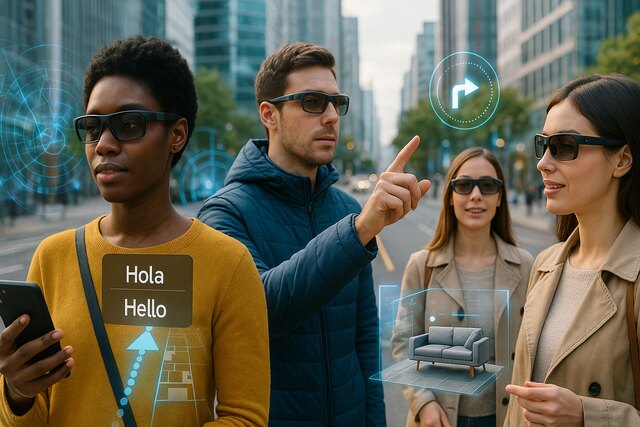
AI Glasses adoption will accelerate across verticals where real-time, context-aware, and non-intrusive computation offers competitive value. From healthcare to logistics, the utility of hands-free intelligence drives demand.
How Will AI Glasses Enhance Healthcare and Accessibility?
Healthcare professionals can use AI Glasses for real-time patient data retrieval, procedural guidance, and visual diagnostics. For visually impaired users, scene narration, object detection, and person recognition offer increased autonomy. Semantic edge-AI supports real-world audio-visual captioning and real-time sign-to-text translation.
What Enterprise Use Cases Benefit from Smart Wearables?
Enterprises in logistics, manufacturing, and construction are testing AI Glasses for task guidance, quality checks, and inventory management. Workers can receive step-by-step instructions overlaid on their field of view. Semantic object recognition minimizes manual input, reducing cognitive load and error rates.
How Will Travel and Navigation Be Transformed?
AI Glasses enable real-time wayfinding with semantic layers showing local tips, landmark history, and transit connections. Travelers can translate foreign signage, read restaurant reviews, and explore cities without relying on phone screens. Multilingual NLP ensures queries like “where to eat cheap sushi nearby” generate personalized semantic results.
What Will Shopping and E-Commerce Look Like in a Post-Screen World?
Retailers can offer augmented try-ons, contextual promotions, and product comparisons through semantic overlays. A user can glance at a sneaker, ask “Is this waterproof?” and receive brand-certified responses. Commerce shifts from web-based search to real-world scanning and immediate Q&A.
Conclusion
AI Glasses do not just replace screens they redefine the ontology of interaction. By combining voice, vision, and location with semantic parsing, these devices shift computing from reactive to anticipatory. The battleground has moved from who builds the best phone to who owns the best semantic layer.
