

Highlights
- Prompt engineering improves communication between users and AI systems like ChatGPT by making instructions clearer and more structured.
- Clear prompts increase output accuracy, relevance, and usefulness across writing, coding, and learning tasks.
- Effective prompts include four main parts: instruction, context, constraints, and output format.
- Small wording changes can significantly impact AI responses, making precision more important than length.
- Techniques like zero-shot, few-shot, and role-based prompting help control output quality.
- Iteration is essential because refining prompts leads to better and more consistent results over time.
- Avoiding vague and overly complex prompts improves efficiency and reduces frustration.
- Prompt engineering enhances productivity by saving time and delivering better results faster.
- Beginners can quickly improve by practicing, testing variations, and learning from outputs.
Prompt engineering for beginners means learning how to communicate clearly with AI systems so that the output matches your intention, expectations, and context. Prompt design directly influences accuracy, relevance, tone, and usefulness of generated responses. Strong prompts reduce ambiguity, improve efficiency, and help users unlock the full potential of tools like ChatGPT.
Understanding prompt engineering requires combining language clarity, structured thinking, and iterative refinement. Every prompt acts as an instruction set where wording, constraints, and context determine how the AI processes and generates output. Better prompts produce better answers.
Learning prompt engineering early gives users a competitive advantage in writing, coding, research, automation, and content creation. Beginners who master prompting techniques quickly move from random outputs to consistent, high-quality results.
What is Prompt Engineering and Why Does It Matter?
Prompt engineering refers to the process of designing structured inputs that guide AI systems toward desired outputs. Prompt structure includes instruction clarity, context inclusion, constraints, and expected format. Clear prompts reduce confusion and improve output precision.
Prompt engineering matters because AI models rely entirely on input text for understanding intent. Poor prompts lead to vague or incorrect responses, while refined prompts create accurate and actionable outputs. Better prompting improves productivity across multiple domains.
From my experience, early attempts with AI felt inconsistent because prompts lacked structure. After refining instructions and adding constraints, results became significantly more reliable. That shift made prompt engineering feel like a practical skill rather than guesswork.
How Does Prompt Engineering Affect Output Quality?
Prompt clarity directly impacts response accuracy because AI models interpret instructions based on wording. Specific prompts produce focused answers, while vague prompts generate broad or irrelevant responses. Adding examples, tone instructions, and constraints improves quality.
Why Should Beginners Learn Prompt Engineering Early?
Early learning reduces frustration and builds confidence when interacting with AI tools. Beginners who understand prompting avoid trial-and-error cycles and achieve better results faster. Strong prompting skills also transfer across multiple AI platforms.
How Do AI Models Interpret Prompts?

AI models interpret prompts using patterns learned from large datasets. Language structure, keywords, and context signals influence how the model predicts the next words. Every prompt acts as a probability guide for response generation.
AI systems prioritize clarity and structure. Instructions placed at the beginning often carry more weight, while ambiguous language creates multiple possible interpretations. Adding constraints narrows those possibilities and improves output consistency.
From my experience, changing a single word in a prompt can completely alter the response. That realization helped me focus on precision rather than length, which improved my results significantly.
Cwhat Role Does Context Play in Prompt Interpretation?
Context provides background information that helps AI understand intent. Without context, responses remain generic. Adding details such as audience, purpose, and format improves relevance and depth.
How Does Wording Influence Ai Understanding?
Wording determines how instructions are interpreted. Direct and specific language reduces ambiguity. Action-oriented phrases like “explain,” “compare,” or “list” guide the model toward structured outputs.
What Are the Core Elements of an Effective Prompt?
Effective prompts include instruction clarity, context, constraints, and output format. Each component plays a role in guiding the AI toward the desired response. Missing one element often leads to incomplete or inaccurate results.
Instruction clarity defines what needs to be done. Context explains why and for whom the output is required. Constraints limit the scope, while format ensures structured responses. Combining these elements creates strong prompts.
From my experience, adding output format instructions such as “write in bullet points” or “use simple language” immediately improves readability. Small adjustments create noticeable improvements.
What is Instruction Clarity in Prompts?
Instruction clarity means stating exactly what the AI should do. Clear instructions reduce confusion and eliminate unnecessary information. Direct commands produce better outcomes.
Why Are Constraints Important in Prompting?
Constraints define limits such as word count, tone, or style. Constraints help the AI stay focused and avoid irrelevant details. Structured limitations improve precision.
Prompt Components Overview
| Component | Description | Example |
| Instruction | Defines the task clearly | Write a blog introduction |
| Context | Provides background or purpose | For beginners learning AI |
| Constraints | Sets limits such as tone or length | Use simple language, under 200 words |
| Output Format | Specifies how the answer should appear | Bullet points |
How Can Beginners Start Writing Better Prompts?
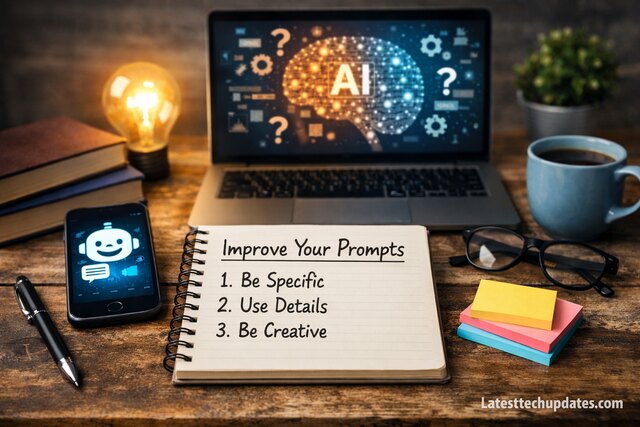
Beginners can start by focusing on simplicity, clarity, and structure. Short and direct prompts often work better than complex ones. Starting simple allows gradual improvement.
Adding examples helps guide the AI toward expected outputs. Example-based prompting improves accuracy by showing the desired format. Iteration plays a key role in refining prompts.
From my experience, rewriting the same prompt in different ways taught me how small changes affect results. Practice turned confusion into confidence over time.
What is the Role of Examples in Prompts?
Examples provide a reference for expected output. AI models learn patterns from examples and replicate similar structures. Including examples improves consistency.
How Does Iteration Improve Prompt Quality?
Iteration involves refining prompts based on previous outputs. Adjusting wording, adding constraints, and clarifying instructions leads to better results over time.
What Are Common Prompt Engineering Techniques?
Prompt engineering techniques include zero-shot prompting, few-shot prompting, and role-based prompting. Each technique serves different purposes depending on the task complexity.
Zero-shot prompting relies on direct instructions without examples. Few-shot prompting includes examples to guide responses. Role-based prompting assigns a specific role to the AI, such as “act as a teacher.”
From my experience, role-based prompts produce more natural and context-aware responses. Asking AI to act as an expert often improves depth and clarity.
What is Zero-shot Prompting?
Zero-shot prompting involves giving instructions without examples. AI generates responses based on learned patterns. Simple tasks work well with this approach.
What is Role-based Prompting?
Role-based prompting assigns a perspective or role to the AI. Examples include teacher, writer, or consultant. Role assignment improves tone and relevance.
Prompt Techniques Comparison
| Technique | Description | Best Use Case |
| Zero-shot | No examples provided | Simple tasks |
| Few-shot | Includes examples | Structured or complex outputs |
| Role-based | Assigns a role to AI | Context-rich responses |
What Mistakes Should Beginners Avoid in Prompt Engineering?
Common mistakes include vague instructions, lack of context, and overly complex prompts. These issues lead to unclear or inconsistent outputs. Avoiding these mistakes improves results.
Another mistake involves expecting perfect responses without refinement. Prompt engineering requires iteration and experimentation. Adjustments improve output quality.
From my experience, expecting instant perfection created frustration. Accepting prompt refinement as part of the process made learning easier and more effective.
Why Do Vague Prompts Fail?
Vague prompts lack direction, leading to generic responses. Clear instructions provide better guidance and improve output relevance.
How Does Overcomplication Affect Prompts?
Overcomplicated prompts confuse the AI and reduce clarity. Simple and structured prompts perform better in most cases.
How Can Prompt Engineering Be Used in Real-Life Tasks?
Prompt engineering applies to writing, coding, research, marketing, and learning. Each use case benefits from structured prompts that guide AI toward specific outputs.
Writers use prompts to generate ideas and drafts. Developers use prompts for code generation and debugging. Marketers use prompts for campaigns and content creation.
From my experience, prompt engineering significantly improved productivity. Tasks that once took hours became faster and more efficient with well-structured prompts.
How is Prompt Engineering Used in Content Creation?
Content creators use prompts to generate articles, outlines, and ideas. Structured prompts improve creativity and consistency in writing.
How Can Prompt Engineering Help in Learning?
Students use prompts to simplify complex topics and generate explanations. Structured prompts improve understanding and retention.
Conclusion
Prompt engineering for beginners represents a foundational skill for interacting with AI systems effectively. Clear instructions, structured context, and iterative refinement define successful prompts. Strong prompting improves accuracy, saves time, and enhances productivity across various tasks.
FAQ’s
What is prompt engineering in simple terms?
Prompt engineering involves designing clear instructions for AI to generate accurate and useful responses.
Do beginners need technical knowledge for prompt engineering?
Basic understanding of language and structure is enough to start. Practice improves skill over time.
How long does it take to learn prompt engineering?
Initial learning takes a few days, while mastery develops with continuous practice and experimentation.
Can prompt engineering improve productivity?
Effective prompts reduce time spent on tasks and improve output quality, increasing efficiency.
Is prompt engineering useful for non-technical users?
Prompt engineering benefits writers, students, marketers, and professionals without technical backgrounds.
