
Highlights
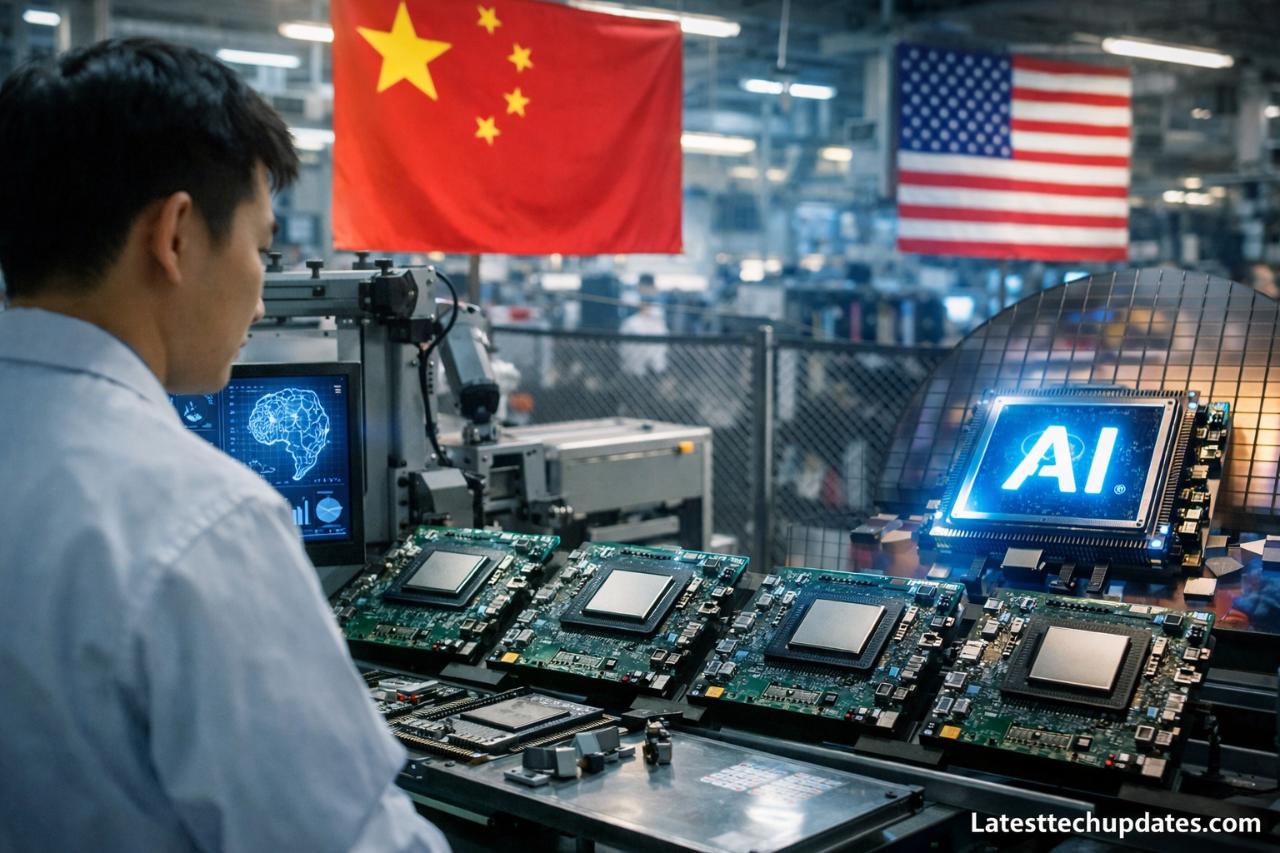
- Chinese AI developers admit they can’t match U.S. capabilities without access to advanced chips.
AI firms in China are voicing concerns over hardware bottlenecks that restrict model training and innovation.
- U.S. export controls block China’s access to top-tier AI chips like NVIDIA A100 and H100.
Regulations prohibit the sale of high-performance GPUs, limiting China’s AI model scalability.
- Domestic chip production in China remains stuck at 14nm–7nm nodes.
Foundries like SMIC lack the tools and talent for cutting-edge chip fabrication required for advanced AI models.
- Chinese tech giants shift focus to in-house chip design but struggle with fabrication.
Efforts by Huawei, Baidu, and Alibaba are ongoing but hampered by missing EDA software and lithography systems.
- Lack of advanced compute delays China’s development of foundational AI models.
China falls behind the U.S. in generative AI, NLP, and large-scale multimodal systems.
- China lacks access to EUV lithography tools and high-end EDA software.
Dependence on U.S. and Dutch technology remains a critical vulnerability for AI hardware.
- China explores AI collaborations with non-Western allies to bypass chip restrictions.
Strategic partnerships with Russia and Southeast Asian nations are underway, though limited in scope.
- China’s AI roadmap to 2030 now under threat due to compute capacity shortfalls.
The national vision to lead global AI innovation is jeopardized without sovereign chip solutions.
- Global AI ecosystem risks fragmenting into U.S.-led and China-led infrastructures.
The chip divide could drive technological and ethical divergence in AI research and deployment.
- U.S. chip advantage reinforces cybersecurity, defense AI, and global research dominance.
China’s hardware gap results in inferior inference speed and slower national AI readiness.
Why Are Chinese AI Developers Struggling to Compete with U.S. AI Advancement?
Chinese AI companies are facing structural limitations due to restricted access to advanced semiconductor chips, which are essential for high-performance AI model training and inference. U.S. export controls and domestic manufacturing gaps create a bottleneck for innovation in China’s AI sector.
How Do Semiconductor Chips Influence AI Capabilities?
Semiconductor chips, particularly GPUs and AI-specific accelerators, serve as computational backbones for training large language models (LLMs) and computer vision systems. Without access to high-throughput chips like NVIDIA’s A100 or H100, AI developers in China cannot match the training efficiency or inference scalability of U.S.-based AI firms. Processing speed, energy efficiency, and memory bandwidth all critical attributes for AI workloads depend on the latest chip architectures.
What U.S. Export Restrictions Are Affecting China’s Access to AI Chips?
U.S. export controls under the Bureau of Industry and Security (BIS) have banned the export of advanced chips and chipmaking tools to China. Regulations such as the CHIPS and Science Act of 2022 and additional restrictions in 2023 explicitly limit the transfer of GPUs optimized for AI workloads. Entities like NVIDIA and AMD are prohibited from supplying cutting-edge accelerators to Chinese firms. This constraint impedes China’s ability to source advanced AI hardware legally.
How Are Chinese Firms Responding to These Semiconductor Limitations?
Leading Chinese tech firms such as Baidu, Tencent, and Alibaba are redirecting resources toward domestic chip design efforts through subsidiaries like Huawei’s HiSilicon and Alibaba’s T-Head. However, domestic fabrication capacity remains insufficient for producing 5nm or 3nm chips, forcing reliance on older 14nm nodes. Model training efficiency deteriorates significantly with these lower-tier chips, requiring workarounds like model quantization and layer pruning to operate within performance ceilings.
What Are the Consequences for China’s AI Roadmap and Global Positioning?
The lack of cutting-edge chips forces Chinese AI labs to scale down model sizes or increase training time exponentially. As a result, China lags in releasing competitive frontier models in foundational AI categories such as generative text, multimodal AI, and autonomous reasoning. This technological gap widens the global AI divide, where U.S.-based entities such as OpenAI, Google DeepMind, and Anthropic continue to deploy larger and more capable models at a rapid pace. The imbalance also affects geopolitical AI influence, research citations, and talent migration.
What Structural Challenges Prevent China from Achieving Chip Self-Sufficiency?
China’s domestic semiconductor supply chain remains incomplete across fabrication, lithography, EDA software, and raw material purification.
Why Is Lithography a Critical Bottleneck?
Extreme ultraviolet (EUV) lithography machines, produced almost exclusively by Dutch firm ASML, are essential for manufacturing chips under the 7nm threshold. China cannot domestically replicate EUV systems with precision optics and light sources required for next-gen chip etching. Without EUV access, even the most advanced designs by SMIC (Semiconductor Manufacturing International Corporation) remain limited to 14nm-7nm nodes, which severely undercut AI compute efficiency.
How Does EDA Software Affect China’s Chip Development?
Electronic Design Automation (EDA) software ecosystems, dominated by U.S.-based companies like Synopsys and Cadence, are essential for designing complex chip architectures. These tools assist in logic simulation, physical verification, and timing analysis. Export bans on EDA tools especially those optimized for 3nm design flows prevent Chinese engineers from achieving design closure on par with Western firms, resulting in flawed or delayed chip rollouts.
Which Materials and Tools Are Still Imported?
China remains dependent on high-purity photoresists, etching gases like fluorine and argon, and advanced wafer inspection systems from Japan, South Korea, and the U.S. These materials and tools are subject to multilateral export restrictions coordinated through the Wassenaar Arrangement. Even minor disruptions in any of these components introduce fabrication delays and yield uncertainty.
What Role Do Foundries and Talent Shortages Play?
China’s leading foundries, such as SMIC and Hua Hong, struggle with yield rates and equipment calibration, which directly impacts chip quality. Furthermore, high-end semiconductor R&D talent trained in U.S., Taiwanese, or South Korean institutions is in short supply domestically. Talent shortages in lithography optics, process integration, and cleanroom engineering compound the difficulty of scaling chip production.
Can China’s Strategic AI Goals Be Achieved Without Advanced Chips?

China’s long-term AI ambition, outlined in the “Next Generation Artificial Intelligence Development Plan,” is incompatible with a constrained semiconductor base.
What Are the National AI Goals Stated by China?
The Chinese government aims to become the world’s primary AI innovation center by 2030, focusing on areas like intelligent robotics, NLP, computer vision, and brain-inspired computing. Achieving this vision necessitates unfettered access to compute infrastructure for both academic and industrial labs.
Are Alternative Compute Strategies Viable?
Chinese researchers are experimenting with architectural alternatives such as analog AI chips, neuromorphic processors, and distributed compute over national AI clouds. However, these systems remain in experimental stages and do not yet offer reliable or scalable solutions compared to industry-standard NVIDIA GPU clusters.
How Are Policy and Investment Structures Adjusting?
Massive government-led investments are being funneled into the National Integrated Circuit Industry Investment Fund and various semiconductor research parks. Nonetheless, bureaucratic inefficiencies, duplicated efforts, and lack of cross-institutional coordination reduce the effectiveness of these investments. Centralized funding often misses the agile R&D cycles needed for rapid iteration in AI chip design.
Does Collaboration With Non-U.S. Entities Offer Relief?
China is exploring collaboration with Russia, Iran, and several Southeast Asian countries for chip design and AI compute sharing. However, such partnerships often come with geopolitical risk and are unable to fill the technological gap left by Western firms. Moreover, secondary sanctions and surveillance further limit the scalability of such collaborations.
What Is the Global Impact of the Chip-AI Divide Between the U.S. and China?
The AI chip divide between China and the U.S. reinforces digital nationalism and accelerates tech bifurcation on a global scale.
How Does It Influence Global AI Research Distribution?
With U.S. firms monopolizing large-scale model research, global benchmarks such as MLPerf and papers at NeurIPS and ICML are increasingly U.S.-centric. Chinese researchers face challenges replicating experiments, participating in collaborative datasets, or validating SOTA (state-of-the-art) claims due to hardware constraints.
What Are the Cybersecurity and National Security Implications?
The imbalance in compute power amplifies cybersecurity disparities. AI-enabled cyber defense systems built by U.S. entities far outpace China’s current capability. In military AI and surveillance systems, lack of advanced chips directly reduces inference speed and prediction accuracy, affecting national defense efficacy.
How Are Other Nations Responding to the Divide?
Countries like India, Israel, and the EU are reassessing their chip sovereignty strategies to avoid reliance on either superpower. Initiatives such as the European Chips Act and India’s semiconductor mission aim to localize compute power, with a focus on trustworthy and ethical AI deployment.
Will the Divide Lead to Long-Term AI Fragmentation?
Global AI frameworks may splinter into Western-aligned and China-aligned ecosystems, each with distinct hardware standards, API protocols, and governance models. This division risks undermining interoperability, open-source collaboration, and shared ethical frameworks in AI development.
