
Highlights
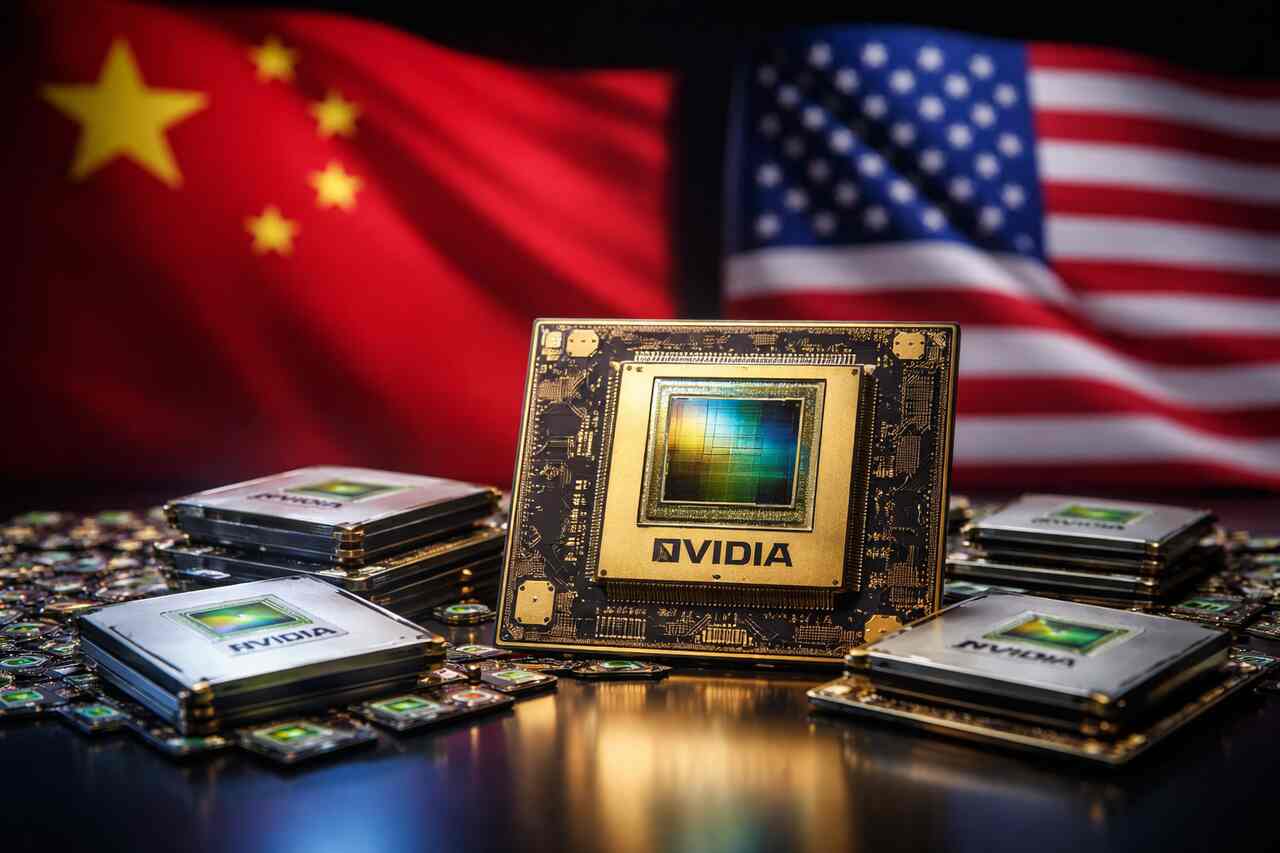
- US Commerce Department begins a fresh review of Nvidia’s AI chip exports to China, targeting the powerful H20 and other Blackwell-based chips.
- Concern: AI chips like H100 and H20 could enhance Chinese military capabilities, prompting renewed scrutiny on advanced semiconductor flows.
- Potential Outcome: New licensing requirements or stricter export controls may be implemented after the regulatory assessment.
- Nvidia’s H20 chip, designed to comply with previous US export curbs, now under evaluation for its actual compliance and capabilities.
- Geopolitical Backdrop: Rising tension in US-China tech race is driving tighter regulations on AI, semiconductors, and supercomputing exports.
- Micro-Storyline: As AI becomes the next frontier of strategic power, the US tightens its grip on Nvidia’s AI chips aiming to outpace China not just in silicon, but in sovereignty.
Why is the US Reviewing Nvidia’s AI Chip Sales to China?
The United States government has launched a targeted regulatory review of Nvidia’s AI chip exports to China due to growing national security concerns. The review, initiated by the US Commerce Department, specifically focuses on Nvidia’s high-performance chips such as the H20 and other Blackwell-based semiconductors, which are designed to meet escalating AI compute demands.
US regulators are assessing whether these chips, despite being tailored to comply with existing export restrictions, might still deliver advanced capabilities that could support China’s military modernization or surveillance infrastructure. The regulatory move aligns with Washington’s broader strategy to maintain a technological edge in AI, quantum computing, and semiconductor design.
What is the Strategic Importance of Nvidia’s H20 and H100 Chips?

Nvidia’s H20 chip, part of the Hopper GPU architecture, represents a critical component in large-scale AI training systems and supercomputers. The chip was engineered to adhere to prior export limits by reducing memory bandwidth and interconnect speed to stay below the Threshold Aggregate Performance Density (TAPD) enforced by the US government.
However, authorities now question whether the H20’s architectural adaptations still provide compute advantages that surpass regulatory intentions, especially when aggregated in parallel GPU clusters. Nvidia’s H100, while already banned from export, shares design lineage and operational paradigms with H20, prompting further investigation.
How Could National Security Be Affected by AI Chip Exports?
Advanced AI chips serve as foundational infrastructure for neural network training, simulation for autonomous weapons, and predictive analytics in cyber warfare. Washington fears that unrestricted access to chips like H20 could enable China to accelerate its development of:
- Military-grade AI systems
- Mass surveillance platforms using facial recognition and biometric analytics
- Next-gen drones and missile guidance systems
- Quantum-resistant cryptographic algorithms
The convergence of AI chip performance and state-sponsored development in China raises alarms over potential dual-use scenarios where civilian AI applications mask military objectives.
What Policy Outcomes Might Result from the Review?
Following the assessment, the US may impose new licensing requirements, amend Export Administration Regulations (EAR), or initiate a broader Entity List expansion. These actions would limit not only Nvidia’s direct sales but also indirect access through third-party distributors or cloud providers.
The review could influence how other AI hardware vendors such as AMD, Intel, and Google Cloud operate in China. Additionally, semiconductor supply chain policies may shift toward “de-risking” strategies, emphasizing trusted manufacturing in Taiwan, South Korea, and the US domestic fabs
How Does This Fit into the Larger US-China Tech Conflict?
The review is part of a broader geopolitical strategy known as “tech containment,” where the US leverages export control, supply chain restrictions, and investment screening to throttle China’s access to frontier technologies. Previous steps include:
- Placing Huawei and other AI firms on the Entity List
- Restricting exports of extreme ultraviolet (EUV) lithography tools
- Prohibiting outbound investments in sensitive Chinese sectors
By curbing Nvidia’s chip flows, the US aims to safeguard intellectual property, strategic sovereignty, and military asymmetry in the age of artificial intelligence. The effort underscores a shift from free-market technology policy to security-first industrial governance.
