
Highlights
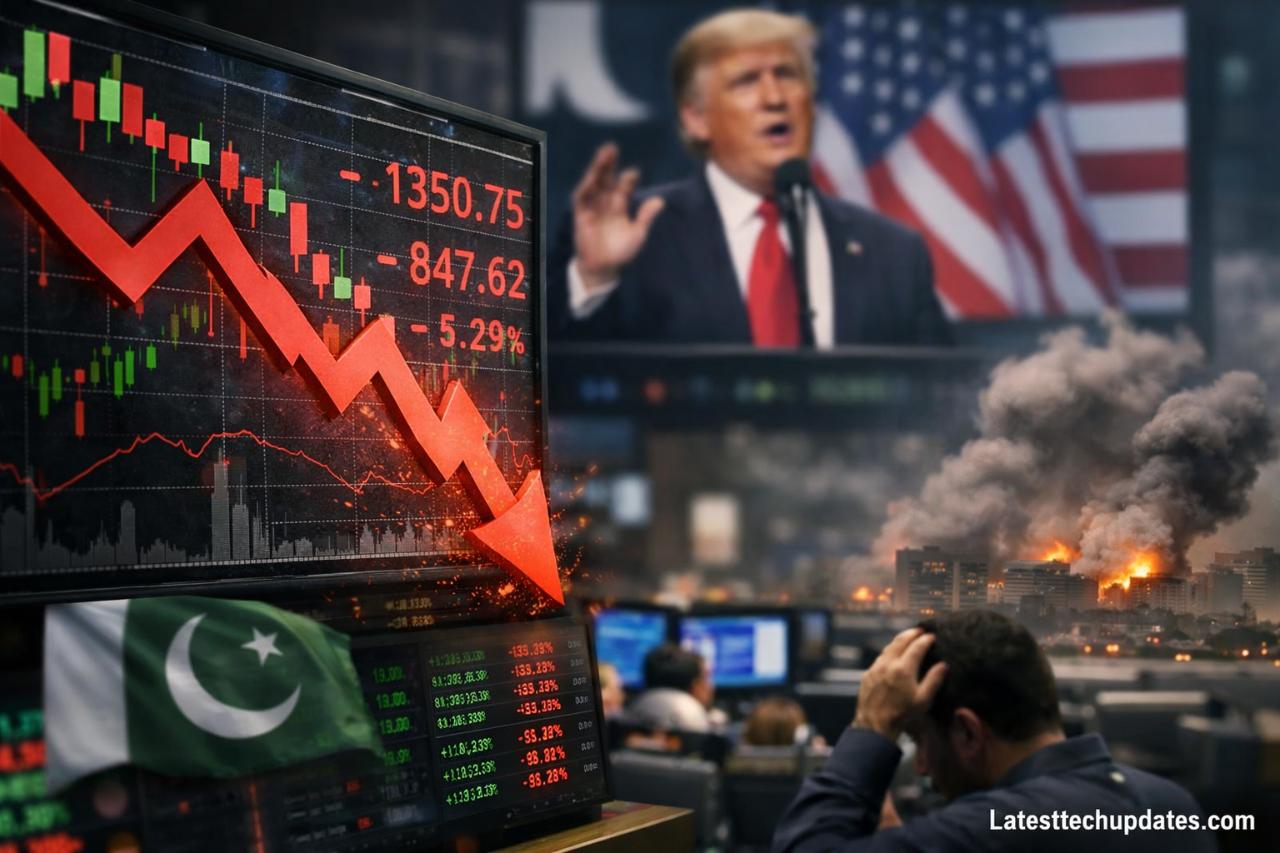
- The Pakistan Stock Exchange recorded a massive drop of 3,500 points, reflecting a sudden shift in investor sentiment from optimism to fear.
- Investor confidence weakened immediately after statements from Donald Trump indicated no quick resolution to ongoing geopolitical tensions.
- Market participants interpreted the speech as a signal of prolonged global conflict, increasing uncertainty across financial markets.
- Foreign investors accelerated sell-offs in emerging markets like Pakistan, as geopolitical instability raised risk perception.
- Banking, energy, and cement sectors led the decline due to their sensitivity to economic and geopolitical uncertainty.
- Global conflict involving Ukraine and Russia remained a key factor shaping investor expectations and risk calculations.
- Algorithmic trading systems intensified the fall by executing rapid sell orders based on negative sentiment analysis of the speech.
- Currency pressure and inflation fears added to bearish sentiment, reducing expectations of corporate profitability.
- Short-term panic selling dominated trading activity, while long-term investors adopted a cautious wait-and-see approach.
- Analysts suggest that recovery in PSX depends on clear geopolitical de-escalation signals and improved global stability.
Why Did Pakistan Stock Exchange (PSX) Drop 3,500 Points After Trump’s Speech?
The sharp decline in Pakistan Stock Exchange reflects immediate investor reaction to geopolitical uncertainty triggered by remarks from Donald Trump. Trump’s speech introduced ambiguity regarding the timeline of war resolution, which directly influenced market sentiment. Market sentiment drives equity valuation because investor expectations determine liquidity flows.
Investor expectations shifted from optimism to risk aversion as Trump avoided signaling a quick diplomatic resolution. Risk aversion increases sell-side pressure because institutional investors prioritize capital preservation during uncertainty. Capital preservation strategies often include portfolio rebalancing toward safe-haven assets such as gold and US Treasury bonds, reducing equity exposure in emerging markets like Pakistan.
Emerging market dependency on global stability amplifies volatility because foreign inflows dominate marginal liquidity. Foreign investors interpret geopolitical escalation as a signal to exit high-risk regions. High-risk perception directly reduces demand for equities listed on PSX, causing index-wide declines across sectors including banking, energy, and cement.
Algorithmic trading systems further accelerated the downturn because automated sell triggers respond to global news sentiment. Sentiment analysis tools classified Trump’s speech as negative for conflict resolution. Negative classification increases sell orders in milliseconds, amplifying the index drop beyond fundamental valuation changes.
How Did Global Geopolitics Influence PSX Market Behavior?
Global geopolitical tension acts as a macroeconomic variable influencing capital markets through uncertainty channels. Uncertainty affects discount rates because investors demand higher returns for perceived risk. Higher discount rates reduce present value of future earnings, leading to lower stock prices.
The ongoing conflict linked with Ukraine and Russia remains a key driver of global risk perception. Conflict persistence disrupts commodity markets, especially oil and gas, which impacts import-dependent economies like Pakistan. Energy price volatility increases inflation expectations, reducing corporate profitability projections.
US political signaling influences global financial markets because the United States controls monetary and strategic policy frameworks. Statements from influential figures such as Donald Trump reshape expectations about diplomatic engagement. Diplomatic uncertainty reduces investor confidence in near-term stabilization, leading to synchronized sell-offs across emerging markets.
Currency depreciation risk also rises during geopolitical stress because capital outflows weaken local currencies. Weak currency increases import costs, further stressing corporate margins. Margin pressure translates into lower earnings forecasts, which negatively affects equity valuations on PSX.
Cross-market correlation increases during crises, meaning PSX movements align with global indices such as S&P 500 and MSCI Emerging Markets Index. Correlation reduces diversification benefits, prompting investors to reduce exposure broadly rather than selectively.
Which Sectors Were Most Affected by the PSX Decline?
Banking sector stocks experienced significant losses because financial institutions remain highly sensitive to interest rate expectations and economic stability. Economic instability increases non-performing loan risk, which reduces bank profitability. Lower profitability expectations lead to aggressive selling of banking shares.
Energy sector companies declined due to global oil price uncertainty and demand fluctuations. Oil price instability affects exploration and production revenues. Revenue uncertainty reduces investor confidence in future cash flows, triggering sell-offs in energy equities.
Cement and construction sectors faced pressure because infrastructure investment depends on economic confidence. Economic confidence declines during geopolitical instability, reducing development activity projections. Lower demand expectations result in declining stock valuations for construction-linked firms.
Technology and export-oriented sectors showed relatively smaller declines because revenue streams depend on foreign markets. However, global slowdown fears still impacted growth expectations. Growth-sensitive stocks remain vulnerable when macroeconomic uncertainty rises.
Consumer goods sector experienced mixed performance because domestic demand remains relatively stable but inflation risk reduces purchasing power. Reduced purchasing power affects sales volume projections, influencing stock prices negatively.
What Does Trump’s Statement Signal for Future Market Trends?
Trump’s cautious tone signals prolonged geopolitical tension, which implies continued market volatility. Volatility increases trading risk because price swings become unpredictable. Investors respond by reducing exposure or shifting toward defensive assets.
Policy uncertainty in the United States affects global monetary expectations because fiscal and defense strategies influence inflation and interest rates. Interest rate expectations shape global liquidity conditions, which directly impact emerging markets like Pakistan.
Long-term investor behavior may shift toward diversification strategies including commodities, stable currencies, and developed markets. Diversification reduces portfolio risk exposure to single-region instability. Reduced inflows into PSX could persist if geopolitical risks remain unresolved.
Short-term market rebounds remain possible due to technical corrections and bargain hunting. Bargain hunting occurs when investors perceive undervalued stocks after sharp declines. However, sustained recovery requires clear geopolitical de-escalation signals.
Institutional investors will monitor diplomatic developments closely because resolution timelines determine risk premium adjustments. Risk premium reduction leads to capital inflows, stabilizing markets. Stability in global narratives will be the key catalyst for PSX recovery.
What Should Investors Understand About Market Volatility in This Context?
Market volatility during geopolitical crises reflects structural sensitivity rather than isolated events. Structural sensitivity arises from reliance on external capital, energy imports, and global economic alignment. Understanding structural factors helps investors make informed decisions rather than reactive trades.
Risk management becomes essential because sudden market swings can erode portfolio value quickly. Diversification, asset allocation, and hedging strategies mitigate downside risk. Strategic planning outperforms emotional decision-making during uncertain periods.
Information flow speed has transformed modern markets because news impacts prices instantly. Digital trading ecosystems amplify reactions, making markets more responsive but also more volatile. Investors must interpret news context rather than reacting to headlines alone.
Long-term fundamentals of PSX remain tied to economic reforms, fiscal discipline, and political stability within Pakistan. Domestic stability can offset external shocks over time. Sustained policy consistency will determine whether PSX recovers resilience against global disruptions.
