
What Defines NVIDIA Nemotron 3 Nano Omni in Multimodal AI Evolution?
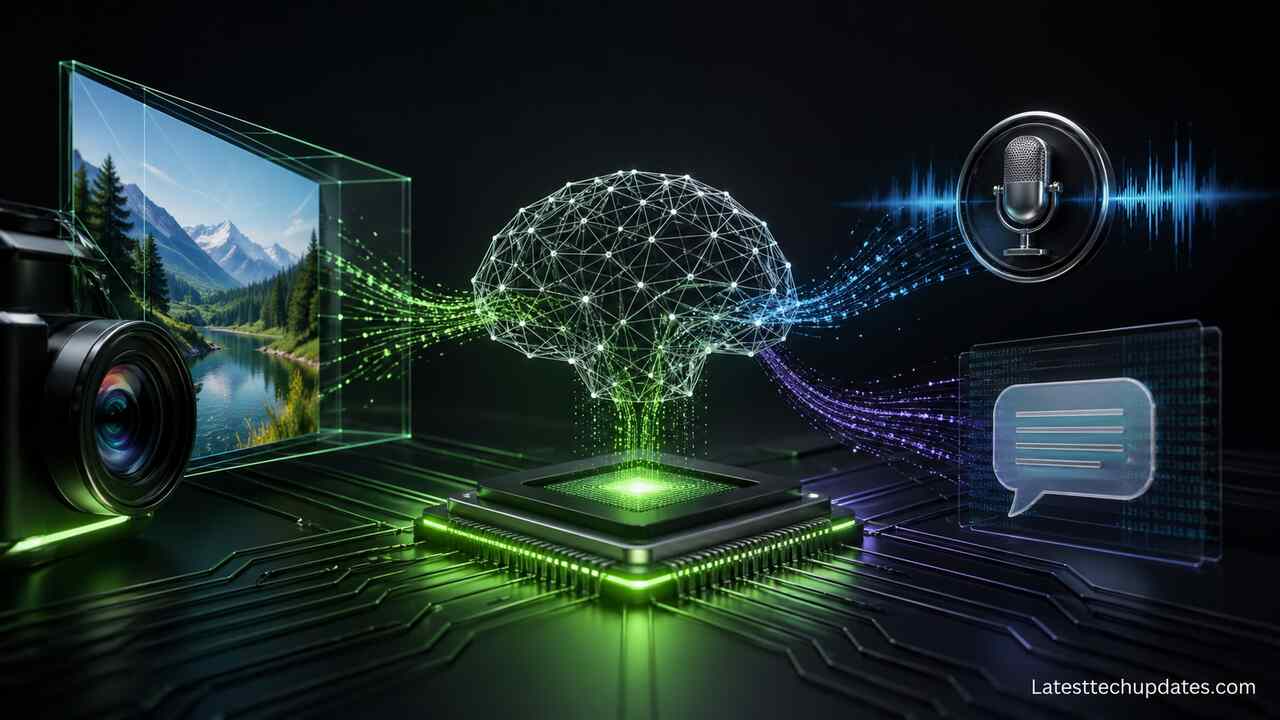
NVIDIA introduces Nemotron 3 Nano Omni as a unified multimodal architecture that integrates vision processing, audio interpretation, and natural language understanding into a single optimized system. The architecture reduces computational fragmentation while increasing inference efficiency, making AI agents significantly faster and more resource-aware. Multimodal convergence enhances contextual reasoning by linking visual semantics with auditory signals and linguistic structures.
How Does Multimodal Integration Improve Semantic Understanding?
Multimodal integration aligns visual tokens, audio embeddings, and textual vectors into a shared latent space where semantic relationships become more coherent. The shared representation enables AI agents to interpret context holistically, allowing an image, spoken instruction, and textual query to reinforce each other. Cross-modal attention mechanisms ensure that relevant features from each modality influence decision-making processes without redundancy.
Why Does Model Unification Reduce Computational Overhead?
Unified architectures eliminate the need for separate pipelines for image recognition, speech processing, and language modeling. A single model reduces memory duplication and minimizes latency caused by inter-model communication. Parameter sharing across modalities ensures efficient utilization of GPU resources, which enhances scalability across edge devices and cloud infrastructure.
How Does Nemotron 3 Nano Omni Enhance Contextual Reasoning?
Contextual reasoning improves through synchronized modality alignment, where temporal audio cues and spatial visual patterns combine with linguistic context. The model identifies intent more accurately by correlating tone, imagery, and syntax. Context retention improves conversational AI systems, enabling continuity across interactions without repeated recalibration.
What Role Does Latent Space Optimization Play in Performance?
Latent space optimization compresses multimodal information into high-density embeddings that retain semantic richness. Efficient encoding reduces token redundancy while preserving relationships between entities and attributes. High-density representations improve downstream tasks such as summarization, classification, and multimodal generation.
How Does Nemotron 3 Nano Omni Achieve 9x Efficiency Gains?
Efficiency gains emerge from architectural compression, optimized inference pipelines, and hardware-software co-design within NVIDIA ecosystems. The model leverages parallel computation and reduced parameter footprints to outperform traditional multimodal systems.
What Is the Impact of Parameter Optimization on Efficiency?
Parameter optimization reduces model size while maintaining performance benchmarks. Techniques such as pruning, quantization, and knowledge distillation remove redundant weights and compress neural layers. Smaller parameter sets lead to faster inference and lower energy consumption, which directly contributes to efficiency improvements.
How Does Hardware Acceleration Enhance Performance?
Hardware acceleration through NVIDIA GPUs ensures that tensor operations execute with minimal latency. CUDA cores and tensor cores process multimodal data streams simultaneously, reducing bottlenecks. Hardware-software synergy ensures that model architecture aligns with GPU capabilities, maximizing throughput.
Why Does Reduced Latency Matter for AI Agents?
Reduced latency enables real-time decision-making in applications such as autonomous systems, conversational assistants, and surveillance analytics. Faster response times improve user experience and operational efficiency. Low latency also supports edge deployment where computational resources are limited.
How Does Memory Efficiency Influence Scalability?
Memory efficiency allows deployment across diverse environments, from cloud data centers to edge devices. Efficient memory allocation reduces the need for high-end infrastructure, enabling broader adoption. Scalable deployment ensures that enterprises can integrate AI agents without excessive cost.
What Are the Core Applications of Nemotron 3 Nano Omni?
The model supports diverse applications by combining multimodal intelligence with efficient computation. Industries benefit from enhanced automation, improved analytics, and more intuitive human-machine interaction.
How Does the Model Transform Conversational AI Systems?
Conversational AI systems gain multimodal awareness, allowing chatbots and assistants to interpret voice tone, facial expressions, and textual input simultaneously. Enhanced understanding leads to more accurate responses and improved user engagement. Context-aware dialogue systems reduce misunderstandings and increase reliability.
What Role Does Nemotron Play in Autonomous Systems?
Autonomous systems utilize multimodal inputs such as camera feeds, sensor audio, and command instructions. The model integrates these inputs to improve navigation, object detection, and decision-making. Real-time processing ensures safety and operational efficiency in dynamic environments.
How Can Enterprises Leverage Multimodal AI Agents?
Enterprises deploy AI agents for customer service, data analysis, and workflow automation. Multimodal capabilities enable agents to process documents, images, and voice interactions simultaneously. Improved efficiency reduces operational costs while increasing productivity.
How Does the Model Support Content Creation and Media Analysis?
Content creation benefits from AI systems that understand visual aesthetics, audio patterns, and narrative structures. The model generates multimedia content, analyzes trends, and enhances creative workflows. Media analysis becomes more precise through integrated semantic interpretation.
Why Does Nemotron 3 Nano Omni Represent a Shift in AI Architecture?
The model represents a paradigm shift by prioritizing efficiency, integration, and scalability within a single framework. Traditional AI systems rely on modular architectures, whereas Nemotron emphasizes unified intelligence.
How Does Unified Intelligence Redefine AI Development?
Unified intelligence simplifies development pipelines by reducing dependency on multiple specialized models. Developers focus on a single architecture that handles diverse tasks. Simplification accelerates innovation and reduces maintenance complexity.
What Are the Implications for Edge AI Deployment?
Edge AI deployment becomes feasible due to reduced computational requirements and optimized performance. Devices such as smartphones, IoT sensors, and embedded systems can run advanced AI models locally. Local processing enhances privacy and reduces reliance on cloud connectivity.
How Does Semantic Alignment Improve AI Reliability?
Semantic alignment ensures that outputs remain consistent across modalities. Alignment reduces ambiguity and improves interpretability. Reliable outputs enhance trust in AI systems across critical applications such as healthcare and finance.
What Future Trends Does Nemotron Enable in AI Ecosystems?
Future trends include widespread adoption of multimodal agents, increased focus on efficiency, and deeper integration of AI into everyday devices. The model sets a benchmark for balancing performance with resource optimization, influencing next-generation AI research and development.
Conclusion
Nemotron 3 Nano Omni shapes the future by combining multimodal intelligence with unprecedented efficiency. Integration across vision, audio, and language enables AI agents to operate with enhanced contextual awareness and reduced computational cost. The innovation from NVIDIA establishes a new standard for scalable, efficient, and intelligent AI systems, driving the evolution of next-generation digital ecosystems.
