
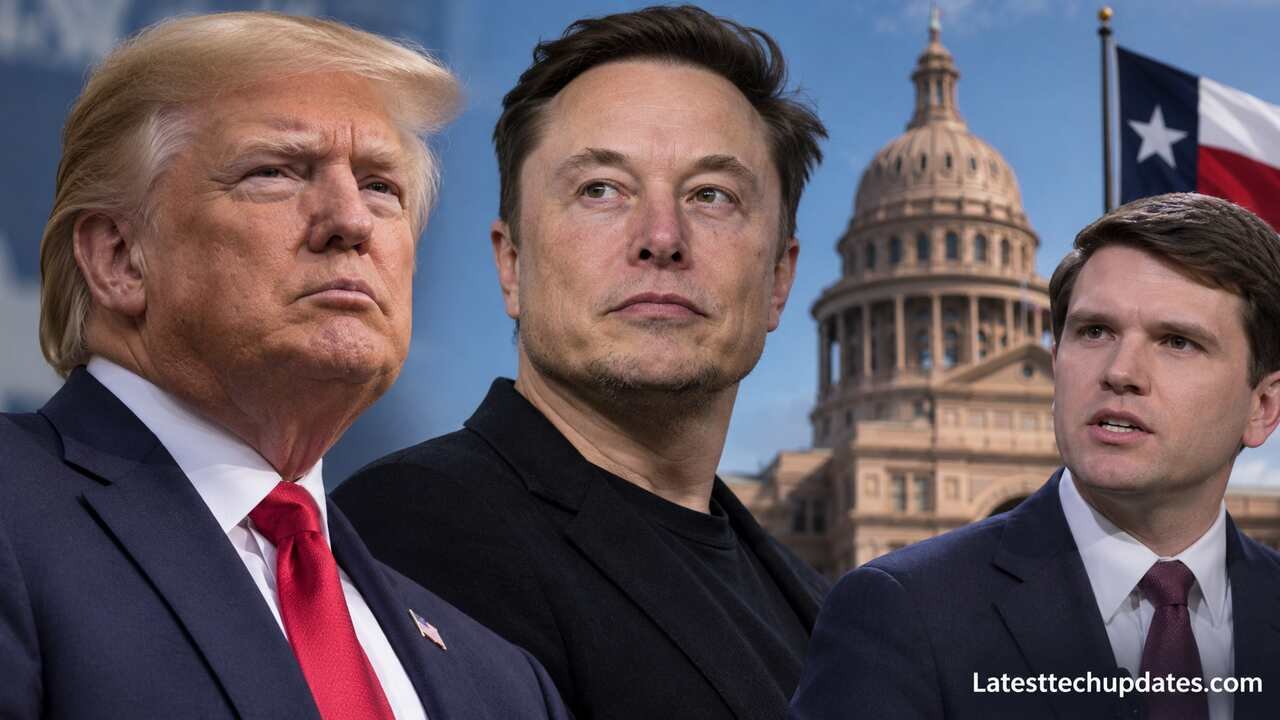
President Donald Trump’s involvement in the 2026 Texas Senate election has brought renewed national attention to the Republican Party’s decades-long dominance in the state. Billionaire entrepreneur Elon Musk has also become a major financial force in the contest, contributing $158 million to a Republican-aligned political organization supporting efforts to elect Ken Paxton and defeat Democratic candidate James Talarico.
Why Is Donald Trump Campaigning in Texas to Protect Republican Control?
Donald Trump is campaigning in Texas to support Republican Senate nominee Ken Paxton against Democratic challenger James Talarico. The president’s involvement highlights the importance of maintaining Republican representation in the U.S. Senate and preserving the party’s longstanding electoral record in Texas.
1. Texas Republican Dominance and the 32-Year Winning Streak
Texas Republicans have controlled statewide elected offices since the 1994 election cycle, establishing a political record spanning more than three decades. Republican victories have depended on support from conservative voters, rural counties, suburban communities, and established political organizations operating throughout the state.
The Republican winning streak represents a significant feature of modern Texas political history. Democratic candidates have repeatedly attempted to challenge the state’s conservative electoral structure through voter registration campaigns, fundraising initiatives, and outreach to changing demographic groups.
The Senate contest carries an additional historical distinction. Texas voters have not elected a Democratic U.S. senator since Lloyd Bentsen secured reelection in 1988. The 2026 election therefore connects two separate political records: Republican dominance in statewide offices and the longer absence of Democratic Senate victories.
2. Donald Trump’s Campaign Appearance in Lubbock
Donald Trump visited Lubbock, Texas, on October 27 to campaign for Ken Paxton and reinforce Republican participation ahead of the November 3 midterm election. The appearance placed national attention on the state’s Senate race during the final phase of campaign activity.
Trump’s political message emphasized conservative governance, immigration enforcement, border security, and opposition to Democratic policy proposals. Republican campaign messaging also portrayed James Talarico as too progressive for the state’s political traditions.
The president’s appearance connected the Texas contest with broader Republican priorities in Washington. Senate representation affects federal legislation, judicial appointments, executive nominations, and congressional oversight, making individual Senate elections relevant to national political power.
3. Ken Paxton’s Role in the Republican Senate Campaign
Ken Paxton, Texas’s attorney general, is the Republican nominee seeking the state’s U.S. Senate seat. Paxton has developed a political identity through conservative legal challenges, support for Trump, and opposition to Democratic policies on immigration and federal regulation.
Paxton’s political record includes several major legal and ethical controversies. The Texas Senate acquitted him during a 2023 impeachment trial, while a securities fraud case was dismissed in 2025 after completion of a pretrial diversion agreement.
The Republican candidate has emphasized his conservative credentials and alignment with Trump’s political agenda. Democratic opponents have focused on Paxton’s legal controversies and public record, creating competing interpretations of his qualifications and approach to government.
4. James Talarico’s Challenge to Republican Control
James Talarico, a Democratic state representative from the Austin area, is challenging Republican control through a campaign centered on economic affordability, public education, healthcare, and government accountability.
Talarico has criticized the political influence of wealthy donors and large corporations, arguing that financial power can affect government priorities and public policy decisions. His campaign has connected those concerns with household expenses and the economic pressures experienced by Texas residents.
The Democratic candidate has also emphasized his Christian faith and background in public education. Religious values, educational experience, and economic policy have become important components of his public messaging, offering voters an alternative to the Republican platform.
5. National Importance of the Texas Senate Election
The Texas Senate election has national significance because the Republican Party is defending its majority in the U.S. Senate. Senate control influences federal legislation, presidential appointments, judicial confirmations, and congressional investigations.
Texas also represents a major political fundraising and advertising market. Campaign organizations must reach voters across large metropolitan regions, smaller cities, suburban communities, and rural counties.
The scale of the electorate creates substantial communication costs for candidates and outside political organizations. National party committees, wealthy donors, and independent expenditure groups have consequently devoted significant resources to the contest.
How Is Elon Musk’s $158 Million Supporting Ken Paxton?
Elon Musk contributed $158 million to the Senate Leadership Fund in September 2026, providing substantial financial support to a Republican-aligned super PAC. The organization subsequently transferred equivalent amounts to Texas PAC, a political committee supporting Ken Paxton’s Senate campaign.
1. Elon Musk’s $158 Million Political Contributions
Elon Musk made two major September contributions to the Senate Leadership Fund. The first contribution totaled $75 million on September 9, followed by an additional $83 million on September 23.
The combined contributions reached $158 million, representing a significant financial commitment to Republican Senate election activities. Musk’s involvement attracted national attention because the contributions arrived during a highly competitive campaign period.
The financial support demonstrates how wealthy political donors can provide substantial resources to independent political organizations. Federal campaign finance rules allow super PACs to accept unlimited contributions, subject to disclosure requirements and restrictions on coordination with candidate campaigns.
2. Senate Leadership Fund and Republican Campaign Financing
The Senate Leadership Fund is a Republican-aligned super PAC that supports Senate candidates through independent political expenditures. The organization raises funds from individuals and other legally permitted contributors to finance advertising and election-related communications.
Musk’s contributions expanded the organization’s available financial resources during the final weeks of the Texas Senate campaign. The Senate Leadership Fund subsequently transferred substantial funding to Texas PAC, which supports Paxton’s election effort.
The relationship between these organizations illustrates the structure of modern federal campaign financing. Super PACs operate separately from authorized candidate committees and must follow federal restrictions governing coordination with political campaigns.
3. Texas PAC and Political Advertising Expenditures
Texas PAC received $158 million in transfers from the Senate Leadership Fund following Musk’s contributions. The political committee has supported advertising efforts favoring Paxton and criticizing Talarico.
Political advertising allows organizations to communicate campaign messages through television, digital platforms, and other media channels. Texas contains several large advertising markets, making statewide communication a substantial financial undertaking.
Advertising expenditures can increase public exposure to candidates, policy disagreements, and campaign allegations. Spending totals, however, do not establish voter agreement or determine election results. Electoral outcomes depend on the ballots cast and counted under applicable election procedures.
4. America PAC and Musk’s Additional Political Activities
America PAC, another political organization associated with Musk, also participated in the Texas Senate contest during 2026. The organization reportedly spent approximately $250,000 earlier in the campaign to support Paxton and oppose Talarico.
The spending included campaign materials and other political communications. America PAC’s involvement represented a separate financial activity from Musk’s contributions to the Senate Leadership Fund.
The distinction matters because federal campaign finance reporting separates donor contributions, political committee transfers, and independent expenditures. Each category identifies a different financial relationship between contributors, political organizations, and electoral campaigns.
5. Talarico’s Response to Billionaire Political Spending
James Talarico has criticized Musk’s financial involvement in the Texas Senate race, arguing that concentrated political spending can give wealthy individuals disproportionate influence over public policy.
During an October campaign appearance in El Paso, Talarico accused Musk of attempting to purchase political influence through support for Paxton. The allegation represents the Democratic candidate’s political criticism rather than an established legal finding of improper conduct.
Federal campaign finance disclosures establish the existence and size of reported contributions. Financial contributions alone, however, do not establish unlawful coordination or demonstrate that a donor controls the decisions of an elected official.
Why Does the Texas Senate Race Matter for the 2026 Midterm Elections?
The Texas Senate race matters because the contest combines longstanding Republican electoral dominance, substantial outside campaign financing, and competing policy proposals from Ken Paxton and James Talarico.
1. Republican and Democratic Policy Differences
Republican campaign messaging emphasizes immigration enforcement, border security, conservative judicial policies, and reduced federal regulation. Paxton has connected his campaign priorities with Trump’s broader political agenda.
Democratic messaging emphasizes healthcare affordability, public education, household expenses, and government accountability. Talarico has argued that political leaders should prioritize economic pressures affecting working families.
The competing platforms present different approaches to federal policy and public spending. Voters can examine the candidates’ legislative records, policy proposals, and public statements when evaluating those differences.
2. Urban, Suburban, and Rural Voting Patterns
Texas contains several major metropolitan areas, including Houston, Dallas–Fort Worth, Austin, and San Antonio. Those population centers contain diverse communities with differing economic circumstances, political priorities, and voting histories.
Suburban counties represent another important part of the statewide electorate. Population growth, housing development, education, and transportation concerns contribute to political discussions across those communities.
Rural counties and smaller cities also influence statewide election totals. Campaign organizations must therefore communicate with geographically dispersed voters whose priorities may differ according to local economic conditions and public services.
3. Economic Affordability as a Campaign Issue
Economic affordability has become a central subject in the contest between Paxton and Talarico. Housing expenses, grocery prices, healthcare bills, and transportation costs affect household budgets throughout Texas.
Talarico has linked economic concerns with corporate power and wealthy political donors. His campaign argues that government priorities should focus on household financial security and access to essential services.
Republican campaign messaging emphasizes economic growth, regulatory policy, and conservative fiscal priorities. The different approaches reflect broader disagreements about government intervention, business regulation, and the policies most relevant to household finances.
4. Campaign Advertising and Voter Information
Political advertising has become a defining feature of the 2026 Texas Senate race. Reported advertising expenditures associated with the contest exceeded $563 million by October 27.
The spending includes communications from candidate campaigns, party organizations, and independent political committees. Television advertisements, online videos, digital promotions, and printed materials have contributed to the volume of political messaging.
Large advertising budgets can increase the frequency of campaign messages, but financial expenditures do not provide a direct measurement of voter preferences. Independent examination of candidate records and political claims remains important for understanding the competing campaigns.
5. Election Day and the Senate’s Future
Texas voters will decide the Senate contest on November 3, 2026. The election will determine representation for the contested U.S. Senate seat and contribute to the national distribution of Senate seats.
The result will also provide information about voter participation, regional voting patterns, and responses to competing campaign messages. Official election returns will establish the outcome after ballots have been counted and applicable election procedures completed.
The Senate contest therefore represents both a statewide electoral decision and a component of the broader 2026 congressional elections.
What Are the Key Takeaways From Trump’s Texas Campaign and Musk’s Spending?
Donald Trump’s support for Ken Paxton and Elon Musk’s $158 million in contributions to the Senate Leadership Fund have brought substantial national attention to the 2026 Texas Senate election.
Republicans are defending a state where their party has maintained statewide electoral dominance for more than three decades. Democrats, represented by James Talarico, are challenging that record through campaign messaging focused on affordability, public education, healthcare, and political accountability.
Musk’s financial contributions demonstrate the scale of independent political spending in the contest, while Trump’s campaign appearance highlights the connection between Texas politics and national Republican priorities.
The November 3 election will determine the Senate seat through voter participation and official ballot counting, rather than campaign fundraising totals or political advertising expenditures.
Read Also: Gold Prices Surge to Record High Amid Trump’s Davos Agenda Focused on Greenland’s Strategic
