
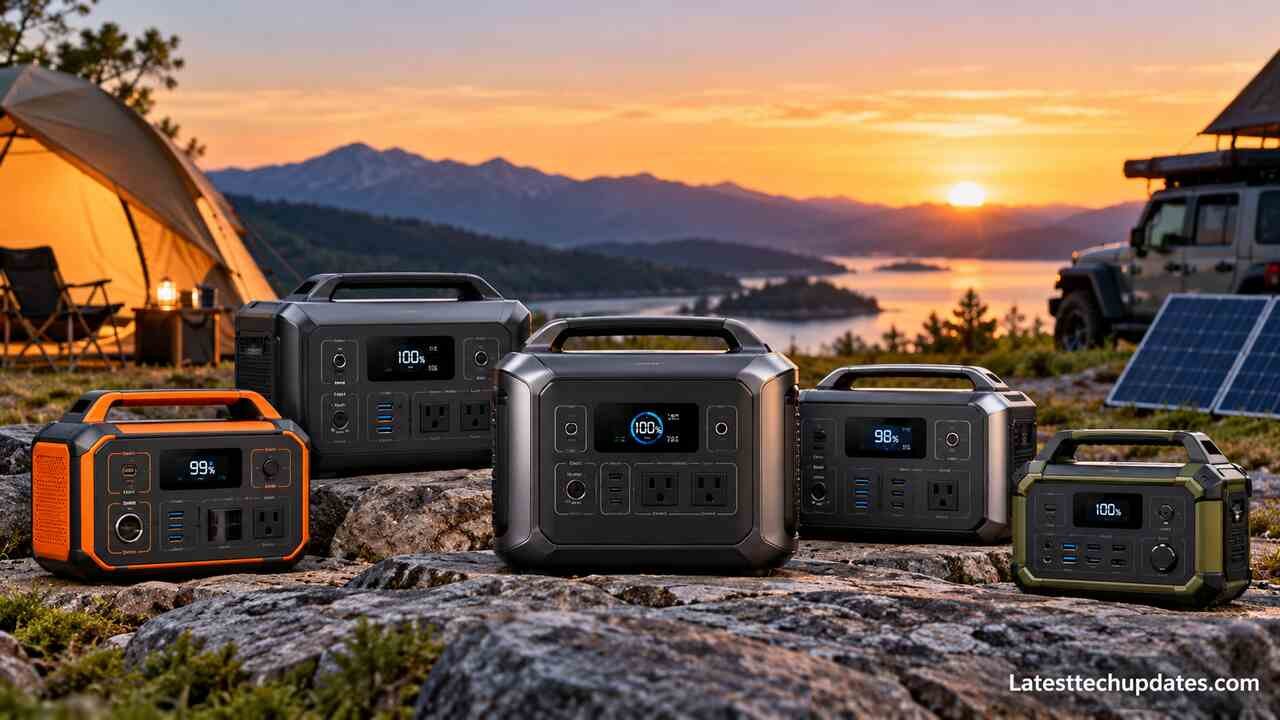
The best portable power stations combine reliable battery capacity, sufficient power output, fast charging, and long battery life in a design that suits your needs. The EcoFlow DELTA 2 Max is a strong all-around option for home backup and outdoor use, while the Jackery Explorer 1000 Plus offers a practical balance of portability and expandable capacity.
Best Portable Power Stations at a Glance
The following models cover different power requirements, from short camping trips to extended outages. Their specifications refer to standard configurations, and actual features can vary by model version and regional availability.
| Portable Power Station | Battery Capacity | Rated AC Output | Best For |
|---|---|---|---|
| EcoFlow DELTA 2 Max | 2,048Wh | 2,400W | Best all-around option |
| Jackery Explorer 1000 Plus | 1,264Wh | 2,000W | Camping and expandable power |
| Anker SOLIX C1000 | 1,056Wh | 1,800W | Fast charging and portability |
| BLUETTI AC200L | 2,048Wh | 2,400W | High-capacity home backup |
| EcoFlow RIVER 2 Pro | 768Wh | 800W | Small appliances and weekend trips |
| Anker SOLIX C300 (AC version) | 288Wh | 300W | Lightweight camping |
| Jackery Explorer 300 Plus | 288Wh | 300W | Basic outdoor electronics |
These figures describe nominal battery capacity and continuous rated output. They do not represent the exact amount of electricity available through AC outlets after conversion losses.
1. EcoFlow DELTA 2 Max: Best Overall Portable Power Station
The EcoFlow DELTA 2 Max stands out because it combines a large battery, strong inverter output, expandable capacity, and flexible charging options. Its 2,048Wh battery provides enough stored energy for several small appliances or a combination of electronics during a power outage.
The unit delivers 2,400W of continuous AC output, making it suitable for many refrigerators, kitchen appliances, power tools, and electronic devices, provided their operating and startup requirements remain within the unit’s limits.
Key Features
-
2,048Wh lithium iron phosphate (LiFePO4) battery
-
2,400W continuous AC output
-
Expandable battery capacity up to 6,144Wh
-
AC and solar charging support
-
App-based monitoring and power management
-
Multiple AC, USB, and DC connections
One advantage is its expandable battery system. Users who initially need power for camping can add compatible batteries later if their backup requirements increase.
The DELTA 2 Max also supports combined AC and solar charging, allowing users to replenish battery energy through different sources.
Advantages: High output, expandable storage, versatile charging, and long-cycle battery chemistry.
Limitations: Relatively heavy, expensive compared with smaller models, and unnecessary for users who only charge phones and laptops.
Best for: Households needing emergency backup, RV owners, and users who want one power station for both indoor and outdoor applications.
2. Jackery Explorer 1000 Plus: Best for Camping and Expandable Power
The Jackery Explorer 1000 Plus offers a useful balance between battery capacity and portability. Its 1,264Wh battery and 2,000W continuous AC output can support camping appliances, photography equipment, laptops, and selected household devices.
Its expandable battery design is particularly useful for campers who occasionally take longer trips. The standard unit is suitable for moderate energy requirements, while additional compatible battery packs increase the available runtime.
Key Features
-
1,264Wh LiFePO4 battery
-
2,000W continuous AC output
-
Expandable capacity up to approximately 5kWh
-
Solar panel compatibility
-
AC and USB charging connections
-
App connectivity for monitoring
The Explorer 1000 Plus can handle devices that demand relatively high wattage, such as some coffee makers and cooking appliances. However, high-power equipment consumes battery energy quickly.
For example, a 1,000W appliance running continuously for 30 minutes uses approximately 500Wh before conversion losses. That represents a substantial portion of the Explorer 1000 Plus battery.
Advantages: Strong AC output, expandable capacity, LiFePO4 battery, and a practical range of charging connections.
Limitations: Heavier than compact camping models, and solar panels are generally a separate purchase.
Best for: Car camping, outdoor work, weekend travel, and users who want expandable battery storage without starting with a 2kWh system.
3. Anker SOLIX C1000: Best for Fast Charging and Everyday Portability
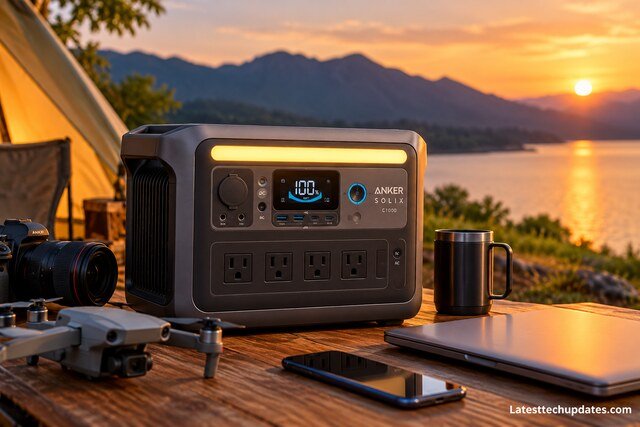
The Anker SOLIX C1000 is a practical choice for users who want substantial power without carrying a larger 2kWh station.
It features a 1,056Wh LiFePO4 battery and 1,800W continuous AC output. This combination makes it suitable for laptops, portable refrigerators, small cooking appliances, and temporary household backup.
Key Features
-
1,056Wh LiFePO4 battery
-
1,800W continuous AC output
-
Fast AC recharging
-
Solar charging compatibility
-
Optional expansion with a compatible battery
-
App-based controls and battery monitoring
Fast recharging is one of the C1000’s strongest features. Under appropriate conditions, its high-speed AC charging mode can replenish the battery much faster than many conventional portable battery systems.
That matters when electricity is available only intermittently. During short periods of grid power, users can recharge the station before the next outage.
Advantages: Fast charging, compact design for its power class, capable inverter, and expandable storage.
Limitations: Limited runtime with high-wattage appliances and potentially higher fan noise during rapid charging.
Best for: Frequent travelers, apartment residents, home office backup, and users who prioritize short recharge times.
4. BLUETTI AC200L: Best High-Capacity Power Station for Home Backup
The BLUETTI AC200L is designed for users who need substantial battery storage and enough inverter output to operate several household appliances.
Its 2,048Wh LiFePO4 battery and 2,400W continuous AC output make it a capable solution for refrigerators, lighting, routers, televisions, and selected kitchen appliances.
Key Features
-
2,048Wh LiFePO4 battery
-
2,400W continuous AC output
-
Expansion battery compatibility
-
High solar input capability
-
AC, USB, and DC connections
-
App-based system monitoring
The AC200L is particularly useful for users who want to combine battery backup with portable solar panels. Its relatively high solar input rating can help recharge the battery more quickly when adequate sunlight and compatible panels are available.
Its capacity also supports longer runtimes for low-power essentials. A refrigerator, for instance, may consume substantially less energy than its rated compressor wattage suggests because the compressor cycles on and off.
Advantages: Large battery, high output, expandable capacity, and flexible solar charging.
Limitations: Heavy, less convenient for frequent carrying, and potentially excessive for basic electronic devices.
Best for: Home emergency power, RV systems, off-grid cabins, and users with multiple essential appliances.
5. EcoFlow RIVER 2 Pro: Best for Weekend Camping
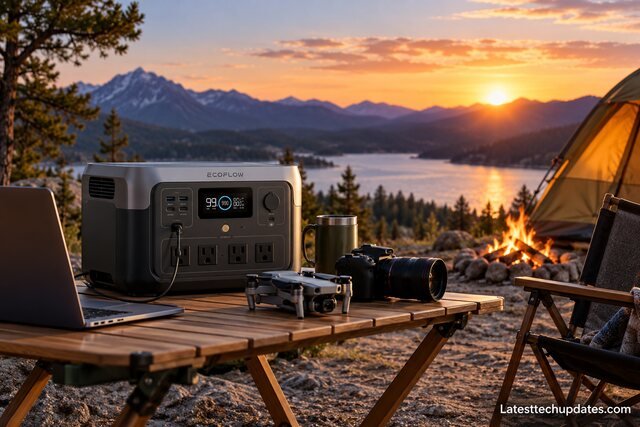
The EcoFlow RIVER 2 Pro offers a middle ground between small portable batteries and larger home backup stations.
Its 768Wh LiFePO4 battery provides more energy than most entry-level models, while its 800W continuous AC output supports a useful range of camping and everyday electronics.
Key Features
-
768Wh LiFePO4 battery
-
800W continuous AC output
-
Fast AC charging
-
Solar charging support
-
USB and AC connections
-
Portable carrying design
The RIVER 2 Pro works well for powering laptops, lights, cameras, routers, and certain portable refrigerators. It can also operate some smaller appliances, provided their startup and running wattage remain within its supported limits.
Its manageable capacity makes it attractive for weekend trips where users want enough energy for multiple devices but do not need a heavy 2kWh system.
Advantages: Portable design, useful battery capacity, fast charging, and long-life battery chemistry.
Limitations: Not suitable for sustained operation of high-wattage kitchen appliances or large household loads.
Best for: Weekend camping, road trips, outdoor photography, and occasional home office backup.
6. Anker SOLIX C300: Best Small Portable Power Station
The Anker SOLIX C300 AC version is a compact option for people who primarily need to charge personal electronics.
With a 288Wh battery and 300W continuous AC output, it is better suited to smaller loads than full-sized household appliances.
Key Features
-
288Wh LiFePO4 battery
-
300W continuous AC output
-
Compact, travel-friendly design
-
USB-C charging connections
-
Solar charging compatibility
-
Multiple charging methods
The C300 is useful for charging smartphones, tablets, cameras, drones, and some laptops. Its smaller battery means users can carry it more easily than a high-capacity model.
However, a 288Wh battery is not designed for running power-hungry appliances for extended periods.
Advantages: Compact size, versatile charging connections, and suitable capacity for everyday electronics.
Limitations: Limited battery storage and low continuous AC output compared with larger models.
Best for: Day trips, tent camping, outdoor photography, and short-term charging needs.
7. Jackery Explorer 300 Plus: Best for Basic Outdoor Electronics
The Jackery Explorer 300 Plus is another compact option for users who prioritize simple operation and portable battery power.
Its 288Wh LiFePO4 battery and 300W continuous AC output are sufficient for many low-power devices.
Key Features
-
288Wh LiFePO4 battery
-
300W continuous AC output
-
USB-C charging support
-
Solar panel compatibility
-
Compact carrying design
-
Battery monitoring features
The Explorer 300 Plus is especially useful when the main goal is to keep phones, cameras, tablets, and laptops charged away from electrical outlets.
It can also support certain low-power lighting systems and small electronic accessories.
Advantages: Simple operation, lightweight design, reliable battery chemistry, and convenient charging options.
Limitations: Small battery capacity and insufficient output for most heating or cooking appliances.
Best for: Short camping trips, travel, outdoor events, and emergency charging kits.
How to Choose the Best Portable Power Station
The right portable power station depends on three primary factors: how much electricity your devices consume, how long you need to run them, and whether the power station can handle their maximum power demand.
Battery capacity, inverter output, charging speed, and battery chemistry all affect performance. Understanding these specifications prevents two common purchasing mistakes: buying a station that cannot power your appliances or paying for more capacity than you need.
1. Battery Capacity: How Much Energy Do You Need?
Battery capacity is measured in watt-hours (Wh). It indicates how much energy the battery stores.
A 1,000Wh battery theoretically contains enough energy to power a 100W device for 10 hours. However, real-world runtime is shorter because the inverter, electronics, and connected devices consume additional energy.
For planning purposes, assuming approximately 80% to 90% usable energy through AC outlets is reasonable, although actual efficiency varies.
| Battery Capacity | Typical Applications | Suitable Usage |
|---|---|---|
| 200–300Wh | Phones, cameras, tablets, small lights | Day trips and basic emergencies |
| 500–800Wh | Laptops, routers, portable refrigerators | Weekend camping |
| 1,000–1,500Wh | Multiple electronics, selected appliances | Extended camping and short outages |
| 2,000–3,000Wh | Refrigerators, household essentials, tools | Home backup and RV use |
| 3,000Wh+ | Multiple appliances and extended backup | Off-grid living and longer outages |
A 300Wh station is generally sufficient for occasional device charging. Someone who needs to keep a refrigerator operating during a blackout should consider a larger battery and verify the refrigerator’s actual energy consumption.
2. Continuous Output and Surge Power
Battery capacity determines how long a station can operate, while inverter output determines which appliances it can power.
Continuous output, measured in watts, represents the amount of electricity a power station can deliver during normal operation.
Surge output represents the higher power it can temporarily provide when appliances start.
For example, a refrigerator might consume 120W while running but briefly require several times that amount when its compressor starts.
A power station must accommodate both requirements.
High-wattage appliances such as electric kettles, hair dryers, and space heaters can exceed the continuous output of smaller stations.
Some manufacturers offer power-boosting modes that allow certain appliances to operate beyond the normal rated output. These modes may reduce the delivered voltage and are not suitable for every device.
For sensitive equipment, choosing a station with sufficient continuous rated output is preferable.
3. Battery Chemistry: LiFePO4 vs. Lithium-Ion
Battery chemistry affects lifespan, weight, safety characteristics, and long-term value.
Most modern portable power stations use lithium iron phosphate (LiFePO4 or LFP) batteries. Many older or particularly lightweight models use nickel-based lithium-ion chemistries, including NMC.
LiFePO4 batteries generally offer longer cycle life and greater thermal stability, making them attractive for frequent charging and discharging.
NMC lithium-ion batteries can provide higher energy density, which helps manufacturers reduce weight and size for a given battery capacity.
A battery cycle refers to cumulative energy use equivalent to a full discharge and recharge. Manufacturers often specify how many cycles a battery can complete before declining to approximately 80% of its original capacity.
A battery rated for 3,000 cycles does not necessarily stop working after the 3,000th cycle. It may continue operating with reduced storage capacity.
For frequent home backup or off-grid use, LiFePO4 is usually the better long-term choice.
4. Charging Speed and Available Charging Methods
A portable power station is only useful if you can recharge it conveniently.
Most models support some combination of AC wall charging, solar charging, and vehicle charging.
AC charging is typically the fastest and most predictable method when grid electricity is available.
Solar charging is valuable for camping and off-grid use, but charging speed depends on sunlight, panel wattage, temperature, orientation, and the power station’s input limits.
Vehicle charging provides another option during road trips, although conventional 12V accessory sockets often deliver relatively little charging power.
Before purchasing, check the maximum input wattage for each charging method rather than relying only on advertised charging times.
5. Weight and Portability
Portability means different things depending on how you plan to use the station.
A 5kg unit may be easy to carry around a campsite, while a 25kg power station is more suitable for transporting between a vehicle and a fixed location.
Larger batteries generally weigh more, although battery chemistry, casing design, and inverter components also affect total weight.
For hiking or frequent movement, a smaller station is more practical. For RV use or home backup, capacity may matter more than weight.
6. Ports, Connectivity, and Additional Features
The best portable power stations should provide the connections required by your devices without relying on multiple adapters.
Useful features include USB-C Power Delivery, USB-A connections, pure sine wave AC outlets, regulated 12V DC outputs, and wireless monitoring.
A high-output USB-C port is particularly useful for modern laptops because it can avoid the conversion losses associated with using an AC charging adapter.
Other features worth considering include low-noise charging, replaceable or expandable batteries, a clear display, and configurable charging limits.
Portable Power Station vs. Gas Generator: Which Is Better?
Portable power stations and fuel-powered generators serve different purposes.
A battery power station is usually quieter, requires less routine maintenance, and can be used indoors when operated according to the manufacturer’s instructions.
A gas generator can provide electricity for extended periods when sufficient fuel is available, making it useful for sustained high-power demands.
| Feature | Portable Power Station | Gas Generator |
|---|---|---|
| Energy source | Rechargeable battery | Gasoline or another fuel |
| Operating noise | Usually low | Generally higher |
| Indoor operation | Generally suitable with proper ventilation and use | Never operate indoors |
| Maintenance | Relatively low | Requires engine maintenance |
| Runtime | Limited by stored energy | Limited by fuel supply |
| Recharging/refueling | Grid, solar, or vehicle charging | Add compatible fuel |
| High-power operation | Depends on inverter and battery size | Depends on generator rating |
| Local exhaust emissions | No combustion exhaust during battery operation | Produces combustion exhaust |
Portable power stations are particularly useful for electronics, camping, indoor backup, and situations where quiet operation matters.
Fuel generators remain practical for extended outages involving high electricity consumption.
Some households may benefit from both systems, using battery power for quiet indoor loads and a generator outdoors for longer-duration charging or high-power applications.
Common Mistakes to Avoid When Buying a Portable Power Station
One common mistake is confusing watts with watt-hours. A 2,000W inverter does not mean the battery stores 2,000Wh. Output power and battery capacity describe different characteristics.
Another mistake is relying on advertised maximum surge output instead of checking continuous rated output. A power station may briefly support a high startup load without being able to operate that appliance continuously.
Buyers also frequently underestimate their daily energy requirements. A laptop, refrigerator, lighting system, and Wi-Fi router can consume a significant amount of electricity when used together.
Other purchasing mistakes include ignoring charging input limits, overlooking battery weight, buying incompatible solar panels, and assuming every model includes an uninterruptible power supply function.
Voltage compatibility deserves particular attention. Some portable stations are designed for 120V markets, while others provide 220V to 240V AC output. The wrong regional version may be incompatible with your appliances.
Finally, check the manufacturer’s warranty terms, service availability, and replacement battery options. A long-life battery offers limited practical value if repairs or compatible accessories are unavailable.
How to Calculate the Right Battery Size Before Buying
A simple energy audit is one of the most effective ways to avoid purchasing the wrong portable power station.
Start by identifying the devices you want to operate, their average wattage, and their expected daily usage.
Consider this hypothetical camping setup:
| Device | Average Power | Daily Usage | Energy Required |
|---|---|---|---|
| LED lighting | 15W | 5 hours | 75Wh |
| Laptop | 60W | 3 hours | 180Wh |
| Portable refrigerator | 40W average | 12 hours | 480Wh |
| Phone charging | 15W | 2 hours | 30Wh |
| Total | 765Wh |
How to Maintain a Portable Power Station
Proper battery care helps preserve capacity and maintain safe operation.
Most modern stations include a battery management system that monitors temperature, voltage, current, and charging conditions. However, users still need to follow appropriate storage and operating practices.
Avoid leaving a power station in extreme heat, particularly inside a parked vehicle exposed to direct sunlight.
Store the unit in a dry, temperature-controlled environment and follow the manufacturer’s recommended storage charge level.
For long-term storage, many manufacturers recommend maintaining a partial charge and periodically checking the battery.
Avoid charging the battery outside its specified temperature range. Some LiFePO4 batteries restrict charging at or below freezing temperatures unless an appropriate heating system is present.
Keep ventilation openings clear, use compatible charging equipment, and inspect cables for damage.
A power station that shows swelling, unusual odors, excessive heating, or physical damage should not be charged or operated until assessed according to the manufacturer’s safety guidance.
Frequently Asked Questions
1. What is the best portable power station for the money?
The Anker SOLIX C1000 and EcoFlow RIVER 2 Pro are worth comparing for value, depending on current pricing and power requirements. The C1000 offers higher output and capacity, while the RIVER 2 Pro may be more economical for lighter loads. Compare the total cost against usable battery capacity, inverter output, warranty, and included accessories.
2. Can a portable power station run a refrigerator?
Yes, many portable power stations can run refrigerators if their continuous and surge output meet the refrigerator’s electrical requirements. Runtime depends on the refrigerator’s average energy consumption, ambient temperature, and battery capacity. A 2,000Wh station generally provides more useful backup time than a 500Wh model.
3. Can you use a portable power station while charging it?
Many modern models support pass-through charging, allowing connected devices to receive power while the station is being recharged. However, operating limits vary. Some stations restrict charging or output under certain conditions, so check the manufacturer’s instructions before using this feature continuously.
4. How many years does a portable power station last?
A portable power station can remain useful for several years, depending on battery chemistry, charging frequency, storage conditions, and product quality. LiFePO4 models commonly advertise thousands of charge cycles before reaching a specified remaining capacity. Calendar aging and electronics reliability also affect overall service life.
5. Can a portable power station run an air conditioner?
Some high-output power stations can operate small or efficient air conditioners, but compatibility depends on running wattage, startup surge, and battery capacity. Air conditioners often consume substantial energy, so even a compatible station may provide limited runtime. Check measured appliance consumption before choosing a battery.
6. Is a portable power station better than a power bank?
A portable power station is generally better for operating AC appliances and multiple devices, while a conventional power bank is more convenient for charging phones, tablets, and smaller electronics. Power stations provide larger batteries and more output options but are heavier and usually more expensive.
Final Verdict: Which Portable Power Station Should You Buy?
The EcoFlow DELTA 2 Max is a strong overall choice for users who need a balance of high output, expandable battery capacity, and flexible charging. The BLUETTI AC200L is another capable option for home backup and solar-powered applications.
For camping and general portable use, the Jackery Explorer 1000 Plus and Anker SOLIX C1000 offer a practical combination of capacity and inverter performance. The EcoFlow RIVER 2 Pro suits lighter weekend use, while the Anker SOLIX C300 and Jackery Explorer 300 Plus are better suited to basic electronic charging.
The best purchase is not necessarily the station with the largest battery or highest advertised output. It is the model that can operate your intended appliances, store enough energy for your required runtime, recharge conveniently, and remain practical to transport.
Before buying, calculate your daily watt-hour requirements, check appliance startup power, confirm regional voltage compatibility, and compare the current price and warranty. Those checks will help you choose a portable power station that delivers reliable performance without unnecessary expense.
