
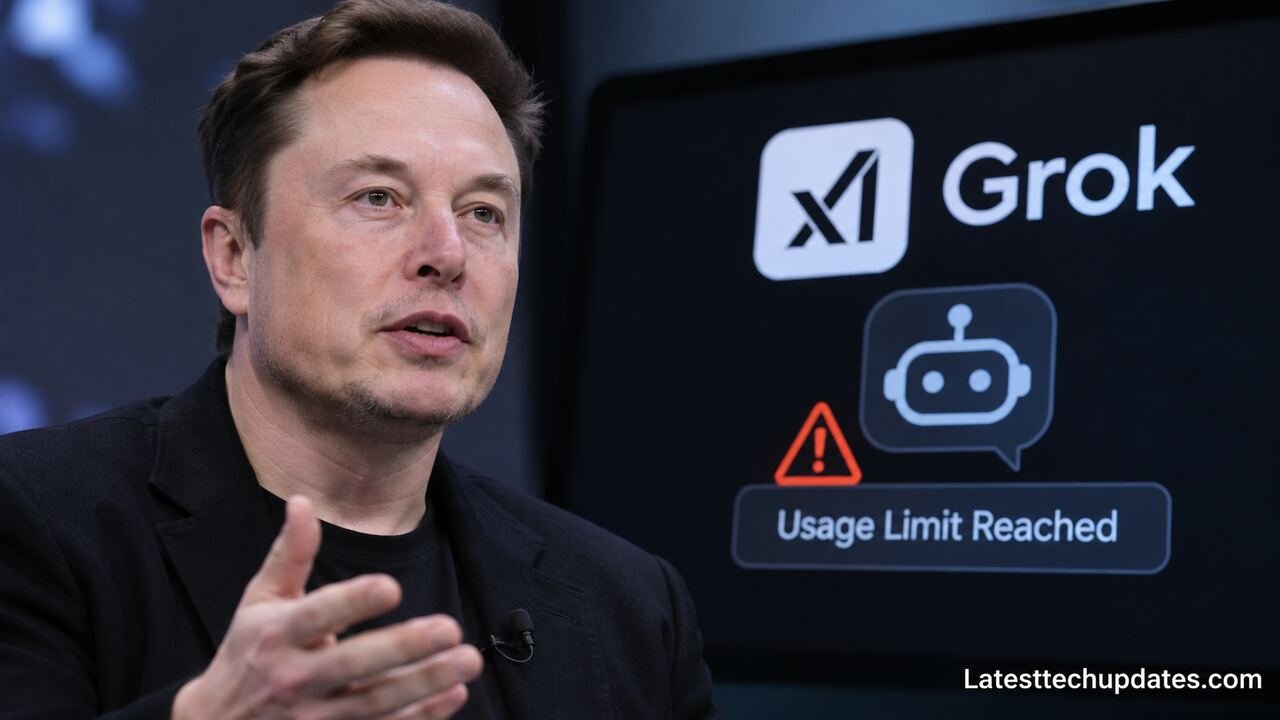
Elon Musk has attributed the usage restrictions on Grok Bot to “unsustainably high” operating costs, highlighting the financial challenges associated with running artificial intelligence services at scale. The explanation sheds light on why xAI, Musk’s artificial intelligence company, has imposed limits on interactions with Grok, the AI chatbot integrated into the social media platform X.
Why Did Elon Musk Introduce Grok Bot Usage Limits?
Elon Musk identified unsustainably high operating costs as the primary reason behind Grok Bot usage restrictions. AI-powered chatbots require substantial computing resources to process user requests, generate responses, and maintain reliable performance during periods of high demand.
1. High AI Computing Costs
Artificial intelligence computing costs represent a major financial challenge for companies operating advanced language models. Grok processes user queries through sophisticated neural networks that require powerful graphics processing units, specialized AI accelerators, and substantial electricity consumption.
Every conversation generates an inference workload, which consumes computing resources even after model training has been completed. Increasing numbers of simultaneous users can raise total infrastructure expenses, particularly when conversations involve lengthy prompts, complex reasoning, or repeated requests.
2. Growing Demand for Grok AI
Growing demand for Grok AI can increase pressure on xAI’s computing infrastructure. The chatbot provides conversational assistance, information retrieval, content generation, and other AI-powered functions through supported interfaces, including X.
Higher interaction volumes require additional processing capacity and stronger resource management. Usage restrictions help regulate demand by limiting the number or frequency of requests users can submit within a defined period.
3. GPU Infrastructure and Operational Expenses
GPU infrastructure plays a central role in Grok’s operating expenses because modern large language models depend on specialized hardware for efficient inference. AI accelerators perform mathematical calculations across billions of model parameters, enabling Grok to interpret prompts and produce natural-language responses.
Infrastructure expenses extend beyond purchasing processors. Data centers require cooling systems, networking equipment, storage resources, maintenance, and reliable power supplies. Higher utilization can improve hardware efficiency, although sustained demand may also require additional infrastructure investment.
4. Financial Sustainability of Free AI Access
Financial sustainability becomes increasingly important when AI services offer free or broadly accessible chatbot interactions. Free users generate computational expenses without necessarily providing direct subscription revenue.
Subscription plans, advertising-related revenue, and other commercial arrangements may help support operating expenses. Usage limits offer another mechanism for controlling costs while preserving access for a larger audience.
Musk’s explanation suggests that unrestricted access can create financial pressure when service demand exceeds economically sustainable levels.
5. Preventing Excessive Automated Requests
Usage limits can also reduce the impact of excessive automated requests on AI infrastructure. Bots, scripts, and unusually frequent interactions may consume substantial computing capacity, potentially affecting service responsiveness for other users.
Rate-limiting systems help distribute available resources by restricting repeated requests over specific intervals. Such systems can also support abuse prevention and infrastructure stability.
However, Musk’s stated cost explanation does not establish whether automated abuse was a specific factor behind the Grok Bot restrictions.
How Do Grok Bot Usage Limits Affect X Users?
Grok Bot usage limits can restrict how frequently users interact with the AI assistant, particularly when demand exceeds available computing capacity. The practical impact depends on the interface, subscription status, model selection, and applicable usage policies.
1. Restrictions on Free Grok Users
Free Grok users may encounter restrictions after submitting a certain number of prompts within a designated period. Usage allowances can vary across service versions and may change as xAI adjusts infrastructure capacity or access policies.
Users reaching an interaction limit may need to wait for an allowance reset or consider another available access option. The precise number of permitted requests cannot be established from Musk’s cost explanation alone.
2. Subscription-Based Grok Access
Subscription-based Grok access provides a potential mechanism for supporting AI infrastructure costs through recurring revenue. Paid access arrangements may offer larger usage allowances, additional capabilities, or priority access, depending on current product terms.
Subscription revenue can help offset inference expenses generated by computationally intensive requests. Nevertheless, paid access does not necessarily guarantee unlimited interactions, since providers may impose safeguards against unusually high resource consumption.
3. Grok Response Availability
Grok response availability depends partly on how effectively xAI allocates computing resources across active users. When simultaneous requests increase, infrastructure capacity can become a constraint on response times and overall service availability.
Usage limits can reduce resource contention and help maintain more predictable performance. Actual improvements depend on system architecture, traffic patterns, and available hardware rather than rate limits alone.
4. User Experience on X
The Grok experience on X depends on the availability of AI features, the applicable account permissions, and interaction limits. Users relying on Grok for explanations, writing assistance, or research-related questions may find restricted access inconvenient.
Frequent interruptions can affect workflows requiring multiple follow-up questions. Longer conversations may also consume more computing resources because the model processes relevant conversational context alongside new requests.
5. Access to Advanced AI Features
Advanced AI features can carry different computational costs depending on model architecture and task complexity. Extended reasoning, large-context processing, and multimodal interactions may require more resources than straightforward text responses.
Service providers can manage those differences through feature-specific allowances, model tiers, or separate subscription entitlements. Whether particular Grok features face additional restrictions depends on xAI’s published access policies.
Why Are Grok AI Operating Costs So High?
Grok AI operating costs arise from the combination of model inference, hardware infrastructure, electricity consumption, engineering operations, and continuous platform development. Large-scale AI deployment requires significant resources even after initial model training has finished.
1. Large Language Model Inference
Large language model inference involves processing input tokens and generating output tokens through a trained neural network. Every request activates computational operations that depend on model size, architecture, prompt length, and response length.
Longer conversations can require additional processing because previous messages may remain part of the model’s context. The resulting workload creates recurring costs for companies serving millions of AI interactions.
2. AI Data Center Infrastructure
AI data center infrastructure provides the physical environment necessary for high-performance computing. Servers, accelerators, networking systems, and storage equipment operate together to support model inference and training workloads.
Infrastructure development requires substantial capital investment before a platform can generate corresponding revenue. Hardware depreciation, equipment replacement, and ongoing maintenance add further financial obligations throughout the operational lifecycle.
3. Electricity and Cooling Requirements
Electricity consumption represents an important component of AI infrastructure expenses. High-performance processors require continuous power during demanding workloads, while cooling systems remove heat generated by concentrated computing equipment.
Energy efficiency influences the cost of each AI interaction. Improved accelerator performance, optimized software, and efficient cooling systems can reduce expenses per unit of computation, although increasing overall demand may offset some efficiency gains.
4. AI Model Training and Development
AI model training requires extensive computing resources, large datasets, technical expertise, and repeated experimentation. Training expenses differ from inference costs because training creates or updates model capabilities, while inference delivers responses to users.
Research teams also invest in model evaluation, safety testing, system optimization, and product integration. Those development activities contribute to the broader financial requirements of operating an AI company, even when individual usage limits primarily address inference demand.
5. Scaling AI Services for Millions of Users
Scaling AI services involves expanding computing capacity while maintaining acceptable latency, reliability, and security. Demand can fluctuate significantly, especially when new features attract attention or usage increases unexpectedly.
Capacity planning helps providers anticipate traffic growth and allocate hardware efficiently. Usage limits provide a short-term mechanism for controlling demand, while infrastructure expansion and model optimization offer potential longer-term solutions.
What Do Grok Usage Restrictions Mean for xAI and the AI Industry?
Grok usage restrictions highlight a broader challenge facing the generative AI industry: providing affordable access to increasingly capable models while controlling recurring computational expenses.
1. Pressure on AI Business Models
AI business models must generate enough revenue to support model development, infrastructure operations, and customer demand. Free access can encourage adoption, but heavy usage creates expenses that providers must absorb or recover through other revenue streams.
Companies may therefore combine free allowances, paid subscriptions, enterprise services, and usage-based pricing. The financial effectiveness of each approach depends on customer behavior, infrastructure efficiency, and operating margins.
2. Competition Between Grok and Other AI Chatbots
Grok competes in a market that includes ChatGPT from OpenAI, Gemini from Google, and Claude from Anthropic. These platforms differ in model capabilities, product integrations, pricing structures, and access policies.
Usage restrictions can influence customer preferences, especially among users who require frequent interactions. However, comparisons require consideration of response quality, reliability, available features, and total subscription value rather than usage allowances alone.
3. AI Subscription Pricing Strategies
AI subscription pricing strategies attempt to align customer payments with the costs of providing computationally demanding services. Providers can offer multiple tiers with different interaction allowances, model capabilities, or performance characteristics.
Pricing decisions also reflect competitive pressure and customer willingness to pay. Lower prices may encourage adoption, while higher allowances can increase infrastructure expenses when customers use resource-intensive features extensively.
4. Efficient AI Models and Cost Reduction
Efficient AI models offer a potential route toward reducing the cost of individual chatbot interactions. Techniques such as quantization, optimized attention mechanisms, caching, batching, and improved inference scheduling can reduce computational requirements.
Model architecture also affects efficiency. Smaller models and specialized systems may handle certain tasks at lower cost than larger general-purpose models.
Cost reductions could eventually support more generous usage allowances, although actual access policies remain commercial decisions.
5. Future of Free Generative AI Services
The future of free generative AI services depends partly on improvements in hardware efficiency, software optimization, and sustainable monetization. Lower inference costs could make broad chatbot access more affordable over time.
However, increasingly sophisticated AI capabilities may introduce new computational demands. Providers will need to balance expanding functionality with the financial requirements of maintaining reliable services.
Musk’s comments illustrate why free access and unlimited access are not necessarily economically equivalent.
Will Grok Bot Usage Limits Be Removed?
Grok Bot usage limits could change if xAI reduces inference costs, expands computing capacity, or revises its commercial access strategy. Musk’s explanation does not establish a confirmed timetable for removing the restrictions.
1. Expansion of xAI Computing Capacity
Additional computing capacity could enable Grok to process more simultaneous requests. Infrastructure expansion may involve deploying new AI accelerators, improving networking performance, or increasing data center resources.
However, expanded capacity also requires investment and creates additional operational obligations. Higher infrastructure availability does not automatically guarantee unrestricted chatbot usage.
2. Improvements in Grok Model Efficiency
Improvements in Grok model efficiency could reduce the computational expense associated with each response. Software optimization, better inference scheduling, and more efficient model architectures may allow existing hardware to serve additional users.
Efficiency improvements can also support faster response generation and lower operating costs. Whether xAI translates those gains into higher usage allowances will depend on business priorities and customer demand.
3. Changes to Free Usage Allowances
Free usage allowances may increase or decrease as xAI evaluates demand, operating expenses, and infrastructure availability. Providers commonly adjust access policies to reflect changing product capabilities and resource constraints.
Users should distinguish between confirmed policy changes and speculation about future allowances. Musk’s cost explanation identifies a financial concern but does not specify a revised free-access quota.
4. New Subscription and Access Models
New subscription and access models could provide additional ways to distribute computing expenses. Potential approaches include higher-tier plans, usage-based billing, and separate allowances for computationally intensive features.
Such approaches remain possibilities rather than confirmed xAI announcements. Any future pricing changes would need to be assessed against officially published subscription terms.
5. Long-Term Sustainability of Grok AI
Long-term sustainability depends on whether xAI can support growing user demand while managing infrastructure investment and operating expenses. Improvements in model efficiency, hardware utilization, and revenue generation may help address the financial pressures identified by Musk.
Sustainable growth also requires reliable service performance and a competitive user experience. Usage limits represent one available resource-management tool rather than a complete solution to the economics of large-scale artificial intelligence.
What Is the Main Reason Behind Grok Bot Usage Limits?
Elon Musk says unsustainably high operating costs are the reason for Grok Bot usage limits. The explanation connects restricted chatbot access with the substantial computational resources required to operate modern artificial intelligence models.
For Grok users, the restrictions can mean fewer available interactions and greater dependence on account-specific usage allowances. For xAI, the limitations provide a way to manage demand while controlling the financial burden associated with AI inference.
The broader significance extends beyond Grok. As generative AI platforms expand, companies face growing pressure to make advanced models more efficient, maintain affordable access, and develop business models capable of supporting large-scale usage.
Whether Grok’s restrictions become more flexible will depend on future infrastructure improvements, operating costs, and xAI’s access policies.
