
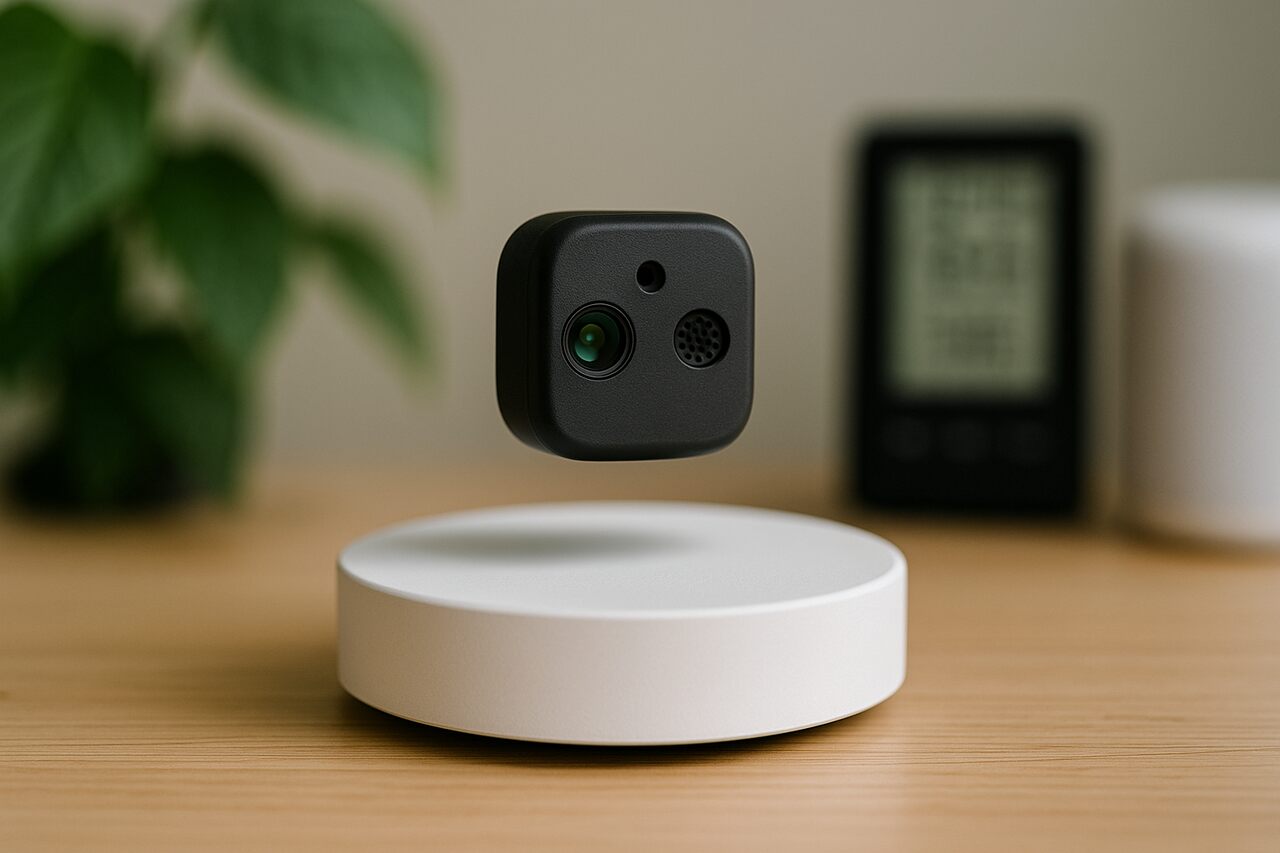
Highlights
- Levitating sensor technology eliminates mechanical friction, increasing device lifespan and precision.
- Environmental monitoring applications now gain higher sensitivity to pollutants, temperature, and humidity variations.
- Consumer electronics benefit from contactless input, energy efficiency, and miniaturization.
- Magnetic levitation and acoustic levitation are key enablers of frictionless sensing platforms.
- Integration with IoT ecosystems allows real-time data streaming and predictive analysis.
- Sensor innovation drives cross-industry impact: from smart homes to atmospheric research.
How Does Levitating Sensor Technology Transform Environmental Monitoring?
Levitating sensors redefine accuracy and sensitivity in environmental measurements.
By removing mechanical contact through magnetic or acoustic levitation, environmental sensors experience zero frictional drag. This absence of physical wear ensures long-term precision in detecting micro-fluctuations in pollutants, particulate matter, and chemical signatures. Levitating platforms allow real-time response to dynamic environmental conditions, ensuring higher fidelity in urban pollution analytics and atmospheric research.
What Types of Levitating Mechanisms Support Sensor Stability?
Magnetic levitation and acoustic levitation are primary enablers of stable sensor suspension.
Magnetic levitation (Maglev) utilizes opposing magnetic fields to suspend sensor elements in mid-air, enabling sub-millimeter control and thermal isolation. Acoustic levitation uses pressure nodes formed by ultrasonic waves to float sensors without physical contact. These levitation techniques mitigate mechanical noise, enhance measurement precision, and enable deployment in highly sensitive environments such as clean rooms or biohazard zones.
How Does Levitating Technology Improve Detection of Airborne Pollutants?
Frictionless levitated sensors detect volatile organic compounds (VOCs) and fine particulates with ultra-high sensitivity.
Sensors suspended via levitation are decoupled from structural vibrations and thermal interference, allowing more accurate readings of airborne toxins, nitrogen dioxide, sulfur oxides, and carbon particulates. Integration with electrochemical or photonic sensor arrays boosts their specificity, enabling real-time alerts in industrial, vehicular, and indoor pollution monitoring systems.
What Is the Impact on Temperature and Humidity Monitoring?
Levitated thermohygrometers provide consistent readings with reduced thermal lag and hysteresis.
Because levitated components avoid heat transfer from enclosures or surfaces, temperature sensors maintain better stability in fluctuating climates. Humidity-sensitive membranes or films respond more linearly when decoupled from conductive surfaces. This results in more reliable atmospheric trend data for climatology, agriculture, and smart city infrastructure.
How Do Levitating Sensors Enhance Remote and Autonomous Monitoring?
Wireless-enabled levitated sensors operate autonomously in remote or harsh environments.
Levitating technology combined with low-power wireless modules enables distributed sensor networks across inaccessible terrains like mountains, deserts, or polar regions. Solar-powered levitating sensors integrated with LIDAR or spectroscopic systems allow autonomous data collection, reducing the need for manual calibration or maintenance.
What Role Do Levitating Sensors Play in Consumer Electronics?

Consumer devices benefit from increased interactivity, durability, and precision via levitated sensing modules.
Levitated input systems eliminate mechanical buttons, enhancing the lifespan and responsiveness of wearables, smartphones, and smart home controllers. Gesture detection becomes more accurate when sensors are isolated from hardware-induced noise. These systems also support contactless data entry and haptic feedback through dynamic field modulation.
How Are Wearables and Health Devices Upgrading with Levitating Sensors?
Levitating sensors enable non-invasive biosignal capture in health-focused consumer devices.
Smartwatches and fitness trackers utilize levitated MEMS (Micro-Electro-Mechanical Systems) to monitor vitals like pulse, motion, and temperature with greater accuracy. The absence of mechanical contact prevents skin irritation and signal distortion. Integration with edge AI allows continuous health diagnostics with minimal power consumption.
How Do Smartphones and Tablets Benefit from This Technology?
Levitating sensors improve spatial sensing and enable seamless human-device interaction.
Smartphones leverage these sensors for augmented reality (AR), proximity sensing, and motion control without requiring mechanical elements. Depth sensing, accelerometers, and gyroscopes using levitation principles offer reduced latency and higher accuracy, enhancing gaming, navigation, and content interaction experiences.
What Is the Role in Smart Home Devices?
Smart home systems use levitated sensors for responsive ambient control and gesture recognition.
Thermostats, lighting systems, and security panels integrate frictionless input via levitated sensors, allowing intuitive user control through air gestures. Environmental sensors detect room conditions with finer granularity, adjusting HVAC and lighting settings autonomously based on occupancy and ambient quality.
How Does Levitating Tech Improve Energy Efficiency?
Frictionless operation reduces energy loss, while sensor miniaturization lowers power demand.
Levitated components experience no mechanical resistance, translating to longer operational cycles and reduced battery depletion. Smaller form factors also mean reduced materials and lower thermal output, aligning with sustainable tech design in both consumer and industrial markets.
What Is the Future Scope of Levitating Sensor Technology?
Cross-domain adoption is accelerating across aerospace, healthcare, environmental science, and automation.
Levitating sensors are transitioning from niche prototypes to mainstream applications. Research collaborations between academic labs and tech corporations are optimizing scalability and robustness. With advancements in quantum sensing, nano-levitation, and AI-driven analytics, levitated platforms are poised to become foundational in next-generation sensing infrastructures.
