
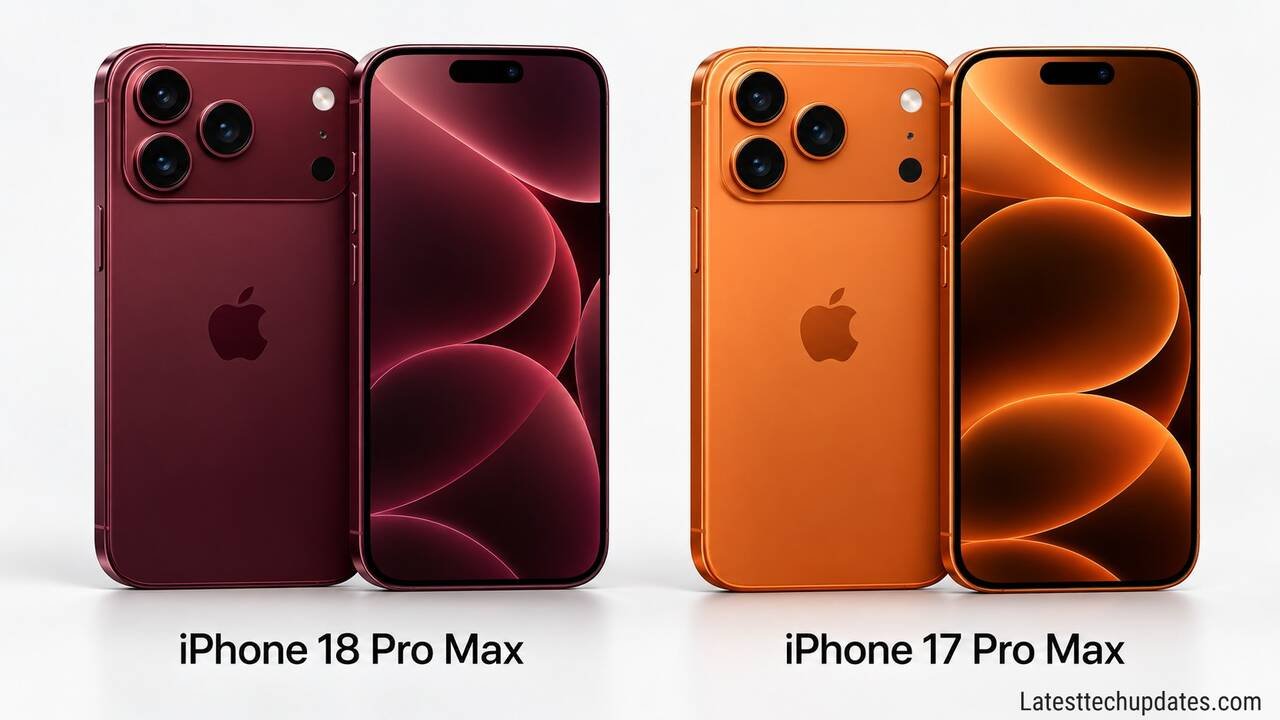
The iPhone 18 Pro Max offers notable upgrades over the iPhone 17 Pro Max, including a faster A20 Pro chip, improved cameras, longer battery life, and enhanced AI capabilities. However, the iPhone 17 Pro Max remains a powerful flagship with excellent performance and premium features.
iPhone 18 Pro Max vs. iPhone 17 Pro Max: Key Specifications
The iPhone 18 Pro Max builds on the foundation established by the iPhone 17 Pro Max rather than introducing an entirely new smartphone design.
Both devices share a large OLED display, premium construction, advanced camera hardware, and professional video recording capabilities. The differences are concentrated in processing performance, camera flexibility, battery efficiency, and software optimization.
| Feature | iPhone 18 Pro Max | iPhone 17 Pro Max |
| Release year | 2026 | 2025 |
| Processor | A20 Pro | A19 Pro |
| Display | 6.9-inch Super Retina XDR OLED | 6.9-inch Super Retina XDR OLED |
| Refresh rate | Adaptive 120Hz | Adaptive 120Hz |
| Resolution | 2868 × 1320 pixels | 2868 × 1320 pixels |
| Main camera | 48MP, variable aperture | 48MP, fixed aperture |
| Ultra-wide camera | 48MP | 48MP |
| Telephoto camera | 48MP, 4x optical zoom | 48MP, 4x optical zoom |
| Front camera | 18MP Center Stage | 18MP Center Stage |
| Maximum video playback | Up to 45 hours (eSIM-only model) | Up to 39 hours |
| Storage options | 256GB to 2TB | 256GB to 2TB |
| Weight | 249g | 233g |
| Operating system at launch | iOS 27 | iOS 26 |
| U.S. starting price at launch | $1,299 | $1,199 |
The iPhone 18 Pro Max is clearly the more advanced device, but not every improvement will change the way people use their phones.
For example, a faster processor benefits demanding applications, while the variable-aperture camera provides more creative control. Neither improvement is particularly valuable to someone who mainly uses their iPhone for communication, social media, and entertainment.
Understanding these practical differences is more useful than choosing the newer device simply because it has better specifications.
Design and Display: Is There a Noticeable Difference?
The iPhone 18 Pro Max maintains the familiar design of Apple’s Pro Max lineup, including its flat edges, aluminum unibody, large rear camera platform, and premium materials.
Both devices feature a 6.9-inch Super Retina XDR OLED display with ProMotion technology, offering adaptive refresh rates up to 120Hz.
This means scrolling, animations, gaming, and everyday navigation feel smooth on both smartphones.
A Smaller and More Functional Dynamic Island
One of the noticeable design improvements on the iPhone 18 Pro Max is its smaller Dynamic Island.
Apple has redesigned this area to occupy less screen space while making it more useful for notifications and background activities.
The updated Dynamic Island can display up to three Live Activities simultaneously, allowing users to monitor multiple ongoing tasks without opening separate applications.
For example, someone could monitor a delivery, a timer, and another supported activity directly from the top of the screen.
While convenient, this refinement is unlikely to transform the overall smartphone experience.
Display Quality Remains Similar
Both iPhones offer:
- 6.9-inch OLED screens
- Adaptive refresh rates up to 120Hz
- Always-On display functionality
- HDR support
- True Tone technology
- Up to 3,000 nits peak outdoor brightness
- Ceramic Shield 2 front protection
The iPhone 18 Pro Max does not introduce a major increase in display size, resolution, or maximum refresh rate.
Consequently, users who already enjoy watching movies, playing games, or reading on the iPhone 17 Pro Max will experience a familiar viewing experience.
Size, Weight, and Color Options
The iPhone 18 Pro Max is also slightly heavier than its predecessor.
At 249 grams, it weighs 16 grams more than the 233-gram iPhone 17 Pro Max.
This represents approximately a 6.9% increase in weight.
Although the difference sounds small, it may become noticeable during prolonged one-handed use.
Apple offers the iPhone 18 Pro Max in Black, Silver, Glacier, and Burgundy. The iPhone 17 Pro Max launched in Silver, Cosmic Orange, and Deep Blue.
Upgrade verdict: Design and display improvements alone don’t justify replacing the iPhone 17 Pro Max. Both devices deliver a similarly premium visual experience.
Performance: How Much Faster Is the A20 Pro Chip?
The iPhone 18 Pro Max introduces Apple’s A20 Pro processor, replacing the A19 Pro found in the iPhone 17 Pro Max.
Manufactured using a 2-nanometer process, the A20 Pro focuses on faster graphics processing, improved memory bandwidth, greater AI processing capability, and more efficient sustained performance.
Its architecture includes a six-core CPU, seven-core GPU, and Dual 16-core Neural Engine.
Apple reports that the A20 Pro GPU can deliver up to 40% faster graphics performance than the A19 Pro, depending on the workload.
However, this doesn’t mean every application will become 40% faster.
Everyday Performance
For everyday tasks, the difference between the two processors may be relatively small.
The A19 Pro already handles demanding smartphone activities comfortably, including:
- Social media applications
- Web browsing
- High-resolution video streaming
- Multitasking
- Photo editing
- Navigation
- Common productivity applications
If these activities already run smoothly on the iPhone 17 Pro Max, the additional processing power of the newer model may not significantly improve your experience.
The difference becomes more relevant when applications place sustained demands on the processor or graphics system.
Gaming and Graphics Performance
Mobile gaming is one area where the A20 Pro can offer more meaningful benefits.
The upgraded seven-core GPU provides additional graphics processing capability, which can help with demanding games that use advanced lighting, detailed environments, and complex visual effects.
The iPhone 18 Pro Max also introduces a redesigned vapor-chamber cooling system.
Apple says the improved thermal architecture can deliver up to 40% better sustained performance than the previous generation under suitable workloads.
This matters because smartphone processors generate heat during demanding activities.
When temperatures rise, a phone may reduce processor speeds to manage heat. Better cooling can help maintain stronger performance during extended gaming or video processing sessions.
For example, someone playing graphically intensive games for an hour may benefit more from improved sustained performance than someone playing a casual puzzle game for ten minutes.
Performance for Video Editing and Productivity
The A20 Pro also benefits applications that process large amounts of data.
Users editing high-resolution videos, working with complex visual effects, or exporting large creative projects may experience faster processing and smoother workflows.
However, the exact improvement depends on whether the application is optimized to take advantage of the newer hardware.
Upgrade verdict: The A20 Pro is a meaningful upgrade for gamers, video editors, and performance enthusiasts. Everyday users are unlikely to notice enough improvement to justify replacing their current device.
Camera Comparison: Is the iPhone 18 Pro Max Worth Upgrading For?
The camera system represents one of the biggest differences between the iPhone 18 Pro Max and iPhone 17 Pro Max.
Both phones offer three 48MP rear cameras, including main, ultra-wide, and telephoto cameras.
However, the iPhone 18 Pro Max introduces variable aperture technology and expanded manual photography controls.
These changes provide greater flexibility over how photographs are captured rather than simply increasing image resolution.
Variable Aperture: The Biggest Camera Upgrade
The iPhone 17 Pro Max uses a fixed f/1.78 aperture on its main camera.
The iPhone 18 Pro Max introduces a variable-aperture main camera with four selectable settings:
- f/1.48
- f/1.8
- f/2.8
- f/4.0
A camera’s aperture determines how much light enters through its lens and influences depth of field.
A wider aperture, represented by a smaller f-number, allows more light to reach the sensor. This can help when photographing subjects in low-light conditions.
A narrower aperture, represented by a larger f-number, can increase depth of field, making it easier to keep objects at different distances in focus.
Consider a photographer taking a picture of several people standing in different rows.
A wider aperture could create a shallow depth of field that makes some people appear less sharp. Using a narrower aperture may help keep more of the group in focus.
The variable-aperture system allows the iPhone 18 Pro Max to adjust for different photographic situations without relying entirely on software-generated effects.
Improved Manual Photography Controls
The iPhone 18 Pro Max also introduces expanded Pro controls within the Camera app.
These controls allow users to adjust settings such as:
- Lens aperture
- Shutter speed
- White balance
- Exposure monitoring through a histogram
These features are particularly useful for photographers who want more control over the final appearance of an image.
For example, manually adjusting shutter speed can help create intentional motion blur when photographing moving traffic or flowing water.
White balance controls can also help maintain consistent colors when shooting under different lighting conditions.
The iPhone 17 Pro Max already offers advanced photography features, including ProRAW, Night mode, macro photography, and Photographic Styles. However, it doesn’t provide the same integrated variable-aperture controls.
Low-Light Photography
The iPhone 18 Pro Max’s wider f/1.48 aperture can allow more light to reach the main camera sensor than the fixed f/1.78 aperture on its predecessor, under comparable conditions.
This can be beneficial for nighttime photography, indoor environments, and scenes with limited available light.
The newer camera system also includes updated image processing designed to improve detail and overall image quality.
However, low-light results depend on more than aperture size.
Sensor performance, exposure duration, subject movement, optical stabilization, and computational processing all affect the final image.
The iPhone 17 Pro Max remains capable of producing excellent low-light photographs, so casual photographers shouldn’t expect every nighttime image to look dramatically different.
Telephoto and Zoom Performance
Both devices feature a 48MP telephoto camera with 4x optical zoom.
They also provide an 8x optical-quality zoom option.
This means the iPhone 18 Pro Max doesn’t introduce an entirely new optical zoom range.
Users who regularly photograph distant subjects may still benefit from updated image processing, but the primary hardware advantage lies in the main camera rather than a dramatic increase in telephoto reach.
Upgrade verdict: Photographers who value manual controls, variable aperture, and greater creative flexibility have a compelling reason to upgrade. Casual users who mainly take family photos, selfies, and travel pictures can comfortably continue using the iPhone 17 Pro Max.
Video Recording: Which iPhone Is Better for Content Creators?
The iPhone 18 Pro Max offers improvements designed to give video creators more control over their footage.
Both smartphones already support advanced recording features, including high-resolution Dolby Vision video, professional recording formats, and sophisticated stabilization.
The newer device expands creative possibilities through improved camera controls, image processing, and cinematic features.
Greater Control Over Video Capture
The iPhone 18 Pro Max’s variable-aperture system allows more flexibility when controlling depth of field and exposure.
For professional-looking videos, these settings can influence how the subject appears against the background.
For example, someone filming a product demonstration may prefer a narrower aperture to keep more of the product sharp.
Another creator recording a close-up interview may choose settings that help separate the subject from the background.
The ability to control aperture directly can make the iPhone more useful for deliberate filmmaking.
Cinematic Effects and Editing Flexibility
The iPhone 18 Pro Max also introduces updated cinematic functionality, including the ability to apply certain cinematic effects after capturing supported video footage.
This provides additional flexibility during editing.
Instead of committing to every visual effect before recording, creators can make some adjustments afterward.
However, the iPhone 17 Pro Max already includes advanced professional features such as ProRes RAW and Apple Log 2.
For many creators, those capabilities remain more than sufficient.
Is It Worth Upgrading for YouTube or Social Media?
It depends on the complexity of your content.
Creators producing commercial videos, detailed product demonstrations, or carefully controlled cinematic footage may appreciate the new camera system.
Someone recording straightforward TikTok videos, Instagram Reels, or occasional YouTube clips may see much less benefit.
Lighting, framing, sound quality, and editing often influence the final result more than the difference between two recent flagship smartphones.
Upgrade verdict: The iPhone 18 Pro Max provides greater creative flexibility, but content creators should upgrade only if the new camera controls support their production needs.
Battery Life: Does the iPhone 18 Pro Max Last Longer?
Battery life is one of the clearest practical improvements offered by the iPhone 18 Pro Max.
Apple rates the eSIM-only iPhone 18 Pro Max for up to 45 hours of video playback, compared with up to 39 hours on the iPhone 17 Pro Max.
That represents six additional hours under Apple’s stated video-playback conditions, an increase of approximately 15.4%.
These figures demonstrate improved battery capability, although real-world results will depend on usage.
What Does the Battery Improvement Mean in Everyday Use?
A smartphone’s battery life depends on several factors, including:
- Screen brightness
- Mobile network signal strength
- Gaming and graphics workloads
- Camera usage
- Background applications
- Navigation and GPS activity
- Battery age and condition
For example, someone frequently using mobile data, recording video, and running navigation applications may appreciate the additional battery endurance.
A lighter user who already finishes the day with substantial battery remaining may not notice much practical difference.
The important question is whether your current battery life creates a problem.
If your iPhone 17 Pro Max comfortably lasts through your routine, upgrading solely for better battery endurance may offer limited value.
Faster Charging
The iPhone 18 Pro Max also supports faster wired charging with an appropriate compatible power adapter.
Under Apple’s specified conditions, the newer model can reach approximately 50% charge in around 15 minutes, compared with around 20 minutes for the iPhone 17 Pro Max.
This improvement can be useful during short charging opportunities.
For example, someone preparing to leave home with a low battery may appreciate receiving a substantial charge in less time.
However, both devices already support relatively fast charging.
Should You Replace the Battery Instead?
If your iPhone 17 Pro Max no longer lasts as long as it once did, checking battery health is a useful first step.
Lithium-ion batteries gradually lose capacity through repeated charging cycles and normal aging.
A battery with significantly reduced maximum capacity may provide noticeably shorter operating time even when the rest of the phone remains in excellent condition.
Replacing the battery could restore much of the device’s original endurance at a fraction of the cost of buying a new flagship.
Upgrade verdict: Battery life is a strong reason to consider the iPhone 18 Pro Max if you consistently struggle to get through the day. Otherwise, the iPhone 17 Pro Max remains highly capable.
iOS 27 and Apple Intelligence: Is the iPhone 18 Pro Max More Future-Proof?
The iPhone 18 Pro Max ships with iOS 27 and features hardware designed to support Apple’s newer AI capabilities.
Its A20 Pro processor introduces a Dual 16-core Neural Engine, offering additional processing capacity for on-device artificial intelligence.
Apple reports approximately twice the AI processing capability of the A19 Pro Neural Engine.
These improvements can help with demanding AI workloads, computational photography, and supported intelligent features.
What Does Siri AI Add?
The newer generation of Siri focuses on improved conversational abilities, personal context, and interactions with information available across supported applications.
Depending on feature availability, these capabilities can help users find relevant information, interpret on-screen content, and complete more complicated requests.
However, some functionality may depend on software versions, supported languages, regions, and beta availability.
Hardware capability alone doesn’t guarantee that every AI feature is immediately accessible to every user.
Does the iPhone 17 Pro Max Support iOS 27?
Yes. The iPhone 17 Pro Max supports iOS 27.
Owners can continue receiving compatible operating system features, security updates, and Apple Intelligence improvements without replacing their devices.
The iPhone 18 Pro Max has additional processing headroom, but that doesn’t mean the older device suddenly becomes outdated.
Future software features may eventually place greater demands on hardware, although specific long-term support differences cannot be guaranteed.
Upgrade verdict: AI performance improvements may appeal to technology enthusiasts, but software support alone isn’t a convincing reason for most users to upgrade.
iPhone 18 Pro Max Price: Is the Upgrade Worth the Money?
The iPhone 18 Pro Max launched in the United States with a starting price of $1,299 for the 256GB model.
The iPhone 17 Pro Max launched at $1,199 for the same entry-level storage capacity.
That represents a $100 increase, or approximately 8.3%, between the two launch prices.
However, existing iPhone 17 Pro Max owners should focus on the actual cost of upgrading rather than the retail price difference.
Calculate Your Real Upgrade Cost
The simplest calculation is:
Upgrade cost = New iPhone price − Trade-in or resale value
For example, suppose your iPhone 17 Pro Max has an estimated resale value of $700.
If you purchase an iPhone 18 Pro Max for $1,299, your effective upgrade cost would be $599 before taxes and other charges.
Different trade-in values produce significantly different results.
| Hypothetical trade-in value | New iPhone price | Effective upgrade cost |
| $500 | $1,299 | $799 |
| $600 | $1,299 | $699 |
| $700 | $1,299 | $599 |
| $800 | $1,299 | $499 |
| $900 | $1,299 | $399 |
These are illustrative calculations rather than guaranteed trade-in offers.
Actual resale values depend on storage capacity, physical condition, battery health, market demand, and promotional offers.
Consider the Cost Per Year
Another useful approach is to spread the upgrade expense across the number of years you expect to use the newer device.
For example, if upgrading costs $600 and you keep the iPhone 18 Pro Max for three years, the upgrade expense averages $200 per year.
If you replace it after only one year, the entire $600 becomes a one-year upgrade expense.
This calculation doesn’t include future resale value, financing, taxes, or accessories, but it makes the financial trade-off easier to understand.
Watch Out for Carrier Promotions
Some carriers advertise substantial trade-in credits or low monthly payments.
These offers may seem attractive, but they can include conditions such as:
- Qualifying unlimited data plans
- Eligible trade-in devices
- Installment agreements
- Promotional credits spread over several months
- Restrictions on early cancellation
A promotion offering a large discount may be less valuable if it requires a more expensive mobile plan.
Compare the total cost of the device and service over the agreement period before committing.
Upgrade verdict: The iPhone 18 Pro Max offers more advanced hardware, but existing owners should calculate the net upgrade expense and decide whether the improvements justify that amount.
Who Should Upgrade to the iPhone 18 Pro Max?
The iPhone 18 Pro Max isn’t equally valuable to every type of smartphone user.
The strongest upgrade candidates are people whose daily activities benefit directly from its improved hardware.
Professional Photographers
Photographers who regularly use manual settings may benefit from the variable-aperture camera, exposure controls, and improved computational processing.
The ability to adjust depth of field and shutter speed provides greater flexibility than the previous generation’s standard Camera app.
For users who depend on smartphone photography for their work, these capabilities may justify the expense.
Mobile Gamers
People who regularly play demanding mobile games may benefit from the A20 Pro GPU and redesigned cooling architecture.
Better sustained performance can be especially useful during extended gaming sessions.
However, users who mainly play casual games won’t necessarily experience a meaningful improvement.
Video Editors and Content Creators
Creators who frequently record and edit high-resolution video may appreciate the newer processor, improved camera controls, and additional creative features.
Faster processing can also save time when working with large media files, depending on application support.
Heavy Battery Users
People who frequently travel, use navigation, stream content, or spend long periods away from chargers may find the improved battery life particularly valuable.
The upgrade becomes more compelling when battery endurance is already a daily inconvenience.
Who Should Keep the iPhone 17 Pro Max?
For many people, keeping the iPhone 17 Pro Max is the more sensible decision.
Its performance, camera capabilities, display quality, and software support remain strong.
Everyday Smartphone Users
If you primarily use your phone for messaging, social media, browsing, video streaming, and occasional photography, the iPhone 17 Pro Max already provides an excellent experience.
The newer processor and camera features may deliver limited practical benefits for these activities.
Users Satisfied With Their Battery Life
If your current device consistently lasts throughout the day, the extra battery endurance may not meaningfully improve your routine.
The additional capacity is valuable only when you need it.
Budget-Conscious Buyers
Replacing a high-end smartphone every year can become expensive.
Keeping a device for two or three years instead of upgrading annually can significantly reduce long-term spending.
For example, avoiding a hypothetical $600 upgrade leaves that money available for accessories, repairs, savings, or other purchases.
People Who Prefer Lighter Phones
The iPhone 18 Pro Max is heavier than the iPhone 17 Pro Max.
If you already find large smartphones uncomfortable during extended use, the added weight may make the newer device less appealing.
Five Things to Check Before Upgrading
Before making a final decision, evaluate your current device and the actual benefits you expect from a replacement.
- Check battery health. Open Settings, select Battery, and review the available battery-health information. A worn battery may explain reduced endurance without requiring a new phone.
- Evaluate current performance. Identify whether your existing applications genuinely feel slow. If everything runs smoothly, additional processing power may offer little immediate benefit.
- Review your photography needs. Consider whether you would regularly use variable aperture, manual shutter speed, and advanced camera controls. These features are more valuable to intentional photographers than occasional users.
- Calculate the net upgrade expense. Compare the new phone’s full price with verified trade-in and resale offers. Include taxes, financing charges, and any new accessories.
- Consider how long you plan to keep the device. An upgrade becomes more economical when the newer phone will be used for several years rather than replaced after another annual release.
Completing these checks can help distinguish a worthwhile purchase from an upgrade driven mainly by new-product excitement.
Frequently Asked Questions
Is the iPhone 18 Pro Max significantly better than the iPhone 17 Pro Max?
The iPhone 18 Pro Max offers substantial improvements in camera flexibility, graphics performance, thermal management, and battery endurance. However, both devices share similar displays and premium features, so the difference may be modest for everyday users.
Is the iPhone 18 Pro Max camera worth upgrading for?
The upgrade is worthwhile for photographers who want variable-aperture control and additional manual settings. Casual users who mostly take portraits, travel photos, and social media pictures may find the iPhone 17 Pro Max sufficient.
Does the iPhone 18 Pro Max have better battery life?
Yes. Apple rates the eSIM-only iPhone 18 Pro Max for up to 45 hours of video playback, compared with 39 hours on the iPhone 17 Pro Max. Real-world battery life will vary depending on usage patterns and environmental conditions.
Will iPhone 17 Pro Max cases fit the iPhone 18 Pro Max?
Users shouldn’t assume compatibility. Although both devices have similar dimensions, changes in the camera system and physical design can affect how a case fits. A case specifically designed for the iPhone 18 Pro Max is the safer choice.
Should I wait for the iPhone 19 Pro Max instead?
If your iPhone 17 Pro Max works well, waiting another generation may be a sensible financial decision. However, future iPhone specifications, pricing, and release details should be treated as unconfirmed until Apple officially announces them.
How long will the iPhone 17 Pro Max remain useful?
The iPhone 17 Pro Max is still a powerful device with current software support and advanced hardware. Its practical lifespan depends on battery condition, storage needs, application requirements, physical care, and future software compatibility. Apple has not provided a guaranteed final support date for the model.
Final Verdict: Should You Upgrade from iPhone 17 Pro Max to iPhone 18 Pro Max?
The iPhone 18 Pro Max is an impressive upgrade, but most iPhone 17 Pro Max owners don’t need to replace their devices in 2026.
Its strongest improvements are the variable-aperture camera, A20 Pro processor, enhanced cooling system, and longer battery life. These features provide genuine value for photographers, content creators, demanding gamers, and people who frequently run out of battery.
However, the iPhone 17 Pro Max already delivers flagship performance, excellent photography, a premium 120Hz OLED display, and ongoing iOS support.
For everyday users, the additional capabilities of the newer model may not justify spending several hundred dollars after accounting for trade-in value.
If your current iPhone struggles with demanding workloads, battery endurance, or the photographic limitations addressed by the newer hardware, upgrading can make sense.
If your iPhone 17 Pro Max still performs smoothly and meets your daily needs, keeping it for another year is likely the better decision.
