
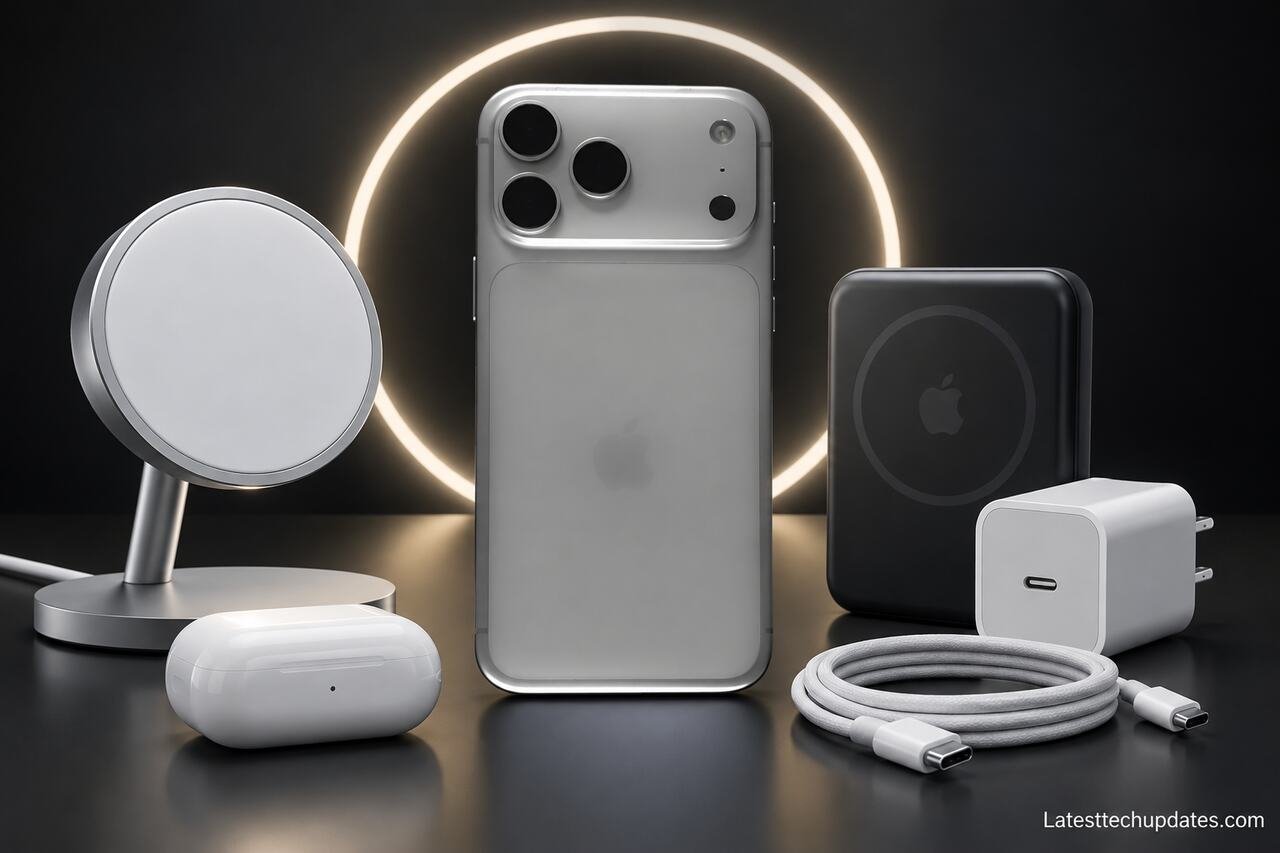
The iPhone 18 Pro Max supports 25W MagSafe and Qi2 wireless charging, along with fast USB-C charging that can reach approximately 50% battery in 15 minutes using a compatible 60W or higher adapter. Charging performance depends on the charger, power adapter, magnetic alignment, and temperature.
iPhone 18 Pro Max Charging Specifications
The iPhone 18 Pro Max offers three main charging options: USB-C wired charging, Apple’s MagSafe magnetic wireless charging, and Qi2 wireless charging. Each option serves a different purpose, with wired charging offering the fastest advertised charging time and magnetic charging providing greater everyday convenience.
| Charging feature | iPhone 18 Pro Max specification |
| Charging connector | USB-C |
| MagSafe wireless charging | Up to 25W |
| Qi2 wireless charging | Up to 25W |
| Fast wired charging | Up to 50% in approximately 15 minutes |
| Wired fast-charging requirements | 60W or higher AVS-capable adapter and USB-C cable |
| MagSafe fast-charging performance | Up to 50% in approximately 30 minutes |
| Adapter for the stated MagSafe charging time | 35W or higher |
| Magnetic alignment | Built-in magnet array and alignment magnet |
| Accessory identification | NFC support |
| Battery type | Built-in rechargeable lithium-ion |
The distinction between maximum charging power and actual charging speed matters. A 25W wireless charging rating represents a supported peak, not a guarantee that the phone will continuously receive 25W throughout the entire charging session.
As the battery charges, the iPhone manages power delivery according to battery level, temperature, and other operating conditions. Therefore, a charger advertised at 25W will not necessarily provide identical charging times to every other 25W charger.
How MagSafe Charging Works on the iPhone 18 Pro Max
MagSafe uses a magnetic alignment system to position a compatible wireless charger against the charging area on the back of the iPhone. This helps keep the phone and charging coil correctly aligned, reducing the inconvenience of repeatedly adjusting the device on a traditional wireless charging pad.
The iPhone 18 Pro Max includes a built-in magnet array, alignment magnet, magnetometer, and NFC-based accessory identification. These components support Apple’s magnetic charging and accessory ecosystem.
MagSafe Charging Speed and Power Requirements
The iPhone 18 Pro Max supports up to 25W MagSafe charging, but reaching the supported peak requires the appropriate charger and power supply.
Compatible MagSafe Charger models can provide up to 25W charging when paired with an adapter capable of supplying at least 30W at the required voltage. For the iPhone 18 Pro Max’s advertised approximately 30-minute charge to 50%, a 35W or higher adapter is specified.
This creates a useful distinction for buyers:
- A compatible 30W adapter can meet the requirements for up to 25W peak MagSafe power.
- A 35W or higher compatible adapter matches the power-adapter requirement for the published 50% charging-time claim.
- A 65W or 100W adapter does not automatically make MagSafe charge faster than the iPhone’s supported limit.
A higher-wattage adapter can still be useful when shared with a laptop, tablet, or multi-device charging station.
Does MagSafe Work Through a Phone Case?
MagSafe works best with cases specifically designed for the iPhone 18 Pro Max and equipped with properly positioned magnetic rings.
A MagSafe-compatible case can support charging without removal, provided the case does not create excessive distance between the charger and phone. Thick protective cases, poorly positioned magnetic inserts, and certain metal accessories may interfere with alignment or charging efficiency.
Cases designed for earlier iPhone generations should not automatically be considered suitable. Even when their magnetic rings appear similar, changes in dimensions and camera layout can prevent a proper fit.
Qi2 Wireless Charging on the iPhone 18 Pro Max
Qi2 is a wireless charging standard developed by the Wireless Power Consortium (WPC). It establishes requirements for interoperability between certified wireless charging products and compatible devices.
The original Qi2 standard introduced magnetic alignment with charging power up to 15W. In July 2025, the WPC announced Qi2 25W, based on version 2.2.1 of the Qi standard, extending the certified ecosystem to higher wireless charging power.
The iPhone 18 Pro Max supports Qi2 charging up to 25W, making compatible third-party wireless chargers a practical alternative to Apple’s own MagSafe Charger.
MagSafe vs. Qi2: What’s the Difference?
MagSafe is Apple’s magnetic charging and accessory system, while Qi2 is an industry wireless charging standard maintained by the WPC.
Both can provide magnetic alignment and wireless charging, but they are not identical certifications or product categories.
| Feature | Apple MagSafe | Qi2 wireless charging |
| Ecosystem | Apple magnetic accessory system | Industry standard |
| iPhone 18 Pro Max charging support | Up to 25W | Up to 25W |
| Magnetic alignment | Yes | Yes, on magnetic Qi2 charging products |
| Accessory manufacturers | Apple and compatible third parties | Certified third-party manufacturers |
| Older products | Charging capability varies by generation | Original Qi2 products generally support up to 15W |
| Best for | Apple’s charging ecosystem and compatible accessories | Wider selection of certified chargers and designs |
A critical buying detail is that Qi2 does not always mean 25W. Original 15W Qi2 chargers remain available, while newer products may be specifically labeled Qi2 25W or Qi2.2.
A genuine Qi2-certified 15W charger can be an excellent product. It simply should not be purchased with the expectation that it will reach the iPhone 18 Pro Max’s 25W charging ceiling.
Is Qi2 Better Than Standard Qi Wireless Charging?
Qi2 magnetic charging offers a practical advantage over conventional wireless charging pads because alignment becomes more consistent.
On an ordinary wireless pad, an incorrectly positioned phone may charge inefficiently or fail to charge. Magnetic alignment makes placement more predictable, particularly when using vertical charging stands or mounts.
However, certification, input power, and design still determine performance. A charger that magnetically attaches to an iPhone is not automatically Qi2-certified.
Buyers should check the exact product’s certification and supported wireless output rather than relying solely on phrases such as magnetic compatible or MagSafe-style.
Best MagSafe and Qi2 Charging Accessories for iPhone 18 Pro Max
The best charging accessories for the iPhone 18 Pro Max depend on where the phone is used most frequently. A magnetic charging stand makes sense for a desk, a wireless power bank is useful during travel, and a multi-device charging station can reduce cable clutter at home.
Products from Apple, Belkin, Anker, mophie, Twelve South, Zens, and other manufacturers cover a wide range of charging needs. The accessories below represent useful product categories rather than a laboratory-tested charging-speed ranking.
1. Apple MagSafe Charger for Everyday Charging
The Apple MagSafe Charger is a straightforward choice for users who want a magnetic charging solution without extra features.
It is available in different cable lengths, including 1-meter and 2-meter versions. Pairing a suitable version with a compatible power adapter enables the iPhone 18 Pro Max’s supported MagSafe charging performance.
The longer cable can be especially helpful at a bedside table or workstation where the power outlet is not close to the phone.
The main drawback is that the basic MagSafe Charger does not provide the upright positioning, portability, or multi-device capabilities of more elaborate charging accessories.
2. Qi2 Charging Stands for Desks and Nightstands
Magnetic charging stands keep the phone elevated, making notifications, video calls, and charging status easier to view.
The Anker MagGo Wireless Charger (Stand with Spotlight) is one example worth considering. Verify the exact model’s wireless charging wattage before purchasing because not every magnetic stand offers 25W output.
An adjustable viewing angle is particularly useful for people who use StandBy mode while the phone charges in landscape orientation.
For nightstand use, consider whether the charger has bright indicator lights or built-in illumination that could become distracting in a dark room.
3. Multi-Device Wireless Charging Stations
A three-in-one charging station is particularly convenient for users who charge an iPhone, Apple Watch, and wireless charging earbuds each day.
Products such as the Belkin UltraCharge Pro 3-in-1 Magnetic Charging Dock combine multiple charging areas into a single desktop unit, reducing the need for separate charging cables and adapters.
Before choosing a multi-device station, check the supported charging output of each charging surface. The station’s total advertised wattage is not necessarily the power available to the iPhone alone.
Apple Watch fast charging also has separate hardware requirements, so a charging station’s iPhone compatibility does not automatically establish its Watch charging performance.
4. Magnetic Power Banks for Travel
Magnetic power banks attach to the back of the iPhone, allowing users to recharge without keeping a separate cable connected.
Compact models such as the Belkin BoostCharge Pro Magnetic Power Bank 5K are suitable for occasional charging during commuting, sightseeing, or long days away from an outlet.
A 5,000mAh power bank is primarily a portability option, while a 10,000mAh model offers greater stored energy at the cost of additional size and weight.
However, advertised battery capacity does not equal the energy delivered to the phone. Wireless conversion losses, operating temperature, and power-bank electronics reduce usable output.
For example, a typical 5,000mAh lithium-ion power bank rated at a nominal 3.7V stores approximately:
5,000mAh3.7V=18.5Wh
The energy eventually reaching the iPhone battery will be lower than 18.5Wh. Consequently, buyers should not assume that a 5,000mAh power bank will deliver a particular percentage of recharge without considering the phone’s battery energy capacity and the accessory’s efficiency.
5. Foldable Qi2 Chargers for Frequent Travelers
Foldable charging accessories are designed for portability. They can replace multiple charging pads while occupying relatively little space in a bag.
The Twelve South ButterFly SE 2-in-1 Travel Charger is an option worth comparing for people who regularly carry an iPhone and Apple Watch.
When evaluating travel chargers, inspect the exact model version, included power adapter, supported regional plugs, and folded dimensions. Product families sometimes contain older variants with different wireless charging limits.
Choosing the Right USB-C Charger and Cable
USB-C is the best option when charging speed takes priority over the convenience of magnetic attachment.
The iPhone 18 Pro Max can charge to approximately 50% in 15 minutes using a 60W-capable or higher adapter with Adjustable Voltage Supply and a suitable USB-C charging cable.
The adapter’s capabilities matter more than its headline wattage alone.
Why USB Power Delivery and AVS Matter
USB Power Delivery (USB PD) enables compatible devices and chargers to negotiate suitable electrical power levels. Adjustable Voltage Supply provides finer voltage control on supported equipment.
A power adapter advertising 65W does not necessarily deliver the same iPhone charging performance as another 65W adapter if it lacks the required charging profile.
For the fastest advertised charging performance, check for:
- A USB-C power adapter rated at 60W or higher.
- Explicit support for the required AVS charging capability.
- A suitable, undamaged USB-C charging cable.
- Compliance with applicable electrical safety requirements.
A USB-C cable used exclusively for charging does not need premium high-speed data transfer capabilities. However, its power-handling capability must be appropriate for the connected charger.
Multi-port adapters introduce another consideration: available power may be redistributed when multiple devices are connected. A charger labeled 100W might allocate less than 60W to the iPhone when a laptop or tablet occupies another port.
MagSafe vs. USB-C: Which Charging Method Is Faster?
USB-C wired charging is faster based on the advertised charging benchmarks for the iPhone 18 Pro Max.
In ideal test conditions, wired fast charging can reach 50% in around 15 minutes, while the specified MagSafe setup can achieve 50% in approximately 30 minutes.
| Charging method | Approximate time to 50% | Best use |
| USB-C fast charging | 15 minutes | Quick charging before leaving home |
| MagSafe wireless charging | 30 minutes | Convenient everyday charging |
| Qi2 wireless charging | Depends on charger | Flexible third-party charging setups |
These figures are based on specified compatible charging equipment and do not represent full-charge times.
The difference matters most when time is limited. Someone preparing to leave home with a nearly empty battery will generally benefit more from a suitable USB-C fast charger than from a wireless charging stand.
MagSafe is more convenient when the phone is frequently placed on and removed from a charging surface. Wireless charging also reduces the need to plug a cable directly into the phone’s connector.
A practical arrangement is to use both methods: MagSafe or Qi2 for routine desktop and nighttime charging, and USB-C for faster top-ups before travel.
MagSafe Cases, Wallets, and Mounts: Compatibility Considerations
MagSafe is also an accessory attachment system. Its built-in magnets allow compatible cases, wallets, grips, stands, and vehicle mounts to attach to the iPhone without permanent adhesives.
iPhone 18 Pro Max-specific cases, magnetic wallets, and third-party grips can complement a magnetic charging setup, provided their dimensions and attachment mechanisms are compatible.
MagSafe-Compatible Cases
A good MagSafe case needs to satisfy two requirements: it must physically fit the iPhone 18 Pro Max, and its magnets must be aligned correctly with the device.
The first requirement affects camera clearance, button access, speaker openings, and overall protection. The second affects how securely chargers and accessories attach.
A case’s magnetic strength can also influence whether a heavy phone remains attached to a vehicle mount during vibration.
Magnetic Wallets and Grips
Magnetic wallets provide quick access to cards, while removable grips improve handling and can function as phone stands.
However, an attached wallet generally occupies the same magnetic area needed for wireless charging. It should be removed before attaching the MagSafe Charger.
Users should also avoid placing credit cards, security badges, passports, or key fobs between the iPhone and its MagSafe Charger because magnetic strips or RFID components may be damaged.
Magnetic Car Mounts
Car mounts are useful for navigation, but they introduce additional compatibility and environmental considerations.
The iPhone 18 Pro Max is a relatively large device, so a secure mounting mechanism is especially important. Drivers should look for a mount that remains stable during cornering and over uneven roads.
Charging performance may also be affected by direct sunlight, warm cabin temperatures, and prolonged navigation use. A magnetic mount positioned near an air vent may help with cooling in some conditions, but a heating vent can have the opposite effect.
Choose a mounting location that preserves visibility and does not obstruct vehicle controls or airbags.
How to Avoid Slow Charging, Excessive Heat, and Battery Wear
Wireless charging generates heat during power transfer, and temperature management can affect the charging rate.
MagSafe and Qi2 charging systems are designed to regulate charging, but the surrounding environment still influences performance. A phone charging inside a thick case, in direct sunlight, or while running demanding applications may become warmer than one charging on an open desk.
Practical ways to improve charging reliability include keeping the charger in a ventilated location, removing incompatible accessories, using a suitable power adapter, and avoiding heat-intensive tasks when rapid charging is needed.
A warm phone is not automatically defective. However, excessive or persistent heat, repeated charging interruptions, or warning messages deserve attention.
Troubleshooting a MagSafe Charger That Is Charging Slowly
If the iPhone 18 Pro Max charges slowly on MagSafe, first confirm that the charging puck and power adapter support the desired output. Then inspect the connection and operating environment.
Connect the MagSafe Charger to power before placing the iPhone on it. If the phone was attached before the charger received power, remove the phone, allow a short interval, and reconnect it. This helps the charging system establish the appropriate power-delivery conditions.
Also check whether the phone is performing a demanding task, whether a thick case is affecting alignment, or whether the battery is already near full charge.
An additional consideration concerns attached accessories. MagSafe charging can be limited to 16W on the iPhone 18 Pro Max when certain USB-C accessories, such as headphones, are connected. This can explain lower charging performance even when the charger itself supports 25W.
Does Wireless Charging Damage the Battery?
Properly functioning, compatible wireless charging does not inherently mean the battery will be damaged. The iPhone manages charging to protect the battery under supported operating conditions.
Nevertheless, lithium-ion batteries age over time, and sustained exposure to high temperatures can accelerate deterioration.
Users seeking to preserve long-term battery health should prioritize sensible temperature management over obsessing about minor differences between reputable chargers.
Where available, charging optimization and charge-limit settings can also help manage charging behavior according to individual usage patterns.
How to Build the Best iPhone 18 Pro Max Charging Setup
Buying every type of accessory rarely offers the best value. A better approach is to select equipment for the places and situations where charging is actually needed.
The following table matches common usage scenarios with suitable equipment.
| User scenario | Recommended setup | Main reason |
| Fast charging before leaving home | 60W+ AVS USB-C adapter and suitable cable | Fastest advertised charging option |
| Office desk | Magnetic Qi2 or MagSafe stand | Easy screen visibility and placement |
| Bedside charging | MagSafe or Qi2 nightstand charger | Convenient overnight charging |
| iPhone, Apple Watch, and earbuds | Compatible 3-in-1 charging station | Consolidates several chargers |
| Commuting and travel | Magnetic battery pack | Portable charging without a dangling cable |
| Navigation | Secure magnetic car mount or charging mount | Hands-free positioning |
| Tight budget | Reuse a suitable USB-C adapter and cable | Avoids unnecessary purchases |
For most owners, a capable wired charger and one reliable magnetic charger provide a sensible foundation.
People who travel frequently can add a compact magnetic power bank, while Apple Watch users may benefit from replacing several separate charging pads with a multi-device station.
What to Check Before Buying Third-Party Accessories
Before purchasing, verify the charger’s exact model compatibility, supported wireless output, certification, and input power requirements.
A product advertised as Qi2-compatible may still be limited to 15W, and a product that attaches magnetically may not have Qi2 certification at all.
Also confirm that the phone case and charger fit together correctly, that the accessory meets appropriate safety requirements, and that the package includes the necessary cable or power adapter.
The most common purchasing mistake is confusing magnetic attachment compatibility with charging capability. An accessory may attach securely and charge the phone, yet lack the hardware required for its fastest supported wireless charging speed.
Frequently Asked Questions
Does the iPhone 18 Pro Max support 25W MagSafe charging?
Yes. The iPhone 18 Pro Max supports MagSafe wireless charging up to 25W. Achieving that peak depends on using compatible charging equipment and suitable operating conditions.
Can I use an older MagSafe charger with the iPhone 18 Pro Max?
Yes, compatible older MagSafe charging accessories can still charge the phone. However, an older model may support a lower charging rate. Check the charger’s exact model and rated output before assuming it offers 25W performance.
Can the iPhone 18 Pro Max charge using a Qi2 15W charger?
Yes. A compatible 15W Qi2 charger can wirelessly charge the iPhone 18 Pro Max, but its maximum rated output remains 15W. Buying a 25W-capable phone does not increase the maximum output of an existing 15W charging pad.
Does the iPhone 18 Pro Max need an Apple-branded power adapter?
No. A suitable third-party USB-C power adapter can work, provided it supports the required output, charging protocol, and electrical specifications. For the fastest advertised wired charging performance, verify support for the necessary AVS capability.
Can I charge the iPhone 18 Pro Max with MagSafe while using a magnetic wallet?
A magnetic wallet generally needs to be removed because it covers the rear charging area and may interfere with wireless charging. Magnetic cards and sensitive items should not be placed between the charger and phone.
Is a 25W Qi2 charger as fast as Apple’s MagSafe Charger?
Both technologies support up to 25W on the iPhone 18 Pro Max, but identical maximum ratings do not guarantee identical charging times. The charger design, adapter, battery level, temperature, and compatibility all influence real-world performance.
Conclusion
The iPhone 18 Pro Max supports a flexible charging ecosystem built around 25W MagSafe, 25W Qi2, and fast USB-C charging. Wired charging is the preferred choice when speed matters, while MagSafe and Qi2 offer convenient magnetic alignment for desks, nightstands, vehicles, and portable batteries.
For most users, the best combination is a compatible 60W or higher AVS-capable USB-C charger for fast charging, a reliable MagSafe or Qi2 charger for daily use, and a MagSafe-compatible case designed specifically for the iPhone 18 Pro Max.
Before purchasing any additional accessory, check its exact compatibility, certified charging power, and power-adapter requirements. The right accessory is not necessarily the one with the highest advertised wattage, but the one that reliably meets your charging needs.
