
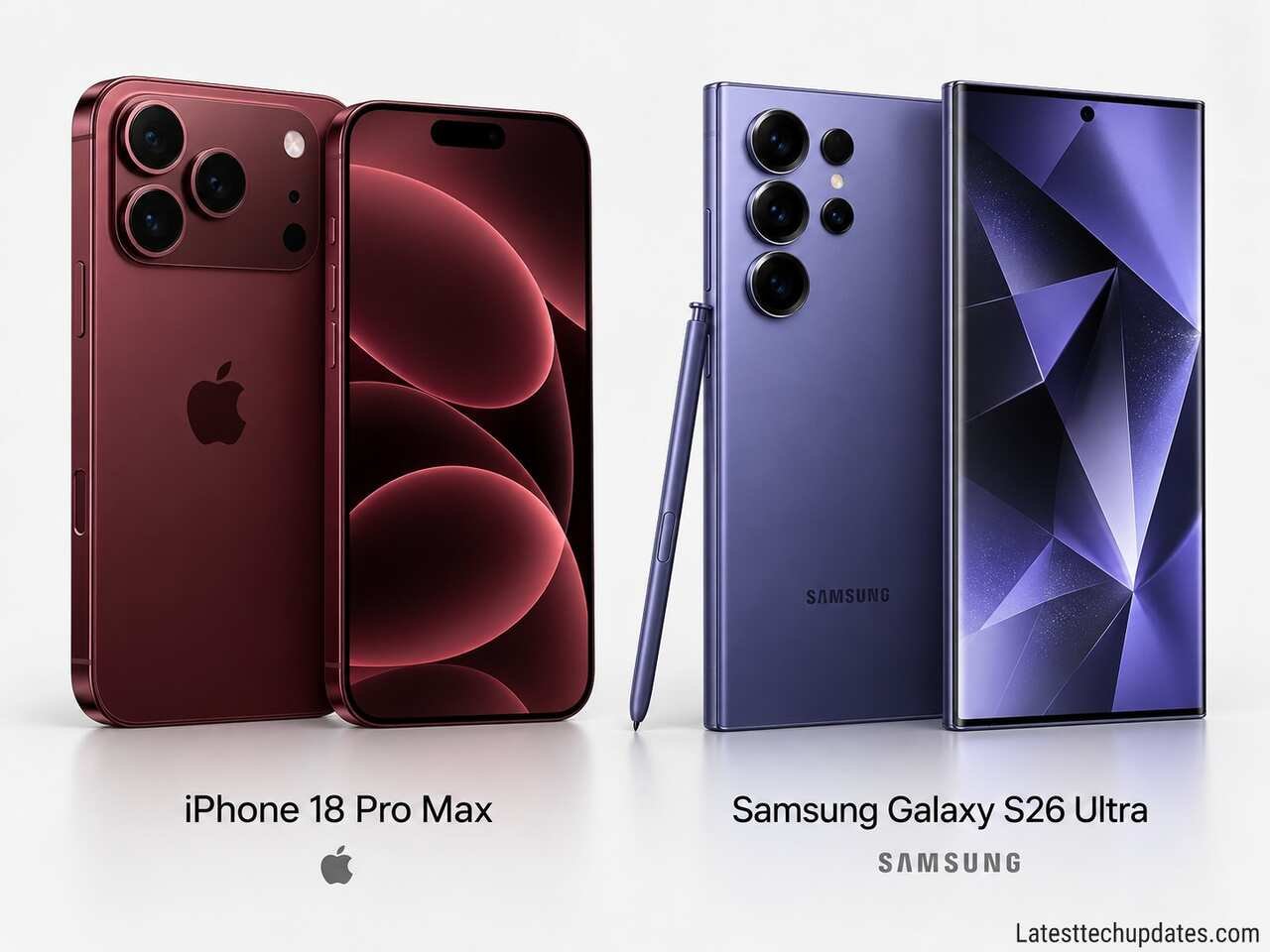
The iPhone 18 Pro Max vs Samsung Galaxy S26 Ultra comparison highlights two powerful flagship smartphones with different strengths. The iPhone 18 Pro Max excels in video recording, battery life, and Apple ecosystem integration, while the Galaxy S26 Ultra stands out for its versatile cameras, S Pen, and advanced productivity features.
iPhone 18 Pro Max vs Samsung Galaxy S26 Ultra: Specifications Compared
Apple released the iPhone 18 Pro Max on September 18, 2026, while Samsung’s Galaxy S26 Ultra became widely available on March 11, 2026. Both launched at approximately $1,299 in the United States, placing them in the same premium price category.
| Feature | iPhone 18 Pro Max | Samsung Galaxy S26 Ultra |
| Display | 6.9-inch Super Retina XDR OLED | 6.9-inch Dynamic AMOLED 2X |
| Resolution | 2868 × 1320 | 3120 × 1440 |
| Refresh rate | Adaptive 120Hz | Up to 120Hz |
| Processor | Apple A20 Pro | Snapdragon 8 Elite Gen 5 for Galaxy |
| Operating system | iOS 27 | Android with One UI |
| Main camera | 48MP, variable aperture | 200MP, f/1.4 |
| Ultra-wide camera | 48MP | 50MP |
| Telephoto system | 48MP, 4x optical | 10MP 3x and 50MP 5x optical |
| Front camera | 18MP Center Stage | 12MP |
| Battery | Up to 45 hours video playback* | 5,000mAh, up to 31 hours video playback* |
| Wired charging | Up to 50% in around 15 minutes | Up to 75% in around 30 minutes |
| Wireless charging | MagSafe and Qi2 up to 25W | Wireless charging supported |
| Weight | 249g | 214g |
| Thickness | 8.75mm | 7.9mm |
| Storage | 256GB to 2TB | 256GB to 1TB |
| Stylus | No integrated stylus | Built-in S Pen |
| Starting US launch price | $1,299 | $1,299.99 |
*Battery figures are manufacturer estimates, obtained under different testing conditions. The iPhone’s 45-hour figure applies to eSIM-only models and should not be interpreted as a direct laboratory comparison. Specifications are based on official Apple and Samsung documentation.
The specifications reveal an important distinction. Samsung offers more physical camera options and productivity features in a noticeably lighter device. Apple counters with creative camera controls, a higher maximum storage capacity, and ambitious battery-life claims.
Design and Build Quality: Which Phone Feels More Premium?
The Galaxy S26 Ultra offers a clear advantage in portability despite having the same advertised display size as the iPhone 18 Pro Max.
Apple uses an aluminum unibody design with Ceramic Shield 2 protection on the front and Ceramic Shield on the back. The iPhone also includes the Action button, Camera Control, and a redesigned Dynamic Island that supports additional Live Activities.
Samsung uses an Armor Aluminum frame with Gorilla Glass protection and a distinctive rear camera arrangement. Its built-in S Pen adds functionality without requiring an external accessory.
The Galaxy S26 Ultra is 35 grams lighter and 0.85mm thinner than the iPhone. That is a meaningful difference for people who frequently use their phones one-handed, read for extended periods, or carry a large phone in their pockets.
Apple’s design is attractive for users who appreciate dedicated camera controls and physical shortcuts. Samsung’s design makes more sense for users who want a large display without carrying the heaviest flagship.
Both phones offer IP68 water and dust resistance, although their tested immersion specifications and warranty exclusions should be checked separately.
Design winner: Samsung Galaxy S26 Ultra, primarily because it offers comparable screen size with substantially less weight.
Display Comparison: Super Retina XDR vs Dynamic AMOLED 2X
Both flagship phones deliver premium viewing experiences with 6.9-inch OLED panels and refresh rates reaching 120Hz. Scrolling, animation, gaming, and video playback should look smooth on either device.
The iPhone 18 Pro Max features a 2868 × 1320 Super Retina XDR display, a pixel density of 460 pixels per inch, and up to 3,000 nits of peak outdoor brightness under Apple’s specified conditions. Its anti-reflective coating helps improve viewing comfort in bright environments.
Samsung equips the Galaxy S26 Ultra with a 3120 × 1440 Dynamic AMOLED 2X display. Its higher resolution delivers more pixels, although the practical difference at typical viewing distances may be small.
Samsung’s Privacy Display Is a Meaningful Difference
One of the Galaxy S26 Ultra’s most distinctive features is its built-in Privacy Display.
This technology is designed to reduce the visibility of on-screen information from side angles. It can be useful when checking messages, viewing confidential documents, or using banking applications in crowded public spaces.
Unlike a removable privacy screen protector, Samsung integrates this capability into the display hardware and software. Users can configure privacy-related behavior according to supported settings.
The feature has practical limitations. It is not a guarantee that people nearby cannot see your screen, and privacy modes may alter the viewing experience.
The iPhone focuses instead on high brightness, color accuracy, smooth animation, and integration with iOS.
Display winner: Samsung Galaxy S26 Ultra for functionality, thanks to its higher resolution and Privacy Display. However, both screens are excellent for everyday content consumption.
Performance: Apple A20 Pro vs Snapdragon 8 Elite Gen 5
The iPhone 18 Pro Max uses Apple’s A20 Pro processor, manufactured using a 2-nanometer process. The Galaxy S26 Ultra runs Qualcomm’s Snapdragon 8 Elite Gen 5 for Galaxy, a customized flagship chipset.
Apple’s A20 Pro includes a six-core CPU, seven-core GPU, and Dual 16-core Neural Engine. Apple also redesigned its cooling system with a larger vapor chamber to improve performance during demanding workloads.
Samsung’s processor combines high-performance CPU and graphics capabilities with an upgraded neural processing unit for Galaxy AI operations.
Gaming and Sustained Performance
Both phones have the processing power to run demanding mobile games, multitask, edit videos, and handle computational photography.
The important distinction is sustained performance rather than how quickly either device opens ordinary apps.
Games running at high frame rates can generate significant heat. As temperature rises, a smartphone may reduce processor speed to manage heat and maintain reliability. Cooling efficiency therefore matters alongside benchmark scores.
Apple claims a substantial improvement in sustained performance compared with its previous generation. Samsung also emphasizes improved processor and thermal performance.
Without identical independent gaming tests, it would be misleading to declare one chip categorically faster across every workload.
AI Processing
Apple’s A20 Pro powers Apple Intelligence and Siri AI, including contextual assistance, photography tools, and supported on-device operations.
Samsung uses its Snapdragon platform to support Galaxy AI capabilities across communication, creative work, and productivity.
For most buyers, the more important question is which software functions they use regularly, rather than which processor achieves the highest synthetic benchmark score.
Performance verdict: Both are flagship-class performers. The iPhone is particularly attractive for demanding iOS creative workflows, while Samsung offers powerful hardware alongside Android multitasking flexibility.
Camera Comparison: 48MP Variable Aperture vs 200MP Quad Camera
The camera system is one of the biggest differences between the iPhone 18 Pro Max and Galaxy S26 Ultra.
Samsung prioritizes multiple focal lengths and high-resolution photography. Apple focuses on sensor improvements, variable aperture technology, creative control, and advanced video recording.
Main Camera: Does 200MP Beat 48MP?
The Galaxy S26 Ultra features a 200MP main camera with an f/1.4 aperture. Its high-resolution sensor can capture substantial image detail under suitable lighting conditions.
However, megapixel count alone does not determine image quality. Sensor size, optical performance, image processing, dynamic range, and exposure also influence the final photograph.
The iPhone 18 Pro Max introduces a 48MP Fusion Main camera with a variable aperture offering four settings: f/1.48, f/1.8, f/2.8, and f/4.0.
This gives photographers additional control over the amount of light entering the camera and the depth of field.
For example, a wider aperture can help when photographing someone indoors under limited lighting. A narrower aperture can make it easier to keep multiple people at different distances in focus, provided sufficient light is available.
Samsung’s wide f/1.4 aperture is designed to capture more light, but actual low-light image quality depends on more than the aperture number.
Main camera verdict: Samsung has the higher-resolution sensor, while Apple offers greater physical aperture control. Neither specification alone establishes the superior image quality.
Zoom Photography: Samsung Offers More Flexibility
Samsung uses two dedicated telephoto cameras: a 10MP 3x optical camera and a 50MP 5x optical camera. Its camera system also supports 10x optical-quality zoom and digital zoom up to 100x.
The iPhone uses a 48MP 4x optical telephoto camera, with 8x optical-quality zoom and digital zoom up to 40x.
This matters when photographing distant subjects.
For concerts, wildlife, architecture, and travel photography, Samsung’s separate 3x and 5x cameras offer useful framing options. The iPhone’s 4x telephoto provides a middle ground, while its 8x optical-quality option extends its practical reach.
Optical-quality zoom should not be confused with having a dedicated optical lens at every advertised magnification. Image cropping and processing can also contribute to the final result.
Samsung offers more zoom choices, particularly at longer distances. Nevertheless, the quality of the resulting photographs still depends on lighting and processing.
Zoom winner: Samsung Galaxy S26 Ultra.
Selfies and Portrait Photography
The iPhone 18 Pro Max features an 18MP Center Stage front camera, while Samsung uses a 12MP selfie camera.
Apple’s Center Stage functionality can help keep people framed during video calls and supported camera activities. Samsung provides autofocus and its own computational image processing.
For portraits, the iPhone’s variable aperture and depth controls create interesting opportunities for photographers who want to adjust the appearance of backgrounds.
Samsung’s multiple focal lengths can also provide useful portrait perspectives.
Image preferences vary. Some people favor brighter, more vivid photographs, while others prefer restrained colors and natural-looking skin tones. A controlled side-by-side photo test is more informative than simply comparing resolutions.
Video Recording: The iPhone Has Strong Creative Advantages
Apple provides an extensive set of professional recording tools, including 4K Dolby Vision recording up to 120fps with the main camera, ProRes video, ProRes RAW, Apple Log 2, and support for external recording workflows.
The Galaxy S26 Ultra supports 8K video recording at 30fps, giving users a higher maximum capture resolution. Samsung also includes advanced stabilization and night-video processing features.
The distinction is about production workflow rather than resolution alone.
Apple’s formats and controls are particularly useful for creators who need to manage color grading, editing flexibility, and consistent footage across projects. Samsung’s 8K option can be useful when recording high-resolution footage for later cropping, although file sizes and editing requirements may increase.
For example, a filmmaker preparing footage for a professional editing timeline may place more value on Apple Log 2 and ProRes RAW than on 8K resolution.
Video winner: iPhone 18 Pro Max for professional workflow flexibility. Samsung remains a capable alternative for users who prioritize 8K recording.
Battery Life and Charging: Which Flagship Lasts Longer?
Battery endurance is a major selling point of the iPhone 18 Pro Max.
Apple advertises up to 45 hours of video playback for the eSIM-only model. Samsung rates the Galaxy S26 Ultra’s 5,000mAh battery for up to 31 hours of video playback.
These figures are not directly comparable because the companies use their own testing procedures and conditions. They indicate each manufacturer’s claimed endurance rather than proving a 14-hour advantage in identical real-world use.
Charging Speed
Apple specifies charging from zero to approximately 50% in 15 minutes with a compatible 60W-capable power adapter and the required charging profile.
Samsung advertises charging up to 75% in approximately 30 minutes under supported conditions.
Both support fast wired charging and wireless charging. The iPhone additionally provides integrated MagSafe magnets and Qi2 wireless charging at up to 25W.
Samsung’s wired charging system can be attractive for people who frequently recharge during short breaks. Apple offers a particularly convenient magnetic accessory ecosystem.
Battery Capacity vs Battery Efficiency
Battery capacity should not be treated as a complete measure of endurance.
Two devices with different battery sizes can deliver similar runtime if their processors, screens, radios, and software use different amounts of energy.
A reliable comparison should test activities such as browsing, photography, GPS navigation, video streaming, and gaming at similar display brightness and network conditions.
Until those conditions are controlled, the official figures should be interpreted cautiously.
Battery verdict: Apple has the stronger advertised video-playback endurance, while both offer competitive fast charging. Independent matched testing is necessary to establish the real-world winner.
Software and AI: iOS 27 vs Samsung One UI
Software preference may have a greater influence on long-term satisfaction than any individual hardware specification.
The iPhone 18 Pro Max runs iOS 27, combining Apple’s established software ecosystem with updated Apple Intelligence features. Samsung’s Galaxy S26 Ultra runs Android with One UI and Galaxy AI.
Apple Intelligence and Siri AI
Apple’s new Siri AI is designed to understand personal context and help perform supported tasks across applications.
Its capabilities include contextual assistance, onscreen awareness, and integrations with Apple’s existing applications and services.
Apple also introduced Reference Image functionality for the iPhone 18 Pro camera system, allowing users to preserve a verifiable reference to original captured image data. This may be useful in photography and editorial workflows where image authenticity matters.
Some newer Siri AI functionality was introduced in beta, meaning availability and reliability can depend on software version, language, and region.
Galaxy AI and Samsung Productivity
Samsung emphasizes AI features that assist with communication, content creation, and everyday tasks.
The Galaxy S26 Ultra also includes two notable productivity advantages:
- Samsung DeX: Allows compatible external displays to support a desktop-style working environment.
- S Pen: Supports precise writing, drawing, annotations, and other stylus-based interactions.
These features are relevant to students, professionals, designers, and people who regularly work with documents on their phones.
For example, someone reviewing a PDF can use the S Pen to make handwritten annotations without carrying an additional stylus.
Software Support and Longevity
Samsung promises seven generations of operating system upgrades and seven years of security updates for the Galaxy S26 series, measured from its global launch.
Apple has a history of providing multiple years of iOS updates, although buyers should not assume an identical seven-year contractual commitment without a specific guarantee for the model.
Users should also consider how well their existing accessories, applications, backups, and other devices integrate with a new phone.
Software verdict: Apple offers a tightly integrated experience for users of Macs, iPads, Apple Watches, and other Apple services. Samsung offers more flexibility for people who prefer Android customization, stylus input, and desktop-style productivity.
Price and Storage: Which Phone Offers Better Value?
The iPhone 18 Pro Max launched at $1,299 in the US, while the Galaxy S26 Ultra launched at $1,299.99.
At their starting prices, neither offers a substantial cost advantage over the other.
Apple provides four storage tiers, reaching 2TB. Samsung offers up to 1TB.
The additional 2TB option is particularly relevant to creators who record large video files or keep extensive media libraries locally.
However, the highest storage configuration is not necessarily the best value.
Consider a hypothetical buyer who records videos occasionally, uses cloud storage, and mostly streams entertainment. A 256GB model may be sufficient, provided their existing storage usage supports that decision.
Someone who regularly shoots high-bitrate professional video could require considerably more storage.
When comparing purchase prices, buyers should account for trade-in discounts, carrier promotions, insurance, accessories, and local taxes. Those expenses can change the total cost of ownership.
A practical comparison is to calculate:
Total ownership cost = phone price + accessories + service costs + repairs or insurance − resale or trade-in value.
For example, a $100 price discount may be less valuable if moving to another platform requires replacing an expensive smartwatch or purchasing additional accessories.
Value verdict: Both start at almost identical US prices. Samsung’s additional productivity features may create better value for certain users, while Apple’s larger storage option and ecosystem integration may justify its cost for others.
Which Phone Should You Buy Based on Your Needs?
Rather than choosing based on a single benchmark or headline feature, consider how you use your smartphone most frequently.
| Your main priority | Better fit | Reason |
| Professional video creation | iPhone 18 Pro Max | ProRes RAW, Apple Log 2, video controls |
| Long-distance photography | Galaxy S26 Ultra | Dedicated 3x and 5x telephoto cameras |
| Handwriting and document annotation | Galaxy S26 Ultra | Integrated S Pen |
| Maximum built-in storage | iPhone 18 Pro Max | Up to 2TB |
| Lightweight large-screen phone | Galaxy S26 Ultra | 35g lighter |
| Magnetic charging accessories | iPhone 18 Pro Max | Built-in MagSafe |
| Privacy in public environments | Galaxy S26 Ultra | Integrated Privacy Display |
| Mac and Apple Watch integration | iPhone 18 Pro Max | Apple ecosystem continuity |
| Desktop-style mobile productivity | Galaxy S26 Ultra | Samsung DeX |
A buyer who primarily takes photos, uses messaging apps, watches videos, and browses the internet may be satisfied with either flagship.
The decision becomes clearer when a particular capability is important enough to influence daily use.
A content creator may genuinely benefit from Apple’s professional recording formats. A business traveler who works with spreadsheets and presentations may prefer Samsung’s S Pen and DeX support.
Is Switching From iPhone to Samsung, or Samsung to iPhone, Worth It?
Switching ecosystems introduces costs and inconveniences that specifications rarely capture.
Moving from an iPhone to a Galaxy involves considering Apple-specific accessories, iCloud services, app purchases, and messaging habits. Samsung provides Smart Switch to assist with compatible data transfers, but not every application or setting necessarily transfers identically.
Moving from Samsung to iPhone involves similar considerations, including Google and Samsung services, Galaxy Watch compatibility, and workflows built around Android customization.
Before switching, identify the functions you rely on every day. Check banking apps, work authentication tools, photo backups, wearable compatibility, and messaging services.
A phone that excels in camera tests may still be the wrong purchase if it disrupts services that you use constantly.
Users with relatively recent premium smartphones should also consider whether the new features offer enough practical improvement to justify the expense.
Upgrading purely because a new flagship exists is rarely the strongest financial decision.
Frequently Asked Questions
Is the iPhone 18 Pro Max better than the Samsung S26 Ultra?
The iPhone 18 Pro Max is a strong choice for professional video recording, magnetic accessories, and Apple ecosystem integration. The Galaxy S26 Ultra is more versatile for optical zoom, handwriting, multitasking, and display privacy. The better phone depends on your priorities.
Which phone has a better camera for photography?
Samsung offers more dedicated zoom focal lengths and a 200MP main camera. Apple offers a 48MP variable-aperture main camera and extensive manual controls. Neither specification guarantees superior photography in all conditions. Lighting, processing, and shooting style affect results.
Which phone is better for gaming?
Both smartphones offer high-end processors and 120Hz displays. The best gaming experience depends on game optimization, graphics settings, thermal management, battery drain, and sustained frame rates. Direct game-by-game testing is more reliable than processor specifications alone.
Does the Galaxy S26 Ultra support an S Pen?
Yes. The Galaxy S26 Ultra has an integrated S Pen that supports handwriting, drawing, and compatible productivity functions. The iPhone 18 Pro Max does not have a built-in equivalent.
Which phone is likely to last longer?
Both are premium devices designed for long-term use. Samsung provides a defined seven-year software-support commitment, while Apple’s long-standing update practices are another consideration. Battery aging, repair availability, accidental damage, and usage habits also influence how long either phone remains useful.
Is the iPhone 18 Pro Max worth buying over the Galaxy S26 Ultra?
It is worth considering if you frequently record professional video, use Apple devices, need 2TB of internal storage, or prefer iOS. If you value the S Pen, long-range zoom, Privacy Display, and Android customization, the Galaxy S26 Ultra may be a better purchase at a similar starting price.
Final Verdict: iPhone 18 Pro Max or Samsung Galaxy S26 Ultra?
The iPhone 18 Pro Max and Samsung Galaxy S26 Ultra are both powerful flagships, but they appeal to different kinds of buyers.
The iPhone 18 Pro Max makes the most sense for people who prioritize professional video tools, flexible main-camera controls, Apple ecosystem integration, and the company’s ambitious battery-life capabilities.
The Samsung Galaxy S26 Ultra is the stronger fit for buyers who want versatile zoom cameras, a lighter body, integrated S Pen functionality, DeX productivity, and Privacy Display technology.
Neither is universally superior. Buyers should prioritize the features they will actually use, compare current local prices, and consider the cost of switching ecosystems.
At almost identical launch prices, the smartest choice is the phone whose capabilities solve your everyday needs rather than the one with the most impressive specification on paper.
