
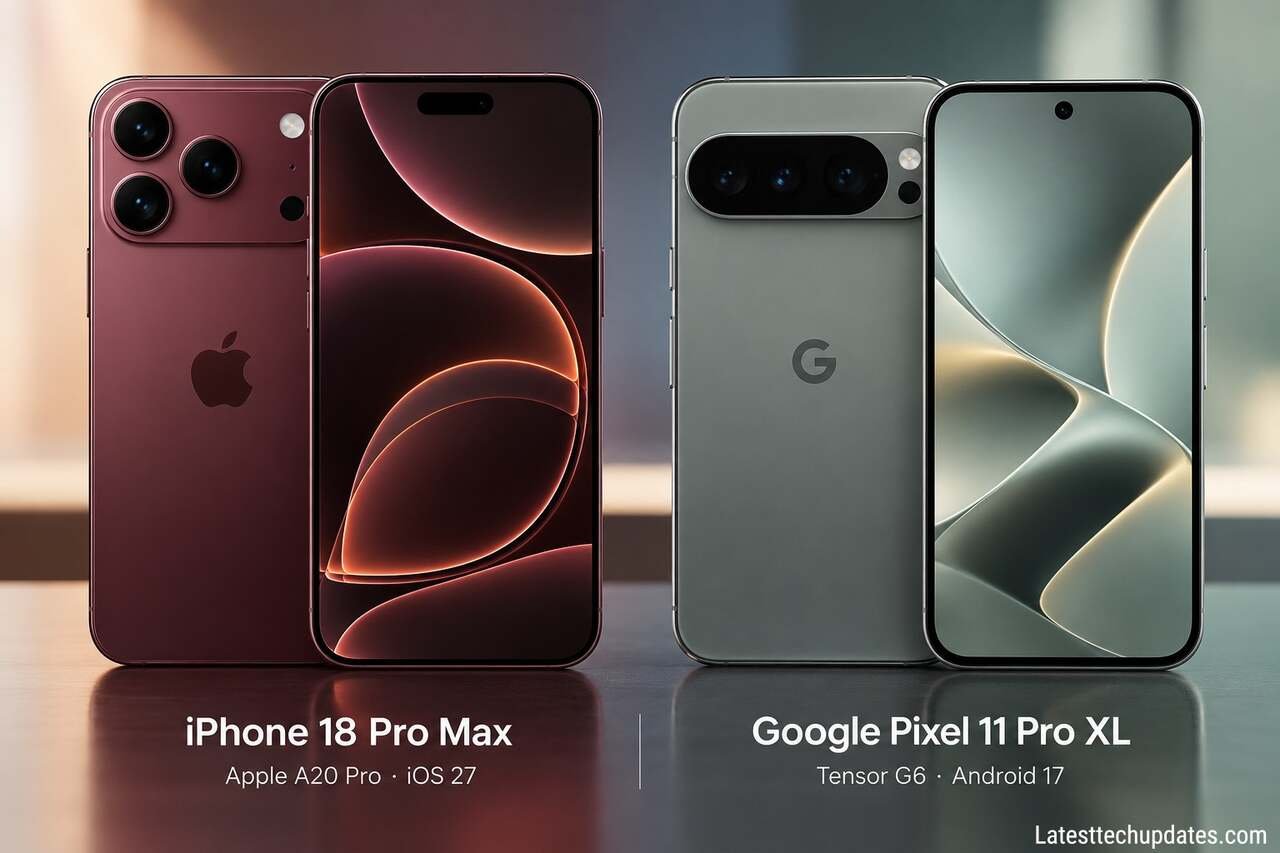
The iPhone 18 Pro Max vs Google Pixel 11 Pro XL comparison highlights two premium smartphones with different strengths. The iPhone focuses on powerful performance, professional video recording, and Apple ecosystem integration, while the Pixel emphasizes AI-powered photography, smart software features, and Android flexibility.
iPhone 18 Pro Max vs Google Pixel 11 Pro XL: Key Specifications
| Specification | iPhone 18 Pro Max | Pixel 11 Pro XL |
| Display | 6.9-inch OLED | 6.8-inch LTPO OLED |
| Refresh rate | Up to 120Hz | 1–120Hz |
| Resolution | 2868 × 1320 | 2992 × 1344 |
| Peak outdoor brightness | 3,000 nits | 3,600 nits peak |
| Processor | Apple A20 Pro | Google Tensor G6 |
| Operating system | iOS 27 | Android |
| Main camera | 48MP, variable aperture | 50MP |
| Ultrawide camera | 48MP | 48MP |
| Telephoto | Dedicated telephoto camera | 48MP, 5x optical |
| Front camera | 18MP Center Stage | Pixel front camera system |
| Battery | Up to 45 hours video playback (Apple claim) | 5,115mAh, 30+ hours typical use (Google claim) |
| Wireless charging | MagSafe and Qi2, up to 25W | Pixelsnap Qi2.2, up to 25W |
| Weight | 249g | 226g |
| Water resistance | IP68 | IP68 |
Specifications are based primarily on Apple’s technical specifications and Google’s Pixel hardware specifications. Manufacturer battery estimates use different testing methods and should not be treated as directly comparable endurance results.
The most noticeable hardware differences are the iPhone’s larger display and heavier construction, the Pixel’s higher advertised peak brightness, and their different processor and camera technologies.
Design and Build Quality: Which Phone Feels Better?
The iPhone 18 Pro Max and Pixel 11 Pro XL both use premium materials, but their physical dimensions produce different handling experiences.
Apple’s flagship measures 163.4 × 78 × 8.75mm and weighs 249g. Its design includes a smaller Dynamic Island, the Action button, and dedicated Camera Control. These controls give users additional ways to access photography functions, shortcuts, and frequently used features.
Google’s Pixel 11 Pro XL measures 162.7 × 76.5 × 8.5mm and weighs 226g. It retains Google’s distinctive camera-bar design while offering a slightly narrower and thinner body.
The Pixel is 23g lighter, approximately 9.2% less weight than the iPhone. That difference can matter when holding the phone for extended periods, reading in bed, or carrying it in a pocket.
Both phones offer IP68-rated water and dust resistance. However, their specific tested immersion conditions and warranty coverage should be checked separately. Water resistance is not permanent and can decline with wear.
Design verdict: The Pixel 11 Pro XL has the advantage for buyers who prioritize lighter, more comfortable handling. The iPhone 18 Pro Max is attractive for users who value its dedicated physical controls and Apple’s design language.
Display Comparison: 6.9-Inch Super Retina XDR vs 6.8-Inch Super Actua
Both smartphones have large, high-resolution OLED displays suitable for watching videos, gaming, editing photos, and multitasking.
The iPhone 18 Pro Max features a 6.9-inch Super Retina XDR OLED display with a resolution of 2868 × 1320 pixels. Apple’s ProMotion technology supports adaptive refresh rates up to 120Hz, while the anti-reflective coating helps reduce distracting reflections.
The Pixel 11 Pro XL features a 6.8-inch Super Actua LTPO OLED panel with a 2992 × 1344 resolution, 486 pixels per inch, and a refresh rate ranging from 1Hz to 120Hz.
Brightness and outdoor visibility
Google advertises up to 3,600 nits of peak brightness for the Pixel 11 Pro XL, compared with Apple’s 3,000-nit peak outdoor brightness specification.
These numbers favor the Pixel on paper, but brightness claims may involve different measurement conditions. Actual outdoor readability also depends on screen reflectivity, automatic brightness behavior, and thermal limits.
Smoothness and visual clarity
Both phones support 120Hz refresh rates, making scrolling, animations, and supported games feel responsive.
The Pixel offers a higher pixel density, while the iPhone has a slightly larger screen. At ordinary viewing distances, most users are unlikely to notice a substantial sharpness difference.
Display verdict: The Pixel 11 Pro XL has an advantage in published peak brightness and pixel density. The iPhone 18 Pro Max offers a marginally larger viewing area and an anti-reflective coating. Neither specification alone establishes a decisive real-world display winner.
Performance and Gaming: Apple A20 Pro vs Google Tensor G6
The iPhone 18 Pro Max has a performance-oriented advantage thanks to Apple’s A20 Pro processor, while the Pixel 11 Pro XL uses Google’s Tensor G6, designed to support AI capabilities alongside everyday smartphone tasks.
Apple A20 Pro performance
Apple’s A20 Pro uses a 2-nanometer manufacturing process and features a six-core CPU, seven-core GPU, and dual 16-core Neural Engine.
Apple also introduced an upgraded vapor-chamber cooling system to improve sustained performance during demanding activities such as gaming, video editing, and graphics-intensive applications.
According to Apple, the redesigned GPU delivers up to 40% faster graphics performance than the A19 Pro, although this is a manufacturer-reported generational comparison rather than an independent benchmark against Google’s chip.
Google Tensor G6 performance
The Pixel 11 Pro XL uses the Tensor G6 processor alongside Google’s Titan M3 security coprocessor.
Its architecture supports computational photography, Gemini AI functionality, voice processing, and Google’s software-based intelligence features.
The Pixel also offers 12GB of RAM in its 256GB configuration and 16GB in its 512GB and 1TB configurations.
Which phone is better for gaming?
The iPhone 18 Pro Max is the more compelling choice for demanding mobile gaming because of its graphics-oriented hardware, improved cooling, and Apple’s established support for high-end games.
The Pixel 11 Pro XL remains suitable for everyday gaming, but a definitive comparison of sustained frame rates, thermal throttling, and power consumption requires independent testing under identical conditions.
Performance verdict: The iPhone 18 Pro Max is the stronger performance-focused option. The Pixel 11 Pro XL prioritizes a combination of capable processing and integrated AI functionality.
Camera Comparison: Which Phone Takes Better Photos?
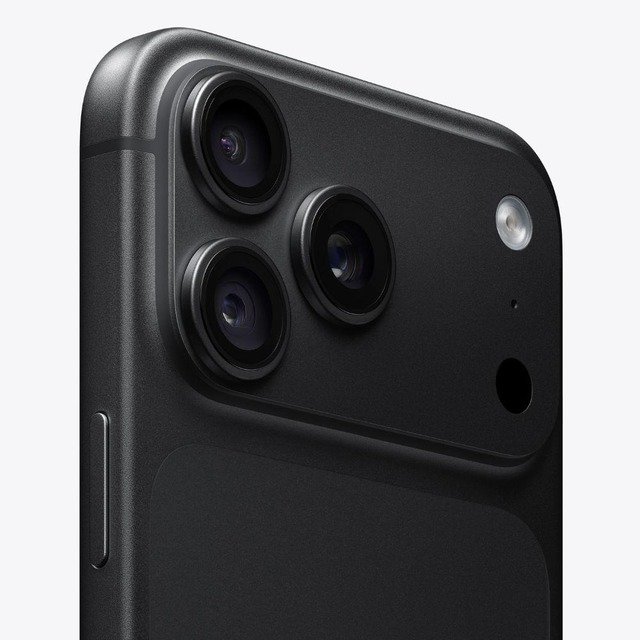
Apple’s variable-aperture main camera
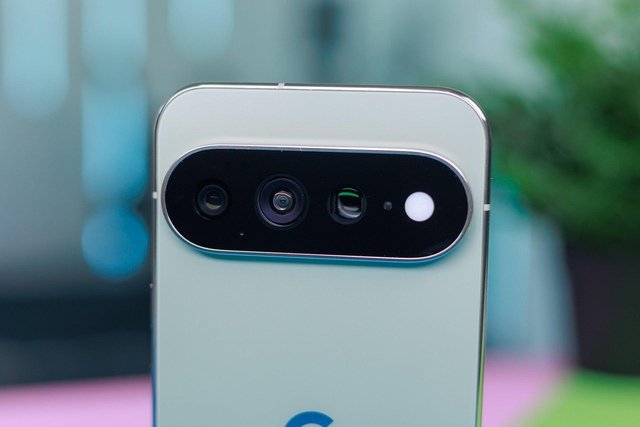
Google’s triple-camera system
Both phones offer sophisticated triple-camera systems, but their strengths are different. Apple emphasizes greater manual control and consistent video capture, while Google combines high-resolution sensors with computational photography and advanced editing tools.
Main camera: 48MP vs 50MP
The iPhone 18 Pro Max features a 48MP Fusion main camera with variable aperture settings of f/1.48, f/1.8, f/2.8, and f/4.0.
Variable aperture allows photographers to adjust how much light reaches the sensor. It can also provide more control over depth of field and exposure, particularly when photographing close subjects or working in bright conditions.
The Pixel 11 Pro XL uses a 50MP main camera with an f/1.68 aperture and a 1/1.3-inch sensor.
Google relies heavily on computational processing to balance exposure, preserve details, and optimize difficult scenes.
A 50MP sensor does not automatically produce better photographs than a 48MP sensor. Image quality also depends on optics, sensor characteristics, stabilization, autofocus, and processing.
Ultrawide and zoom photography
Both phones feature 48MP ultrawide cameras, making them useful for landscapes, architecture, group photographs, and close-up compositions.
Google’s Pixel 11 Pro XL includes a 48MP telephoto camera with 5x optical zoom and Pro Zoom up to 120x.
That extended zoom range provides flexibility when photographing distant subjects. However, images captured at extreme digital zoom levels should not be expected to retain the detail of optical zoom photography.
Apple’s dedicated telephoto camera complements its main and ultrawide lenses, offering additional framing options without relying entirely on digital cropping.
Portraits, selfies, and low-light photography
Apple’s variable aperture and photographic controls make the iPhone particularly interesting for users who want more influence over how their images are captured.
The Pixel offers Google’s familiar computational photography approach, including Night Sight, portrait tools, and AI-assisted editing.
Google’s camera software can be especially useful when a photograph needs adjustments after capture, such as removing distractions, improving composition, or recovering a blurred image.
The iPhone’s 18MP Center Stage front camera also offers automatic framing features for selfies and video calls.
Photography verdict: The Pixel 11 Pro XL is particularly attractive for computational photography, long-range zoom, and AI editing. The iPhone 18 Pro Max is attractive for variable-aperture control and photographers who also prioritize video recording. Neither can be declared the universal still-photo winner without controlled side-by-side image testing.
Video Recording: Why the iPhone Has an Advantage
Video is one of the clearest reasons to choose the iPhone 18 Pro Max.
Apple provides advanced recording options including Dolby Vision, ProRes, ProRes RAW, Apple Log 2, and professional color-management capabilities.
These tools are useful for content creators who want greater control during editing and color grading.
For example, a creator filming interviews, product reviews, or travel footage can record using professional formats and integrate the material into a more demanding editing workflow.
The Pixel 11 Pro XL offers capable 4K recording alongside Google’s Video Boost, Night Sight Video, stabilization, and audio-enhancement features.
These tools make the Pixel practical for social media videos, travel clips, and everyday recording, especially for users who prefer automated improvements.
An October 2026 review by Digital Camera World also highlighted the iPhone 18 Pro Max’s consistent stabilization, color accuracy, and professional video capabilities.
Video verdict: The iPhone 18 Pro Max is the better choice for professional video workflows. The Pixel remains a capable alternative for users who prefer AI-assisted video enhancement.
Battery Life and Charging: Which Lasts Longer?
Battery comparisons require more care than simply comparing capacity or manufacturer endurance figures.
Apple advertises up to 45 hours of video playback for certain iPhone 18 Pro Max configurations, while Google rates the Pixel 11 Pro XL for more than 30 hours of typical battery life.
These figures measure different usage scenarios, so they cannot establish which phone lasts longer during identical daily use.
The Pixel 11 Pro XL contains a 5,115mAh typical-capacity battery. Google’s official specifications state that it can charge to approximately 75% in 30 minutes using a compatible 45W USB-C PPS charger or higher.
The iPhone 18 Pro Max supports fast wired charging and up to 25W wireless charging through MagSafe or compatible Qi2 equipment.
Both phones therefore provide convenient magnetic wireless charging, although their accessory ecosystems differ.
Practical battery comparison
Consider three common usage patterns:
- Heavy gaming: Sustained processor and GPU power consumption, heat, and display brightness matter more than advertised video playback hours.
- Travel and navigation: Cellular signal strength, GPS use, camera activity, and screen brightness can significantly affect endurance.
- Short charging breaks: The Pixel’s published 75%-in-30-minutes charging capability makes it attractive when charging time is limited.
Battery health, ambient temperature, charging accessories, and background applications also influence results.
Battery verdict: Apple’s published endurance figures are impressive, while Google offers a clearly specified rapid-charging capability. A reliable overall battery winner requires standardized real-world endurance testing.
Software and AI: iOS 27 vs Android 17
Software may be the most important difference between these smartphones because it influences how users interact with their phones every day.
iPhone 18 Pro Max: Apple Intelligence and Siri AI
The iPhone 18 Pro Max runs iOS 27 with Apple’s updated intelligence features and Siri AI.
Apple emphasizes personal context, system integration, and privacy-focused processing.
The iPhone is particularly appealing to people who already use a Mac, iPad, Apple Watch, AirPods, or other Apple devices.
Features such as AirDrop, Handoff, iCloud synchronization, and cross-device continuity can make daily tasks more convenient.
Pixel 11 Pro XL: Gemini and Android flexibility
The Pixel 11 Pro XL launched with Android 17 and Google’s Gemini AI ecosystem.
Its software includes Gemini Live, Gemini Nano, Circle to Search, Live Translate, and Google’s AI-assisted communication and photography tools.
The Pixel also supports greater customization of the home screen, default applications, and various system behaviors.
Google promises seven years of operating-system, security, and Pixel Drop updates, providing a clear long-term support commitment.
Which AI experience is more useful?
The answer depends on the task.
Someone who frequently searches visual content, translates conversations, edits photographs, or uses Google services may prefer the Pixel’s Gemini integration.
Someone who works primarily across Apple devices may benefit more from iOS integration, Siri AI, and Apple’s continuity features.
AI capabilities can vary by language, region, account eligibility, and software version. Buyers should verify the availability of specific features before purchasing.
Software verdict: The Pixel 11 Pro XL is appealing for Gemini features and Android customization. The iPhone 18 Pro Max is preferable for users who value Apple’s integrated ecosystem.
Price Comparison: Which Flagship Offers Better Value?
The two smartphones occupy a similar premium price category.
In the United States, the iPhone 18 Pro Max starts at $1,299, according to reporting on Apple’s September launch. Google’s Pixel 11 Pro XL also launched at $1,299 for its 256GB version.
| Price consideration | iPhone 18 Pro Max | Pixel 11 Pro XL |
| US starting price | $1,299 | $1,299 |
| Premium positioning | Flagship | Flagship |
| Major value proposition | Performance, video, Apple ecosystem | AI, photography, Android flexibility |
| Discount considerations | Depends on retailer and trade-in | Retail promotions may reduce cost |
The Pixel has already seen substantial promotional discounts. For example, The Verge reported an October sale offering the 256GB Pixel 11 Pro XL for $999, a $300 reduction from its regular price. That was a promotional price, not a guaranteed ongoing offer.
Calculate the real ownership cost
The initial price does not tell the entire story.
For a hypothetical four-year ownership period, a $1,299 phone costs approximately $325 per year before resale value, repairs, accessories, and financing.
If the same phone is purchased for $999, the equivalent annual purchase cost falls to approximately $250.
That $75 annual difference may matter more to some buyers than a small difference in display resolution or camera megapixels.
Resale value, local warranty coverage, repair pricing, and storage requirements should also influence the decision.
Which Phone Should You Buy?
The best smartphone depends on the features you actually use rather than the number of specifications one model wins.
| Your priority | Better fit | Main reason |
| High-end mobile gaming | iPhone 18 Pro Max | A20 Pro and advanced cooling |
| Professional video | iPhone 18 Pro Max | ProRes, Log recording, creator tools |
| AI photo editing | Pixel 11 Pro XL | Google’s computational photography features |
| Long-range zoom | Pixel 11 Pro XL | 5x telephoto and extended Pro Zoom |
| Lighter design | Pixel 11 Pro XL | 23g lighter |
| Apple ecosystem | iPhone 18 Pro Max | Strong cross-device integration |
| Android customization | Pixel 11 Pro XL | More flexible software experience |
| Long-term stated update policy | Pixel 11 Pro XL | Seven-year commitment |
| Promotional value | Depends on actual price | Discounts and trade-in offers change |
Choose the iPhone 18 Pro Max if:
You regularly record videos, play demanding games, use Apple devices, or prefer iOS. Its camera controls and advanced video formats also make it a compelling option for creators who want professional recording flexibility.
Choose the Google Pixel 11 Pro XL if:
You prioritize Google’s AI features, photography tools, long-range zoom, Android customization, or a lighter phone. It becomes particularly attractive when available at a meaningful discount.
For buyers who already own a recent flagship, upgrading solely for a faster processor or a new AI feature may not justify the cost. Battery condition, camera requirements, and software compatibility should guide that decision.
Frequently Asked Questions
Is the iPhone 18 Pro Max better than the Pixel 11 Pro XL?
The iPhone 18 Pro Max is better suited to performance-intensive tasks, professional video, and Apple ecosystem users. The Pixel 11 Pro XL is particularly appealing for Google AI features, computational photography, Android flexibility, and lighter handling. The better overall choice depends on your priorities.
Which phone has the better camera for photography?
The Pixel 11 Pro XL offers powerful computational photography, a 48MP 5x telephoto camera, and extensive AI editing capabilities. The iPhone 18 Pro Max offers a 48MP variable-aperture main camera and advanced photographic controls. Actual image quality depends on the scene, lighting, and processing preferences.
Does the Pixel 11 Pro XL have better battery life than the iPhone 18 Pro Max?
There is no reliable conclusion from manufacturer specifications alone because Apple and Google publish endurance estimates using different tests. Both are designed for extended daily use, but standardized comparisons are needed to establish a consistent winner.
Which phone is better for gaming?
The iPhone 18 Pro Max is the more performance-oriented choice thanks to the A20 Pro processor and improved thermal management. However, game-specific benchmarks are needed to quantify the advantage over the Tensor G6.
Does the Pixel 11 Pro XL support wireless charging?
Yes. The Pixel 11 Pro XL supports Pixelsnap magnetic wireless charging using Qi2.2 technology at up to 25W with compatible equipment. The iPhone 18 Pro Max also supports magnetic wireless charging up to 25W.
Which smartphone will receive software updates for longer?
Google explicitly promises seven years of OS, security, and Pixel Drop updates for the Pixel 11 Pro XL. Apple has a history of supporting iPhones for many years, but its support policy should not be treated as an identical seven-year guarantee without a corresponding commitment for this model.
Final Verdict: iPhone 18 Pro Max or Google Pixel 11 Pro XL?
The iPhone 18 Pro Max and Google Pixel 11 Pro XL are both capable premium smartphones, but they serve different priorities.
The iPhone 18 Pro Max is the better fit for professional video recording, high-performance gaming, and Apple’s connected-device ecosystem. Its A20 Pro processor, variable-aperture camera, and advanced recording formats give it particular appeal to demanding users.
The Google Pixel 11 Pro XL is a strong alternative for AI-assisted photography, Android customization, zoom versatility, and lighter everyday handling. Its seven-year update commitment and potential retail discounts also strengthen its long-term value proposition.
If both phones cost the same, choose according to your preferred operating system, camera workflow, and existing devices. If the Pixel is significantly discounted, its lower purchase cost can make it the more economical option without sacrificing the core premium smartphone experience.
The final decision should be based on actual regional pricing, available features, warranty support, and independent battery and camera testing rather than specification numbers alone.
