
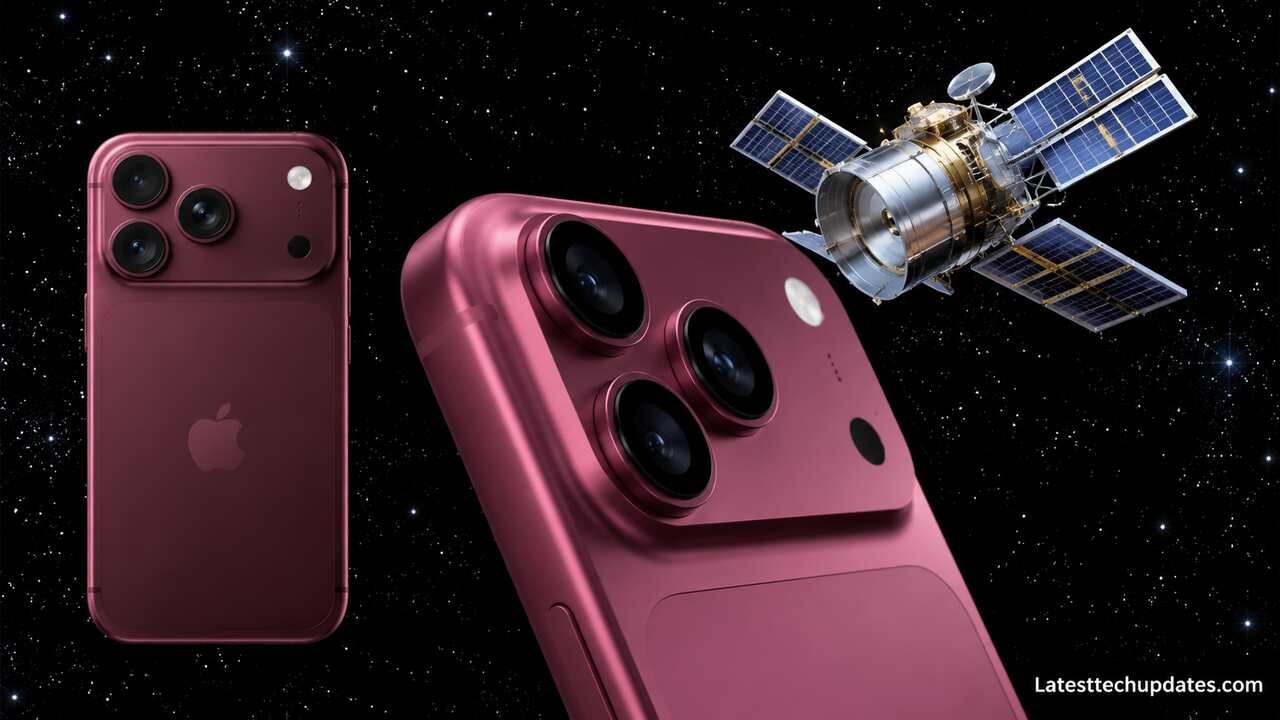
The iPhone 18 Pro Max has one of Apple’s most complete wireless connectivity packages to date. It includes 5G, Wi-Fi 7, Bluetooth 6, Thread, Ultra Wideband, NFC, and satellite connectivity, with Apple’s N1 wireless networking chip handling Wi-Fi, Bluetooth, and Thread, while the C2 modem manages cellular connections.
For most users, the important changes are not simply the higher version numbers. Wi-Fi 7 can improve local wireless performance when paired with the right router, Bluetooth 6 introduces newer ranging and connection technologies, and Apple’s satellite services provide a backup communication path when both cellular and Wi-Fi are unavailable.
The exact benefits still depend heavily on your carrier, router, accessories, country, and network conditions.
iPhone 18 Pro Max connectivity at a glance
| Connectivity | iPhone 18 Pro Max support | What it means in practice |
| 5G | Sub-6 GHz and mmWave support varies by model and region, with 4×4 MIMO | Fast mobile data where compatible carrier coverage is available |
| Wi-Fi | Wi-Fi 7 (802.11be), 2×2 MIMO | Faster and potentially more responsive home and office networking with compatible equipment |
| Bluetooth | Bluetooth 6 | Newer Bluetooth capabilities for accessories, low-power devices, and precise ranging |
| Satellite | Emergency SOS, Messages, Find My, and Roadside Assistance where available | Limited communication outside cellular and Wi-Fi coverage |
| Thread | Supported through Apple’s N1 chip | Connectivity with compatible smart-home devices |
| Ultra Wideband | Second-generation UWB chip | Precise nearby-device and location-related features |
| NFC | NFC with reader mode | Contactless services and compatible NFC interactions |
Regional hardware differences still matter, particularly for cellular bands and mmWave.
5G on the iPhone 18 Pro Max
The iPhone 18 Pro Max supports 5G with 4×4 MIMO, along with Gigabit LTE as a fallback. It also uses Apple’s C2 cellular modem, which is designed to improve cellular quality, reliability, efficiency, and upload performance compared with earlier modem generations.
Sub-6 GHz 5G
Sub-6 GHz is the form of 5G that most people are likely to encounter regularly. It generally provides a better balance between:
- coverage
- building penetration
- speed
- network capacity
Your real-world speed can vary significantly depending on the carrier, frequency band, signal strength, network congestion, and your mobile plan.
A 5G logo on the status bar therefore does not guarantee extremely high download speeds.
mmWave 5G
Some iPhone 18 Pro Max variants also support mmWave 5G, which uses very high-frequency spectrum to provide exceptionally high capacity over relatively short distances.
Regional support varies, so two devices with the same iPhone 18 Pro Max name may support different cellular frequency combinations.
That distinction matters if you import an iPhone from another country.
What 4×4 MIMO means
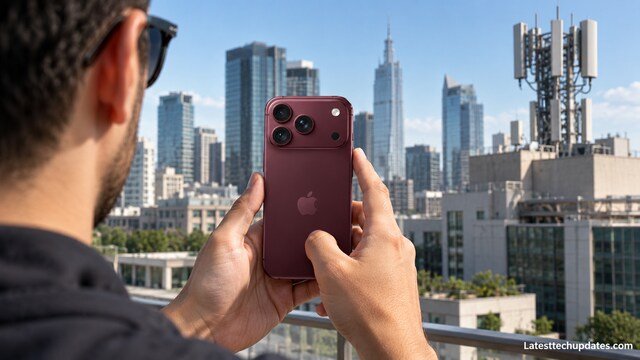
MIMO stands for Multiple Input, Multiple Output. A 4×4 MIMO cellular system can use several antenna streams at the same time when the network supports them.
In favorable conditions, this can improve:
- throughput
- network efficiency
- connection stability
It does not mean the phone will always be four times faster. The network has to support the necessary configuration, and radio conditions still determine performance.
Wi-Fi 7 on the iPhone 18 Pro Max
The iPhone 18 Pro Max supports Wi-Fi 7, also known as IEEE 802.11be, with 2×2 MIMO. It is handled by Apple’s N1 wireless networking chip.
Wi-Fi 7 is more important than simply being “newer Wi-Fi.” Its underlying technology is designed to improve speed, responsiveness, and efficiency on compatible networks.
Do you need a Wi-Fi 7 router?
To benefit from Wi-Fi 7 features, the network infrastructure also needs to support them.
If you connect the iPhone 18 Pro Max to:
- a Wi-Fi 7 router, it can use supported Wi-Fi 7 capabilities
- a Wi-Fi 6E router, it can still connect using an appropriate older standard
- a Wi-Fi 6 router, it works as a Wi-Fi 6 client
- older Wi-Fi equipment, it can fall back accordingly
Buying an iPhone 18 Pro Max does not automatically make an older home network faster.
When Wi-Fi 7 can actually help
The practical difference is most likely to matter when you:
- transfer large files across a fast local network
- stream high-bitrate video
- download large games or media files
- use cloud storage heavily
- make latency-sensitive calls
- use a crowded network with many active devices
Internet speed remains a bottleneck. A 300 Mbps broadband connection will not suddenly become multi-gigabit internet because the phone supports Wi-Fi 7.
Similarly, Apple’s 2×2 MIMO implementation means the phone does not necessarily use every theoretical capability advertised by high-end Wi-Fi 7 routers.
For many people, Wi-Fi 7 is therefore more valuable as a long-term connectivity upgrade than as an immediate dramatic speed increase.
Bluetooth 6 on the iPhone 18 Pro Max
The iPhone 18 Pro Max supports Bluetooth 6.
Bluetooth 6 is a broader specification update rather than a simple “faster Bluetooth” upgrade.
One of its major technical additions is Bluetooth Channel Sounding, which can help compatible devices estimate distance more accurately using advanced ranging techniques.
That technology could be useful for applications such as:
- digital keys
- device finding
- proximity detection
- smart-home access
- accessories that need more accurate distance awareness
Does Bluetooth 6 improve AirPods sound quality?
Not automatically.
The Bluetooth version number alone does not determine wireless audio quality. Audio behavior also depends on:
- the Bluetooth profiles supported by both devices
- codecs
- accessory hardware
- Apple’s software implementation
- interference
- power management
You should therefore not expect every existing pair of Bluetooth headphones to suddenly sound better simply because the phone supports Bluetooth 6.
Do accessories need Bluetooth 6?
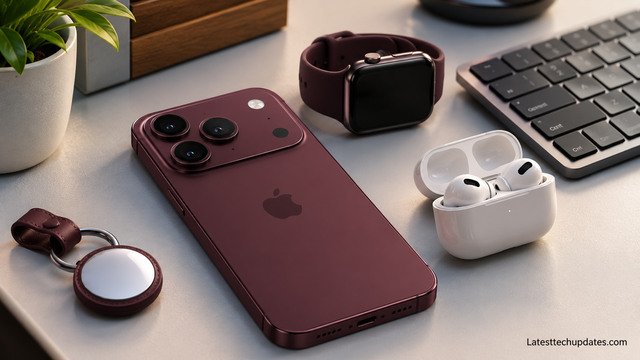
No. Bluetooth maintains backward compatibility for normal accessory use.
Older Bluetooth headphones, speakers, keyboards, cars, and controllers should generally continue working if they were already compatible with iPhone.
However, features specifically designed around Bluetooth 6 may require compatible hardware at both ends.
Satellite connectivity on the iPhone 18 Pro Max
Satellite connectivity is arguably the most unusual part of the iPhone’s wireless system because it works when traditional networks do not.
Depending on regional availability, supported satellite features can include:
- Emergency SOS via satellite
- Roadside Assistance via satellite
- Messages via satellite
- Find My via satellite
These services are intended for situations where there is no cellular and no Wi-Fi coverage.
They are not a replacement for normal mobile broadband.
Emergency SOS via satellite
If you are somewhere without cellular or Wi-Fi coverage and cannot reach emergency services normally, the iPhone can use satellite connectivity in supported regions to send emergency information.
The phone guides you through positioning the device toward an available satellite.
Messages via satellite
Satellite messaging can provide basic text communication when you are off-grid.
However, satellite messaging has important limitations. Rich media such as photos, videos, audio messages, stickers, or some group messaging features may not be available.
That makes sense because satellite communication has far less available bandwidth than cellular or Wi-Fi.
Find My via satellite
Find My can update your location through satellite when normal networks are unavailable.
This can be useful during hiking, remote travel, or other off-grid activities, although it should not be treated as a substitute for proper outdoor safety equipment in high-risk environments.
Roadside Assistance via satellite
In supported markets, the phone can contact a roadside-assistance provider through satellite when you have vehicle trouble outside cellular and Wi-Fi coverage.
Availability and provider requirements can vary by country.
Satellite does not mean satellite internet

This is an important distinction.
The iPhone 18 Pro Max does not turn into a conventional satellite broadband terminal for unrestricted web browsing, video streaming, app downloads, or general internet access.
Apple’s satellite system is designed around specific supported services.
Satellite links also behave differently from normal mobile data. Messages can take longer to send, and environmental conditions have a major effect on whether a connection can be established.
You generally need:
- to be outdoors
- a reasonably clear view of the sky
- minimal obstruction around the horizon
- to follow the phone’s onscreen alignment instructions
Heavy foliage, buildings, mountains, or other obstructions can slow or prevent the connection.
Satellite availability depends on where you are
Apple’s satellite features are not universally available.
Different countries may support different features, and some services can have a narrower availability footprint than others.
Regional device restrictions can also affect satellite functionality.
For anyone buying an imported iPhone 18 Pro Max specifically for satellite use, checking the exact model and purchase region is important.
What the N1 wireless chip changes
The iPhone 18 Pro Max uses Apple’s N1 wireless networking chip for Wi-Fi 7, Bluetooth 6, and Thread.
Bringing several wireless technologies under Apple’s own networking silicon gives the company more control over areas such as:
- radio integration
- power management
- software optimization
- transitions between Apple ecosystem features
However, the presence of Apple’s own chip does not remove external limitations.
Wi-Fi still depends on the router, cellular performance still depends on the carrier, Bluetooth features still depend on accessories, and satellite service still depends on location and regional support.
Which connectivity upgrade matters most?
That depends on how you use the phone.
5G matters most for people who depend heavily on mobile data, tethering, uploads, navigation, or streaming away from Wi-Fi.
Wi-Fi 7 is most useful if you already have, or plan to buy, modern networking equipment and use a fast broadband or local network.
Bluetooth 6 is more of a platform upgrade. Most people will continue using existing accessories normally, while newer Bluetooth 6 devices may gradually take advantage of features such as improved ranging.
Satellite connectivity may be used rarely, but it can be far more important than raw network speed when someone is travelling through an area without cellular coverage.
That is why looking only at theoretical maximum speeds misses much of the value of the iPhone 18 Pro Max’s connectivity package.
Important limitations to remember
The iPhone 18 Pro Max supports very modern wireless standards, but several practical limits remain.
A Wi-Fi 7 phone cannot fix slow internet service. Bluetooth 6 does not automatically improve every accessory. 5G performance can vary from excellent to slower than LTE depending on coverage and congestion. Satellite communication is low-bandwidth, requires suitable outdoor conditions, and is limited to supported services and regions.
There are also regional hardware differences. Buyers importing a device should check cellular bands, SIM configuration, mmWave availability, and satellite restrictions for the specific model rather than assuming every iPhone 18 Pro Max is identical worldwide.
Frequently asked questions
Does the iPhone 18 Pro Max support Wi-Fi 7?
Yes. It supports Wi-Fi 7 with 2×2 MIMO. You need compatible networking equipment to use Wi-Fi 7 capabilities.
Does the iPhone 18 Pro Max have Bluetooth 6?
Yes. Bluetooth 6 is supported.
Does it support mmWave 5G?
Some regional models do. Support can vary depending on the country and specific model.
Can I use satellite connectivity for normal internet access?
No. The satellite system is designed around specific communication and safety features rather than unrestricted satellite internet.
Does satellite messaging work indoors?
Generally, you should expect to go outside. Satellite communication works best with a clear view of the sky and horizon.
Will my old Bluetooth accessories still work?
In general, yes. Bluetooth is designed for backward compatibility. New Bluetooth 6-specific capabilities may still require a compatible accessory.
Conclusion
The iPhone 18 Pro Max combines 5G, Wi-Fi 7, Bluetooth 6, satellite connectivity, Thread, Ultra Wideband, and NFC into a broad wireless package. The biggest day-to-day improvement will depend on your environment rather than the specification sheet alone.
Wi-Fi 7 becomes meaningful with a suitable router and fast network. 5G depends on carrier coverage and the regional iPhone model. Bluetooth 6 creates room for more capable accessories and precise ranging, rather than instantly transforming existing headphones. Satellite connectivity is the most situational feature, but it also provides something Wi-Fi and 5G cannot: a way to communicate in supported situations when terrestrial networks disappear.
For buyers who intend to keep the phone for several years, that combination makes the connectivity hardware particularly future-focused, while the regional and infrastructure requirements remain just as important as the technologies themselves.
