
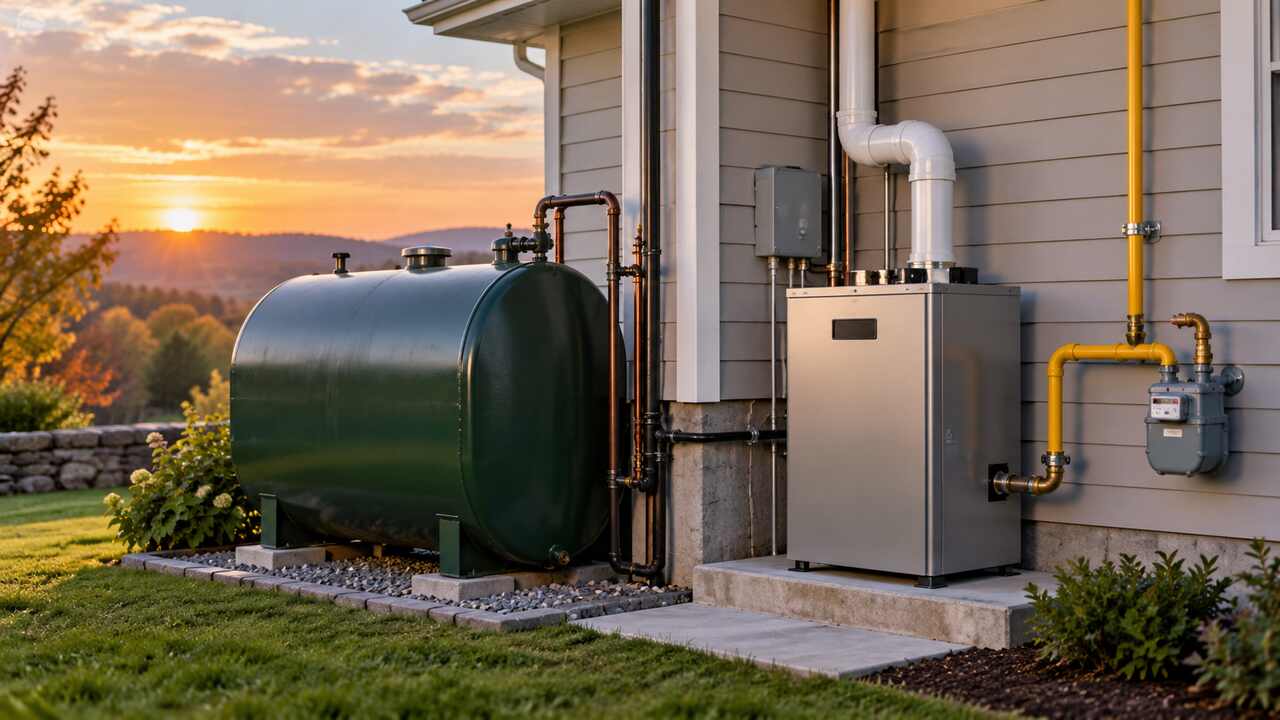
An oil to gas conversion does not always require removing the existing oil heating system. With proper equipment, controls, and safety planning, oil can remain as a reliable backup while natural gas handles everyday heating.
What Is a Dual Fuel Heating System?
A dual fuel heating system uses two energy sources to heat the same home. In an oil-and-natural-gas configuration, this usually means two compatible heating appliances connected to a shared distribution system. For example, an oil boiler and a gas boiler may both supply the home’s hot-water heating zones. Forced-air and zoned configurations are also possible.
A control system determines which appliance receives the call for heat. Natural gas may serve as the primary fuel, with oil reserved for unusually high demand, a gas interruption, or a planned operating schedule. Some systems alternate equipment to balance runtime.
“Dual fuel” can also describe a single appliance fitted with a manufacturer-approved dual-fuel burner, although this arrangement is more common in commercial buildings. Residential installations generally use separate appliances because they are easier to service, control, and approve under local codes.
The dual fuel heating system must be designed as one coordinated installation. Appliance capacity, piping or ductwork, venting, electrical controls, and safety interlocks all affect whether the two heat sources can operate reliably.
The quality of a dual fuel heating system depends heavily on its operating sequence. The design should identify which appliance starts first, what condition activates the second appliance, whether simultaneous operation is allowed, how a failed burner is detected, whether the backup starts automatically, and how the homeowner receives a fault notification.
These details should appear in a written sequence of operation supplied by the installer. Without one, future technicians may have to reconstruct the control strategy from wiring and piping.
A useful dual-fuel system also needs distinct operating modes: normal, backup, service, and emergency. Labeling these modes at the equipment helps prevent accidental shutdowns and incorrect control changes years after installation.
What Is the Difference Between Oil and Gas Heating Systems?
Oil heating stores fuel in a tank on the property. An oil burner draws fuel through a filter and pump, atomizes it through a nozzle, and ignites it inside a furnace or boiler. Homeowners arrange deliveries and remain responsible for the tank, fill and vent piping, fuel lines, and leak prevention.
Natural gas arrives through a utility service line. A gas system uses a meter, regulator, gas valve, and burner assembly. Gas equipment also introduces gas-service capacity, pressure, venting, and combustion-air considerations. High-efficiency condensing gas appliances require approved venting and a way to drain or neutralize acidic condensate.
That distinction changes how dual fuel heating affects the home’s maintenance requirements, emergency planning, and exposure to supply interruptions.
Oil equipment commonly requires burner cleaning, nozzle and filter replacement, combustion testing, and periodic chimney inspection. Several components can deteriorate while the burner sits idle, including the fuel, filter, nozzle, pump, line, and tank. A backup oil system therefore needs scheduled operation and service. Long periods of inactivity do not eliminate maintenance.
Gas equipment still needs professional HVAC maintenance, including combustion analysis, heat-exchanger inspection, vent examination, and condensate-system service where applicable.
In dual fuel heating, efficiency depends on the specific appliance, its condition, installation quality, and controls. AFUE measures an appliance under standardized conditions. It does not capture all losses from keeping a second boiler warm, operating an oversized appliance, maintaining an open chimney connection, or circulating water through an inactive boiler.
Fuel price alone does not reveal the true operating cost. A useful comparison accounts for local fuel rates, delivered heat per unit of fuel, annual maintenance, tank costs, and the appliance’s rated and measured efficiency.
Keeping Oil as Backup With Dual Fuel Heating
In a gas and oil heat system, an existing oil system can often remain in service after natural gas is added, provided the equipment, tank, fuel lines, chimney, and controls remain safe and code-compliant. A licensed heating professional should inspect the complete oil installation in a “standby readiness” assessment before it is designated as backup equipment.
That assessment should cover more than whether the burner starts. The contractor should document tank age and condition, fuel quality and remaining volume, fuel-line routing and protection, burner combustion results, heat-exchanger condition, availability of replacement parts, and estimated remaining service life.
In dual fuel heating systems, the design must establish how the two systems will share the heating load. They may connect to a common hydronic loop, serve separate zones, or operate through an approved changeover arrangement.
The installer should also determine whether the oil appliance is approved for cold-start operation. Some boilers can remain off until needed. Others require a minimum temperature or a different control strategy. Keeping an unnecessary boiler warm throughout the year can create meaningful standby losses.
Using oil as a backup in dual fuel heating also preserves ongoing responsibilities. The tank must contain usable fuel, receive regular inspection, and comply with applicable environmental requirements. The burner needs scheduled service even when it operates only occasionally.
Insurance requirements should be checked before the project is finalized. Some insurers impose conditions based on tank age, location, construction, or fuel-line protection. A technically functional oil system may still create an insurance or property-transfer concern if the tank is old or poorly documented.
How Dual Fuel Home Heating Systems Combine Fuels
For dual fuel home heating systems, selecting the right arrangement matters because each one produces a different level of backup protection.
One practical arrangement uses a gas boiler as the lead appliance and an oil boiler as the standby or second-stage appliance. Both connect to a properly designed hydronic system. In lead-and-standby operation, the gas appliance handles all normal calls. The oil appliance starts after a gas-equipment fault or manual changeover. In lead-and-lag operation, the gas appliance starts first. The oil appliance joins it when indoor demand or water temperature indicates that additional capacity is needed.
A second arrangement assigns different zones or loads to each fuel. The gas appliance might heat the main living space while the oil boiler serves an addition, indirect water heater, or high-temperature heating zone.
In a seasonal changeover, the homeowner or controller selects one fuel for an extended period based on fuel availability, operating cost, or service conditions.
Some dual fuel heating systems use control strategies that rotate the lead appliance periodically so both systems remain operational. Others reserve the oil equipment strictly for emergencies and schedule regular test cycles.
Hydronic systems require provisions that prevent water from flowing unintentionally through the inactive boiler. Uncontrolled flow can turn the idle appliance and its chimney into a heat-loss path. Check valves, isolation valves, circulators, and hydraulic separation may be needed.
The appliances should never be connected through improvised burner, flue, or wiring modifications. Water temperature, return-water protection, flow rate, venting, and control compatibility must be evaluated together. A well-designed dual system behaves like one heating plant, with clearly defined operating stages and fault responses.
In dual fuel heating systems, the contractor should also confirm that combined boiler capacity will not create severe short cycling. Two appliances sized individually to heat the entire house can be inefficient when connected without appropriate staging and water-volume planning.
Automatic Switching in a Gas and Oil Heat System
In a gas and oil heat system, automatic switching is possible when the system includes compatible appliances, sensors, relays, and a properly programmed control panel, although the term “automatic” needs a precise definition in the installation contract. The homeowner can still have a manual operating mode for maintenance or emergencies.
A controller may change equipment according to outdoor temperature, indoor heating demand, time-of-use or fuel-cost settings, boiler water temperature, appliance failure or safety lockout, a utility demand-response signal, or a programmed lead-and-lag schedule.
A more capable system can recognize a burner lockout, enable the backup appliance, and notify the homeowner that a failure occurred.
True failover requires a usable fault signal from the primary appliance. Some controls only know that heat has been requested; they cannot confirm that the burner actually fired or the building received heat. Better designs monitor burner status, boiler temperature response, supply-air temperature, or an appliance alarm contact.
Automatic changeover requires safety interlocks. The controls must prove that pumps, dampers, valves, and burners are in the correct state before firing an appliance. They may also prevent both burners from operating together when the piping, venting, electrical service, or system capacity was designed for one appliance at a time.
Backup operation is not always seamless. Automatic fuel switching also depends on shared components. A failed thermostat, zone panel, circulator, blower, electrical circuit, or common control transformer may stop both heat sources. The design drawings should identify these shared failure points so the homeowner understands the system’s actual level of redundancy.
The commissioning process should include a controlled failure test. The technician can disable the primary burner, confirm that the backup starts, verify that valves and pumps move correctly, and record the time required to restore heat.
Equipment and Controls for Dual Fuel Heating Systems
The exact equipment for dual fuel home heating systems depends on whether the home uses forced air, hot water, or steam. A typical oil-and-gas hydronic installation may require properly sized oil and gas boilers, a primary-secondary piping arrangement or hydraulic separator, dedicated circulators or approved zone valves, and check valves to prevent unwanted flow through an idle boiler. Expansion, pressure-relief, air-removal, and water-feed components may also be required.
Forced-air systems may require compatible furnaces, dampers, a shared air handler, or separate duct connections. Steam systems need specialized engineering because boiler sizing, pressure controls, piping, and waterline behavior are particularly sensitive.
Control equipment may include an outdoor-reset or staging controller, isolation relays and low-voltage control wiring, aquastats, temperature sensors, equipment-enable contacts, and burner-status or alarm contacts.
The installation may also require low-water protection, code-compliant emergency switches and fuel shutoffs, separate service switches and clearly labeled disconnects, separate or specifically approved venting systems, and permanent operating instructions near the equipment.
Every appliance must retain its manufacturer-required safety controls. The staging controller coordinates operation; it does not replace flame detection, high-limit protection, pressure relief, spill switches, blocked-vent protection, or other appliance safeguards.
Adding a second boiler and a selector switch rarely provides complete system supervision.
Remote notification is especially valuable in a backup system. Automatic changeover can keep the house warm while allowing the original failure to remain unnoticed. A text, app alert, alarm light, or clearly visible fault indicator helps prevent the home from quietly consuming its emergency oil supply.
Controls should use standard, serviceable components where practical. A highly customized system can become difficult to repair when the original installer, controller, or programming documentation is no longer available.
Safety, Venting, Permits, and Oil Tanks in a Dual Fuel Heating System
Adding gas while retaining oil usually involves mechanical, plumbing or gas, electrical, and fire-code requirements. Permits may be required for the gas connection, appliance installation, chimney work, electrical controls, oil piping, and tank retirement. Permit names and inspection procedures vary by jurisdiction, so the project should be reviewed by the local code authority before installation begins.
Each appliance needs adequate combustion air and an approved venting path. One frequently overlooked issue is the chimney’s new operating pattern. Removing, replacing, or reducing the runtime of one appliance changes flue temperature and draft. A masonry chimney may require relining when its connected load changes. Every remaining appliance, including a water heater, must be included in the venting assessment.
Sharing a chimney requires specific code approval, correct vent sizing, compatible appliance categories, and suitable operating conditions. Separate venting is often easier to evaluate, although it still requires manufacturer-approved materials and termination clearances. Condensing gas equipment generally uses manufacturer-specified vent materials and requires condensate drainage. Sidewall terminations must maintain required clearances from openings, grade, walkways, meters, and neighboring properties.
The oil tank should be treated as active equipment even when the burner is designated for emergencies. Inspectors and insurers may examine its supports, corrosion, fill and vent pipes, fuel line, shutoff valve, and leak protection. Underground tanks can carry additional testing, disclosure, closure, and environmental obligations. Flood-prone locations may require tank anchoring or other protection.
The completed system should receive combustion testing, draft and spillage testing where applicable, gas-leak testing, control verification, and carbon-monoxide safety checks. Carbon-monoxide alarms remain essential because both fuels produce combustion gases. Fuel-burning equipment should receive annual professional HVAC inspection under current CPSC safety guidance.
Tank-retirement rules are especially location-dependent, and state requirements can exceed federal standards. If the oil system will no longer be used, the tank should be formally decommissioned. Closure should be documented, including fuel removal, tank disposition, required inspections, and any soil assessment.
The completed project should include permit signoffs, combustion-test results, equipment manuals, control diagrams, and tank records.
Backup Oil Costs in Dual Fuel Home Heating Systems
For dual fuel home heating systems, calculate the annual carrying cost, including oil burner service and combustion testing, tank and fuel-line inspection, chimney maintenance, permit or inspection expenses, insurance-related requirements, electricity used by standby controls and pumps, fuel stored for testing and emergency operation, future tank replacement or removal, and repairs associated with aging equipment.
Backup value declines when the oil appliance or tank is near the end of its service life. Estimate the expected backup value across the likely remaining life of the oil equipment, including eventual decommissioning.
Electrical outages deserve separate planning. Most modern oil and gas appliances require electricity for ignition, controls, pumps, or blowers. Fuel diversity alone does not provide heat during a blackout. A correctly sized and safely connected generator may contribute more resilience in locations where power loss is the primary concern.
When a Gas and Oil Heat System Makes Sense
A gas and oil heat system can make sense when the existing oil equipment and tank are in good condition, the home has high winter heating loads, and dependable heat has significant practical or financial value. It may also suit a phased conversion in which the homeowner wants to spread project costs over several years.
Dual fuel deserves consideration when the property is in a severe or outage-prone climate, loss of heat could quickly damage the building, gas service or pressure may occasionally be constrained, the building has critical heating zones, removing the oil system would require major immediate reconstruction, or emergency heating service is difficult to obtain. It also deserves consideration when the gas appliance cannot cover the full design heating load, automatic failover can be tested and monitored, and a licensed designer can integrate both systems without compromising efficiency or safety.
Full oil removal is usually more economical when the tank shows deterioration, the burner needs major repairs, space is limited, or the owner wants fewer maintenance and inspection obligations. Other liabilities may include uncertain underground piping, chimney repairs, unavailable burner parts, poor efficiency, or added insurance requirements. Removal can also simplify venting, controls, insurance reviews, and a future property sale.
The three complete options in the final proposal should be immediate oil removal, manual oil backup, and automatic oil backup. Each option should include equipment condition, design heat loss, gas capacity, venting, tank risk, installation cost, annual carrying cost, expected tank work, control complexity, remaining equipment life, and the failures it can actually protect against. That comparison reveals whether the retained system provides useful resilience or simply postpones decommissioning expenses.
