
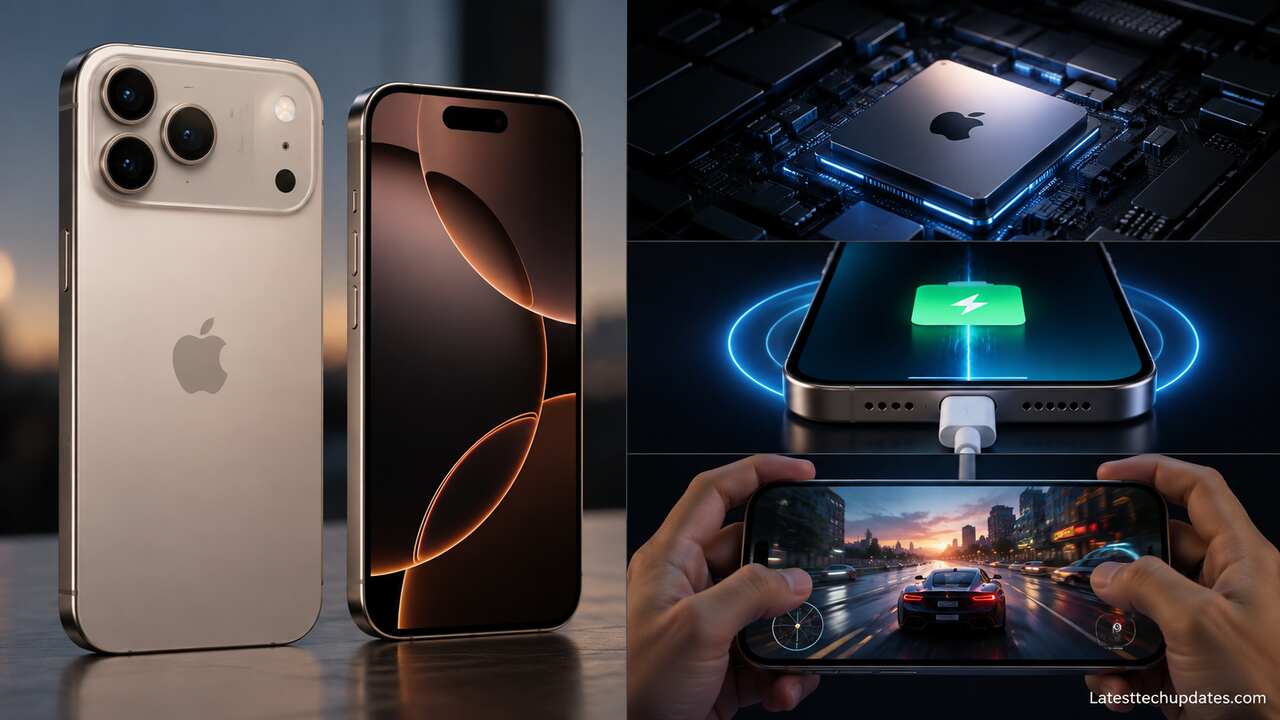
The iPhone 18 Pro Max is a major performance upgrade, but the most important improvement is not simply that the A20 Pro produces higher benchmark scores. Apple has combined its new 2-nanometer chip with a much larger vapor chamber, a larger battery, faster wired charging, and a 120Hz 6.9-inch display. Together, those changes make the phone better suited to demanding games and other sustained workloads.
Apple says the A20 Pro has a 6-core CPU, 7-core GPU, Dual 16-core Neural Engine, hardware-accelerated ray tracing, and 50 percent more memory bandwidth than the A19 Pro. The company also claims up to 40 percent higher GPU performance and significantly better sustained performance.
Independent testing supports the broader performance improvement, although benchmark gains should not be interpreted as an identical percentage increase in every app or game. The biggest practical advantages are likely to appear in graphics-heavy gaming, video processing, computational photography, AI workloads, and other tasks that keep the processor busy for longer periods.
A20 Pro: What Changed?
The A20 Pro is built using a 2-nanometer process and uses a 6-core CPU with two high-performance “super cores” and four efficiency cores. Graphics are handled by a 7-core GPU with Neural Accelerators, while Apple has doubled up its Neural Engine configuration with two 16-core engines. Hardware-accelerated ray tracing is also supported.
The smaller manufacturing process matters because it gives Apple more room to improve performance and efficiency. A smaller process does not automatically guarantee better battery life, but it can help the chip perform more work while using less power when the design and software take advantage of it.
Memory bandwidth is another important change. Apple says A20 Pro provides 50 percent more memory bandwidth than A19 Pro. That matters because the CPU, GPU, and other processing components need fast access to data. Games with detailed textures, demanding graphics effects, video editing, computational photography, and local AI workloads can benefit more than simple tasks such as messaging or web browsing.
For someone upgrading from a relatively recent Pro Max, everyday actions such as opening Messages or checking email will not suddenly feel dramatically different. The extra performance becomes more relevant when the phone is being pushed hard.
iPhone 18 Pro Max Benchmarks
Independent testing from Tom’s Guide provides a useful look at how the A20 Pro performs under repeatable workloads.
| Test | iPhone 18 Pro Max | iPhone 17 Pro Max |
| Geekbench 6 single-core | 4,741 | 3,871 |
| Geekbench 6 multi-core | 12,789 | 9,968 |
| Geekbench 7 single-core | 4,025 | 3,285 |
| Geekbench 7 multi-core | 11,525 | 8,999 |
| 3DMark Solar Bay Unlimited | 17,850 | 12,260 |
| Solar Bay average frame rate | 67.9 fps | 46.6 fps |
| Wild Life Extreme stress-test stability | 79.4% | 65.2% |
These results were recorded by Tom’s Guide, so they should be treated as independent test results rather than Apple’s own performance claims.
The CPU improvement is substantial in synthetic testing. That can help workloads such as exporting video, processing large photos, compiling code, running complex applications, or carrying out intensive calculations.
The graphics improvement is particularly interesting for gaming. In Tom’s Guide’s 3DMark Solar Bay Unlimited testing, the iPhone 18 Pro Max averaged 67.9 frames per second compared with 46.6 fps for the iPhone 17 Pro Max.
That does not mean every game will run 46 percent faster. Real game performance also depends on the game’s engine, graphical settings, frame-rate limits, resolution, optimization, and thermal behavior.
Sustained Performance May Matter More Than Peak Speed
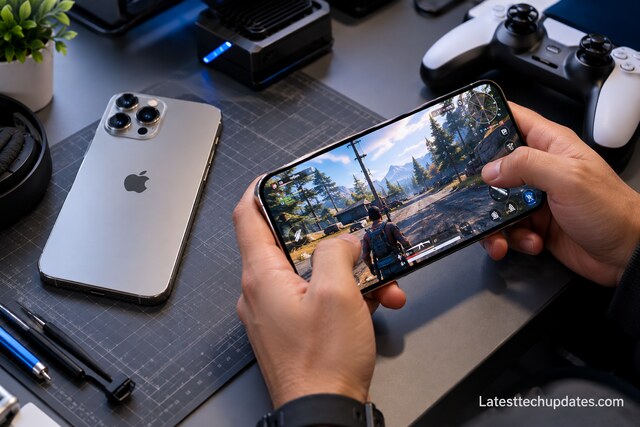
Smartphones can produce impressive benchmark scores for a short period and then reduce performance as internal temperatures rise. This process, commonly called thermal throttling, protects the battery and components from excessive heat.
Apple has addressed this by redesigning the iPhone 18 Pro series’ vapor chamber. According to Apple, the new cooling system has three times the surface area of the previous generation. The A20 Pro packaging also positions the chip and memory differently so heat can transfer more directly into the cooling system. Apple claims this combination can produce up to a 40 percent improvement in sustained performance.
The independent stress-test results are more useful for understanding what that means in practice. Tom’s Guide recorded 79.4 percent stability for the iPhone 18 Pro Max in the 3DMark Wild Life Extreme Stress Test, compared with 65.2 percent for the iPhone 17 Pro Max.
For gamers, this is arguably more important than a single short benchmark run. Better sustained performance means the phone has a greater chance of maintaining consistent graphics performance during longer gaming sessions rather than starting extremely fast and then losing a large amount of performance as it heats up.
The phone can still become warm during demanding gaming, charging, camera recording, or other intensive workloads. A vapor chamber manages heat rather than eliminating it.
iPhone 18 Pro Max Gaming Performance
The iPhone 18 Pro Max has the hardware needed for demanding mobile gaming. Its combination of the A20 Pro, hardware-accelerated ray tracing, improved cooling, and 120Hz ProMotion display gives game developers considerably more performance to work with.
The 6.9-inch OLED display runs at an adaptive refresh rate of up to 120Hz. A 120Hz screen can update its image as many as 120 times each second, which can make animation, scrolling, and supported high-frame-rate games appear smoother than on a conventional 60Hz display.
However, a 120Hz display does not mean every game automatically runs at 120 frames per second. The game itself must support the higher frame rate, and the phone needs enough graphics performance to sustain it. Some demanding games may prioritize image quality over frame rate or dynamically reduce graphical quality to maintain smoother gameplay.
Hardware ray tracing is another useful capability. Ray tracing allows supported games to produce more realistic lighting, shadows, and reflections. It can also place a heavy load on the GPU, so the A20 Pro’s graphics improvements and improved cooling are important when these effects are enabled.
Why the Pro Max Is Better Suited to Long Gaming Sessions
The Pro Max has another advantage beyond the A20 Pro: its larger physical body gives Apple more space for the battery and cooling system.
Tom’s Guide measured a 79.4 percent stability score in its sustained graphics stress test, substantially above the iPhone 18 Pro’s 62.8 percent result in the same test.
That difference suggests the larger Pro Max chassis is particularly useful for gamers who play demanding titles for extended periods.
There is a tradeoff. Apple lists the iPhone 18 Pro Max at 249 grams. Holding a phone this heavy for long periods can become tiring, especially when playing games that require constant touchscreen input.
A controller or stand can make longer sessions considerably more comfortable.
Battery Life
Battery endurance is another major strength of the iPhone 18 Pro Max.
Apple rates the eSIM-only version for up to 45 hours of local video playback, up to 40 hours of streamed video playback, and up to 30 hours under Apple’s newer “typical use” measurement. These are controlled manufacturer ratings rather than guarantees of what every user will experience.
Battery life changes significantly depending on screen brightness, cellular signal strength, gaming, camera use, GPS, background activity, display refresh rate, and whether the phone is using Wi-Fi or mobile data.
Independent testing provides a different perspective. Tom’s Guide tested the phone by continuously browsing the web over a cellular connection with the display adjusted to 150 nits. Under those conditions, the iPhone 18 Pro Max averaged 18 hours and 27 minutes. The iPhone 17 Pro Max recorded 17 hours and 54 minutes.
That is an improvement, but it also shows why manufacturer video-playback numbers and real-world-style endurance tests should not be compared directly.
Apple’s 45-hour figure represents a particular video test. The 18-hour result represents a continuous cellular browsing workload. Neither number predicts exactly how long an individual user’s phone will last.
Battery Capacity Depends on the Region
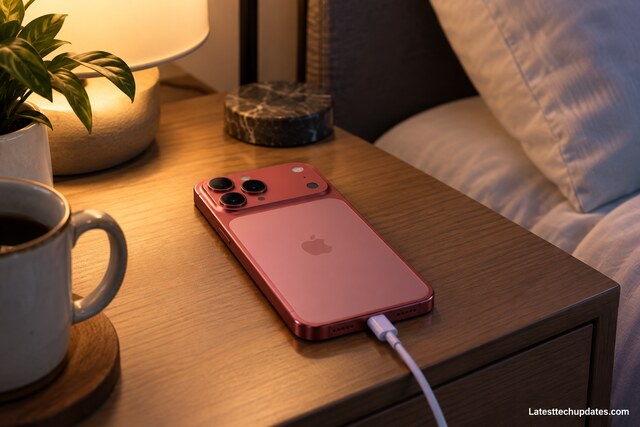
The physical-SIM version of the iPhone 18 Pro Max has been reported with a 5,391mAh battery based on Apple’s regulatory information. eSIM-only versions have more internal space available because they do not need a physical SIM tray, and reports put the larger eSIM-only battery at 5,567mAh.
This means two iPhone 18 Pro Max units sold in different markets can have slightly different physical battery capacities.
The practical difference should be considered alongside Apple’s region-specific battery ratings rather than judging the phone only by its mAh number.
Charging Is Much Faster
Charging has been one of the areas where previous iPhones lagged behind some competing Android flagships. The iPhone 18 Pro series makes a significant improvement.
Apple says the iPhone 18 Pro Max can reach up to 50 percent charge in around 15 minutes when used with a 60W-capable or higher power adapter that supports Adjustable Voltage Supply, or AVS, and a suitable USB-C cable.
The important detail is that buying any charger marked “60W” does not automatically guarantee maximum charging performance. Apple’s specification specifically requires an AVS-compatible adapter.
Independent testing reported by MacRumors found that one iPhone 18 Pro Max reached 50 percent in 15 minutes and completed a displayed 0 to 100 percent charge in about 55 minutes with an appropriate charger. The same test recorded a peak charging rate of about 52W during the first 12 minutes.
That 52W figure is a measured peak from one third-party test, not an official promise that the phone continuously charges at 52W.
Charging power naturally drops as the battery fills and temperatures rise. This protects the battery and explains why doubling the peak wattage would not cut the total charging time in half.
MagSafe and Qi2 Wireless Charging
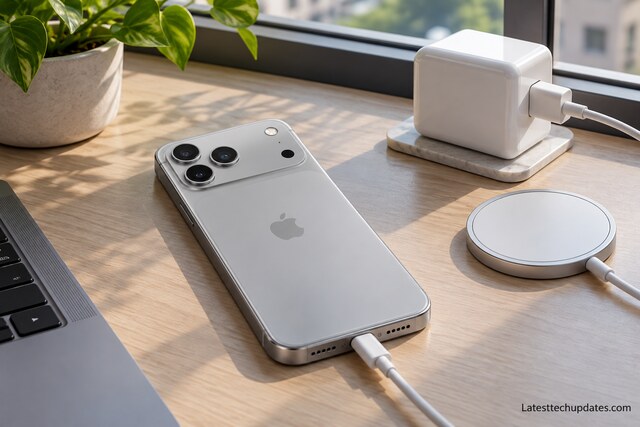
The iPhone 18 Pro Max supports MagSafe wireless charging at up to 25W and Qi2 charging at up to 25W. Apple says its MagSafe setup can reach 50 percent charge in around 30 minutes when paired with a 35W or higher power adapter.
Wired charging remains the better option when maximum speed matters. Wireless charging is primarily about convenience, particularly at a desk or bedside table where the phone can be placed on a charger repeatedly throughout the day.
Does Fast Charging Hurt the Battery?
Faster charging can create additional heat, but the iPhone does not simply accept maximum charging power continuously. Charging speed is controlled dynamically according to battery level, temperature, charger capabilities, and other conditions.
This is why charging slows significantly as the battery approaches full capacity.
For normal use, there is little reason to avoid the faster charger simply because the phone supports higher charging power. Long-term lithium-ion battery health is affected by several factors, particularly temperature, charge cycles, and spending extended periods at very high states of charge.
Keeping the phone cool is generally more useful than obsessing over whether every charging session is slow or fast.
Gaming while fast charging can produce more heat because the processor and charging system are generating heat at the same time. For demanding games, allowing the phone to charge before playing is preferable when practical.
How Long Will the Battery Last While Gaming?
There is no single reliable gaming battery-life figure because games place very different loads on the phone.
A simple 2D game running at moderate brightness may consume relatively little power. A graphically demanding 3D title using high frame rates, ray tracing, cellular data, maximum brightness, and continuous online connectivity can drain the battery far more quickly.
The 45-hour video-playback rating should therefore not be used to estimate gaming time.
For longer gaming sessions, the factors with the greatest impact are graphical quality, frame-rate target, display brightness, network connection, background activity, and phone temperature.
Lowering a game’s graphics settings or frame-rate target can sometimes extend battery life considerably while also reducing heat.
Wi-Fi 7 Can Help Online Gaming, but Your Network Matters
The iPhone 18 Pro Max includes Apple’s N1 wireless networking chip and supports Wi-Fi 7 with 2×2 MIMO.
Wi-Fi 7 can provide higher capacity and other networking improvements, but buying a Wi-Fi 7 phone does not automatically reduce gaming latency.
Your router, internet connection, distance from the access point, local interference, game server location, and network congestion can matter just as much.
For competitive online gaming at home, a strong and stable Wi-Fi connection is usually more important than simply having the newest Wi-Fi standard.
Is the A20 Pro Upgrade Noticeable From an iPhone 17 Pro Max?
It depends on what you do.
For ordinary messaging, web browsing, social media, calls, and light apps, the iPhone 17 Pro Max was already extremely fast. The A20 Pro’s higher benchmark numbers are unlikely to transform those basic tasks.
The upgrade becomes easier to justify for demanding gaming, sustained graphics workloads, on-device AI processing, intensive photo and video work, or users who regularly push their phone hard enough to encounter thermal limits.
The Pro Max’s jump from 65.2 percent to 79.4 percent stability in Tom’s Guide’s sustained graphics test is particularly relevant here.
That improvement tells us more about long gaming sessions than a short CPU benchmark does.
Battery life is more complicated. Independent web-browsing testing found only a 33-minute increase over the iPhone 17 Pro Max, despite Apple’s substantial improvements in battery capacity and efficiency.
Charging is a clearer upgrade. Moving from previous-generation charging performance to roughly 50 percent in 15 minutes can make short daytime top-ups much more useful.
Main Performance Limitations
The iPhone 18 Pro Max is extremely powerful, but several practical limitations remain.
Its 249-gram weight can make extended handheld gaming tiring. High-end games will still generate heat. A 120Hz display does not guarantee 120 fps in every title. Peak charging power is available only under the correct temperature, battery, cable, and charger conditions. Apple also does not match the longest-lasting Android phones in every independent battery test.
There is also little reason to upgrade only for faster app launching if you already own a recent Pro-series iPhone. Modern flagship phones have reached a point where performance gains are most noticeable in demanding workloads rather than everyday communication.
Frequently Asked Questions
Is the iPhone 18 Pro Max good for gaming?
Yes. Its A20 Pro chip, 7-core GPU, hardware-accelerated ray tracing, 120Hz ProMotion display, and improved vapor-chamber cooling make it particularly well suited to demanding mobile games. Independent stress testing also shows a significant sustained-performance improvement over the iPhone 17 Pro Max.
Does the iPhone 18 Pro Max have a 120Hz display?
Yes. The 6.9-inch Super Retina XDR OLED display uses ProMotion with an adaptive refresh rate of up to 120Hz. Supported games can take advantage of higher frame rates, although game performance and developer support determine whether a title actually reaches 120 fps.
How fast does the iPhone 18 Pro Max charge?
Apple rates it for up to 50 percent charge in around 15 minutes using a 60W-capable or higher AVS power adapter and a suitable USB-C cable. One independent test reported a peak of around 52W and roughly 55 minutes from 0 to a displayed 100 percent.
Does the iPhone 18 Pro Max support 60W wireless charging?
No. The 60W figure relates to the charger requirement for Apple’s fastest wired charging. MagSafe and Qi2 wireless charging are supported at up to 25W.
Is the A20 Pro much faster than the A19 Pro?
Synthetic CPU and GPU tests show substantial improvements. Tom’s Guide recorded Geekbench 6 results of 4,741 single-core and 12,789 multi-core on the iPhone 18 Pro Max, compared with 3,871 and 9,968 on the iPhone 17 Pro Max. Graphics testing showed an even larger gain in 3DMark Solar Bay. Real apps will not necessarily improve by the same percentages.
Does gaming reduce battery life significantly?
Yes, particularly with demanding 3D games. High GPU usage, 120Hz operation, high screen brightness, cellular connectivity, ray tracing, and heat can all increase power consumption. Apple’s video-playback rating should not be treated as a gaming-runtime estimate.
Final Assessment
The iPhone 18 Pro Max performance story is less about making already-fast everyday apps open slightly quicker and more about maintaining high performance when the phone is pushed hard.
The A20 Pro delivers large CPU and GPU gains in independent benchmarks, while the redesigned vapor chamber appears to make the Pro Max considerably better at sustaining graphics performance. That combination is particularly relevant to gaming, video work, computational photography, and other demanding workloads.
Battery life also remains strong, although independent testing suggests the real-world generational improvement can be much smaller than Apple’s headline video-playback figures might imply. Charging is arguably the more noticeable everyday improvement, with Apple’s 15-minute 50 percent claim supported by third-party testing under suitable conditions.
For gamers, the 6.9-inch 120Hz display, powerful GPU, hardware ray tracing, better cooling, and large battery make the iPhone 18 Pro Max Apple’s most capable conventional gaming iPhone to date. The main tradeoffs are its substantial weight, heat during intensive workloads, and the fact that its extra performance will matter far less to users whose phone use is mostly messaging, browsing, streaming, and social media.
Read Also: Expected Display Sizes for Apple’s Foldable iPhone Revealed
