
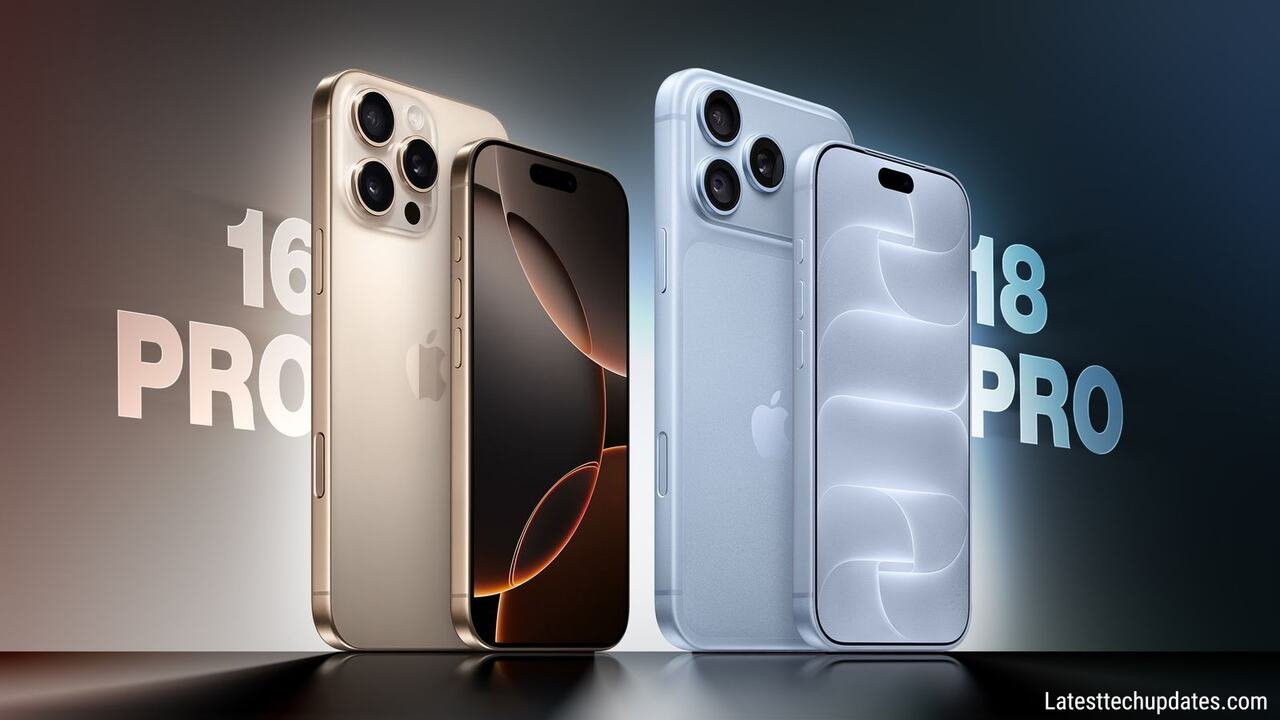
The iPhone 18 Pro Max vs iPhone 16 Pro Max comparison highlights major upgrades in performance, camera technology, battery life, and charging speed. The iPhone 18 Pro Max features the A20 Pro chip, a variable-aperture camera, and improved battery endurance, while the iPhone 16 Pro Max remains a powerful device with a 6.9-inch OLED display and Apple Intelligence support.
iPhone 18 Pro Max vs iPhone 16 Pro Max: Specifications Comparison
Apple introduced the iPhone 18 Pro Max in September 2026, two years after the iPhone 16 Pro Max launched in 2024. Although both belong to Apple’s premium smartphone lineup, the newer model includes several hardware improvements.
| Feature | iPhone 18 Pro Max | iPhone 16 Pro Max |
| Release date | September 18, 2026 | September 20, 2024 |
| Display | 6.9-inch OLED | 6.9-inch OLED |
| Refresh rate | 120Hz ProMotion | 120Hz ProMotion |
| Outdoor peak brightness | 3,000 nits | 2,000 nits |
| Processor | A20 Pro | A18 Pro |
| Main camera | 48MP, variable aperture | 48MP, fixed f/1.78 aperture |
| Ultra-wide camera | 48MP | 48MP |
| Dedicated telephoto | 48MP, 4x optical | 12MP, 5x optical |
| Extended zoom | 8x optical-quality | 5x optical |
| Front camera | 18MP Center Stage | 12MP TrueDepth |
| Video playback | Up to 45 hours | Up to 33 hours |
| Wired fast charging | 50% in around 15 minutes | 50% in around 30 minutes |
| Construction | Aluminum unibody | Titanium design |
| Weight | 249g | 227g |
| Storage | 256GB to 2TB | 256GB to 1TB |
| Launch price (US) | $1,299 | $1,199 |
Figures are based primarily on Apple’s published technical specifications. Battery and charging figures represent controlled testing, not guaranteed everyday results.
The comparison highlights three especially meaningful upgrades: a more flexible camera system, 12 additional hours of rated video playback, and faster wired charging. The older model, however, is 22 grams lighter and retains many premium features.
Design and Build Quality: Titanium vs Aluminum
The iPhone 18 Pro Max uses an aluminum unibody construction, whereas the iPhone 16 Pro Max features a titanium design with a textured matte glass back. Both use premium materials, but they differ in weight, appearance, and overall construction.
The newer model incorporates Ceramic Shield 2 on the front and Ceramic Shield on the back. Its integrated construction also supports Apple’s updated thermal design. The iPhone 16 Pro Max uses Apple’s earlier-generation Ceramic Shield front protection.
The physical differences are relatively small in dimensions but noticeable in weight.
| Measurement | iPhone 18 Pro Max | iPhone 16 Pro Max |
| Height | 163.4 mm | 163 mm |
| Width | 78 mm | 77.6 mm |
| Thickness | 8.75 mm | 8.25 mm |
| Weight | 249g | 227g |
The iPhone 18 Pro Max is approximately 9.7% heavier. That matters for people who frequently use their phones with one hand, record lengthy videos, or prefer a lighter device for daily commuting.
Colors and exterior features
The iPhone 18 Pro Max is available in Black, Silver, Glacier, and Burgundy. The iPhone 16 Pro Max launched in Black Titanium, White Titanium, Natural Titanium, and Desert Titanium.
Both models retain Face ID, the Action button, Camera Control, USB-C connectivity, and IP68 water and dust resistance. Therefore, upgrading does not fundamentally change how users interact with the phone’s physical controls.
Display Differences: Brighter Screen, Same 6.9-Inch Size
The iPhone 18 Pro Max and iPhone 16 Pro Max both have 6.9-inch Super Retina XDR OLED displays with a 2868 × 1320 resolution and 460 pixels per inch. Both also support an Always-On display and adaptive ProMotion refresh rates up to 120Hz.
The major difference is outdoor visibility. Apple rates the iPhone 18 Pro Max for up to 3,000 nits of outdoor peak brightness compared with 2,000 nits on the iPhone 16 Pro Max, a 50% increase in the stated maximum.
This higher brightness can make maps, photographs, messages, and camera previews easier to view in strong sunlight. However, the maximum brightness will not necessarily be maintained across the entire screen or for extended periods.
The iPhone 18 Pro Max also introduces an anti-reflective display coating and a smaller Dynamic Island. Reduced reflections can improve readability outdoors, while the more compact Dynamic Island leaves a less intrusive interruption near the top of the display.
For indoor browsing, streaming, and social media, the two screens remain more similar than different. Users already satisfied with the iPhone 16 Pro Max’s display may not consider this category alone sufficient justification for upgrading.
Performance: A20 Pro vs A18 Pro Chip
The iPhone 18 Pro Max uses Apple’s A20 Pro processor, replacing the A18 Pro found in the iPhone 16 Pro Max. The two-generation improvement brings advances in processing performance, graphics capabilities, and workloads involving artificial intelligence.
The A18 Pro has a six-core CPU, six-core GPU, and 16-core Neural Engine. The newer A20 Pro incorporates a six-core CPU, seven-core GPU with Neural Accelerators, and dual 16-core Neural Engines.
The iPhone 18 Pro Max also includes a next-generation vapor-chamber cooling system. This helps dissipate heat during demanding operations and can support more consistent sustained performance.
Does the faster processor matter in everyday use?
For basic activities such as calling, messaging, web browsing, and watching videos, the iPhone 16 Pro Max remains highly capable. Its A18 Pro processor already handles demanding applications and multitasking effectively.
The A20 Pro’s advantages become more relevant when running intensive 3D games, processing large photo libraries, exporting professional video, or using advanced on-device AI features.
The distinction between peak speed and sustained performance is particularly important. A powerful processor may complete short tasks quickly, but effective cooling helps maintain performance during longer workloads. This makes the newer model more attractive to mobile gamers and content creators.
Camera Comparison: Variable Aperture Is the Biggest Change
The iPhone 18 Pro Max introduces significant camera improvements, especially for photographers who want greater control over exposure, depth of field, and telephoto framing.
The iPhone 16 Pro Max already has a capable camera arrangement with a 48MP main sensor, 48MP ultra-wide sensor, and 12MP 5x telephoto camera. The newer phone keeps a three-camera arrangement but adds a 48MP telephoto sensor and a variable-aperture main camera.
Variable aperture delivers more photographic control
The iPhone 18 Pro Max’s main camera supports four selectable aperture settings: f/1.48, f/1.8, f/2.8, and f/4.0. The iPhone 16 Pro Max has a fixed f/1.78 aperture.
A wider aperture generally allows more light to reach the sensor, while a narrower aperture can increase depth of field in suitable conditions. This gives photographers more creative control when capturing portraits, products, landscapes, and close-up scenes.
For example, someone photographing a product might prefer greater depth of field to keep more of the subject sharp. In dim lighting, a wider aperture can help gather more light.
However, aperture alone does not determine image quality. Sensor characteristics, image processing, stabilization, and lighting conditions all influence the finished photograph.
Telephoto photography gets a higher-resolution sensor
The iPhone 16 Pro Max has a dedicated 12MP camera with 5x optical magnification. The iPhone 18 Pro Max switches to a 48MP telephoto camera with a native 4x optical focal length, plus an 8x optical-quality crop option.
This requires an important distinction: 8x optical-quality zoom is not the same as a dedicated 8x optical lens. Apple uses the higher-resolution telephoto sensor to produce a 12MP image at the equivalent of 8x framing.
The newer model provides more framing flexibility, while the older phone still offers a useful dedicated 5x optical lens. For users who regularly photograph wildlife, sports, or distant subjects, real-world image comparisons at their preferred zoom levels are more valuable than simply comparing magnification numbers.
Front camera improves selfies and video calls
The iPhone 18 Pro Max features an 18MP Center Stage front camera, compared with the iPhone 16 Pro Max’s 12MP TrueDepth camera.
Center Stage can help keep subjects appropriately framed during compatible video calls. The updated front-camera system also offers improvements for group selfies and supported recording modes.
People who regularly use FaceTime, attend video meetings, or record content with the front-facing camera may find this upgrade particularly useful.
Video Recording: Better Creative Tools, Not Just Resolution
Both models support high-end video recording, including 4K Dolby Vision at up to 120 frames per second using their main cameras. Both also support ProRes recording to compatible external storage.
Consequently, the iPhone 18 Pro Max’s video improvement is not simply an increase from 4K to a higher recording resolution.
Instead, the newer phone adds expanded professional controls, including adjustable aperture, shutter speed, white balance, and histogram viewing. It also supports ProRes RAW, Apple Log 2, and enhanced focus-tracking capabilities.
These additions are relevant to filmmakers who need greater control over exposure and color grading. ProRes RAW, for example, offers flexibility in compatible professional editing workflows but also increases the importance of storage, file management, and editing-software compatibility.
For casual family videos or social media clips, the iPhone 16 Pro Max continues to provide excellent capabilities. The iPhone 18 Pro Max offers its strongest advantage to users who actively take advantage of professional recording features.
Battery Life: Up to 12 More Hours of Video Playback
Battery life is one of the strongest reasons to choose the iPhone 18 Pro Max over the iPhone 16 Pro Max.
According to Apple’s published specifications, the newer phone supports up to 45 hours of video playback, compared with 33 hours on the iPhone 16 Pro Max. That represents approximately 36% more rated video playback time.
The iPhone 18 Pro Max also offers up to 40 hours of streamed video playback, compared with 29 hours on the older model.
These improvements can be valuable for travelers, gamers, professionals, and anyone who spends extended periods away from charging outlets.
However, the additional 12 hours should not be interpreted as 12 extra hours of normal daily use. Streaming, gaming, GPS navigation, cellular signal strength, display brightness, and background activity all influence battery consumption.
An iPhone 16 Pro Max with a degraded battery may also deliver substantially less endurance than it did when new. For owners considering an upgrade primarily because of battery problems, replacing the existing battery may be a more economical solution.
Charging Speed: The iPhone 18 Pro Max Charges Faster
The iPhone 18 Pro Max introduces a notable improvement in wired charging speed.
Apple states that the device can reach approximately 50% battery charge in 15 minutes using a compatible 60W-capable or higher USB-C power adapter with Adjustable Voltage Supply support.
In comparison, the iPhone 16 Pro Max can reach approximately 50% in 30 minutes using a compatible 20W or higher adapter and USB-C charging cable.
This means the newer phone can achieve the same stated charge percentage in roughly half the time under Apple’s respective test conditions.
Wireless charging presents a smaller difference. Both models support MagSafe wireless charging up to 25W, while the iPhone 18 Pro Max also supports Qi2 charging up to 25W, compared with up to 15W Qi2 charging on the iPhone 16 Pro Max.
Charging performance depends on the charger, temperature, battery condition, and power-management settings. The headline wired charging improvement does not mean every charging session will be twice as fast.
Software and Apple Intelligence: Is the Newer iPhone Smarter?
The iPhone 18 Pro Max launched with iOS 27 and Apple’s newer Siri AI capabilities, while the iPhone 16 Pro Max originally shipped with iOS 18.
The updated Siri experience emphasizes more conversational interactions, personal context, and assistance integrated into compatible applications. The A20 Pro also provides more processing resources for sophisticated AI workloads.
However, Apple Intelligence is not exclusive to the iPhone 18 Pro Max. The iPhone 16 Pro Max supports Apple Intelligence too, so owners of the older device do not need to upgrade merely to gain access to Apple’s foundational AI features.
The differences involve processing hardware, feature availability, and capabilities that Apple may reserve for newer devices.
Some software features also depend on language, region, system version, and service availability. Buyers should verify individual features rather than assume every advertised AI capability works identically worldwide.
For users who mainly want writing assistance, notifications, photo tools, and ordinary Siri functionality, the iPhone 16 Pro Max remains relevant. The iPhone 18 Pro Max provides the stronger platform for newer and potentially more demanding AI experiences.
Connectivity, Storage, and Everyday Features
Both models support 5G, Wi-Fi 7, USB-C, Face ID, and Apple’s second-generation Ultra Wideband technology. Their USB-C ports support USB 3 data transfers at up to 10Gbps with compatible equipment.
The iPhone 18 Pro Max adds Apple’s N1 wireless networking chip, Bluetooth 6, and updated cellular hardware. These upgrades may improve aspects of connectivity and efficiency, although actual network performance depends heavily on carriers, routers, and local conditions.
Storage is another distinction. The iPhone 16 Pro Max offers 256GB, 512GB, and 1TB configurations, while the newer model extends the range to 2TB.
A 2TB option is especially useful for people who keep extensive photo libraries, record high-bitrate videos, or need substantial offline storage.
Check SIM compatibility before upgrading
SIM support deserves particular attention when buying an imported iPhone.
Apple’s published specifications for the U.S. models describe eSIM-only operation. Some international iPhone 16 Pro Max variants include physical SIM trays, while supported SIM configurations for newer models can differ by sales region.
Anyone purchasing the iPhone 18 Pro Max internationally should check the exact regional model and carrier eSIM compatibility before buying.
Price Comparison: Is the iPhone 18 Pro Max Worth the Extra Money?
The iPhone 18 Pro Max launched at $1,299 in the United States for its 256GB model. The iPhone 16 Pro Max originally launched at $1,199 for the same storage capacity.
The newer model therefore costs $100 more when comparing their original U.S. starting prices. That is roughly an 8.3% increase.
However, launch-price comparisons do not reflect what buyers will actually pay in October 2026. The iPhone 16 Pro Max is now an older device, and its price depends on retailer stock, condition, storage, and whether it is refurbished or pre-owned.
For current iPhone 16 Pro Max owners, the more useful calculation is:
Upgrade cost = New iPhone price + taxes and fees − trade-in or resale value
For example, suppose the iPhone 18 Pro Max costs $1,299 and an owner can sell their iPhone 16 Pro Max for $600. The effective hardware upgrade cost would be $699 before taxes or additional fees.
That amount buys improved camera flexibility, battery endurance, faster charging, and a newer processor. Whether those benefits justify $699 depends on the owner’s existing phone condition and usage.
A discount on the iPhone 16 Pro Max could also make it a particularly attractive purchase for someone choosing between the two devices for the first time.
Which iPhone Should You Buy or Keep?
The right choice depends less on which device has the newer specifications and more on which improvements will actually affect your daily use.
| Your priority | Better choice | Reason |
| Long battery endurance | iPhone 18 Pro Max | Higher rated battery life |
| Professional photography | iPhone 18 Pro Max | Variable aperture and advanced camera controls |
| Intensive gaming | iPhone 18 Pro Max | A20 Pro and enhanced cooling |
| Quick charging | iPhone 18 Pro Max | Faster wired charging |
| Lighter phone | iPhone 16 Pro Max | 22g lighter |
| Routine apps and messaging | Keep iPhone 16 Pro Max | Already highly capable |
| Best value on a budget | Depends on current pricing | Older model may cost considerably less |
Upgrade if your priorities have changed
The iPhone 18 Pro Max is a compelling upgrade for someone who records professional video, frequently uses telephoto photography, spends hours gaming, or regularly struggles with battery endurance.
It also makes sense for buyers who want the latest hardware and expect to keep their next smartphone for several years.
Keep the iPhone 16 Pro Max if it still meets your needs
The iPhone 16 Pro Max remains a premium phone in 2026. It has a large 120Hz display, an advanced camera system, excellent video features, modern wireless connectivity, and Apple Intelligence support.
If its battery remains healthy and performance is satisfactory, upgrading is optional rather than necessary.
Frequently Asked Questions
Is the iPhone 18 Pro Max significantly better than the iPhone 16 Pro Max?
Yes, particularly for battery life, charging speed, sustained performance, and advanced photography. However, both models share a 6.9-inch 120Hz OLED display and many core features, so everyday usability remains similar.
Is the iPhone 18 Pro Max camera better than the iPhone 16 Pro Max?
The newer phone offers more advanced camera hardware, including variable aperture, a 48MP telephoto sensor, and an 18MP front camera. However, results depend on lighting, shooting mode, zoom distance, and photographic preferences. Hardware specifications alone do not guarantee better results in every scene.
Does the iPhone 18 Pro Max have better battery life?
Yes. Apple’s rated video playback increases from 33 hours on the iPhone 16 Pro Max to 45 hours on the iPhone 18 Pro Max, although real-world battery life varies with usage.
Can the iPhone 16 Pro Max run Apple Intelligence?
Yes. Apple Intelligence is supported on the iPhone 16 Pro Max. Specific newer Siri AI functions may have different hardware, software, language, or regional requirements.
Will an iPhone 16 Pro Max case fit the iPhone 18 Pro Max?
Generally, no. Despite sharing a 6.9-inch display size, the phones have different dimensions and exterior construction. Buyers should use cases designed specifically for the iPhone 18 Pro Max.
Is upgrading from the iPhone 16 Pro Max to the iPhone 18 Pro Max worth it in 2026?
It is worth considering if battery life, cameras, and demanding workloads are important to you. If your existing device still performs well and you mainly use everyday apps, keeping it may offer better value.
Final Verdict
The iPhone 18 Pro Max is the more capable smartphone, with meaningful improvements in battery endurance, camera flexibility, processing technology, and wired charging. Its A20 Pro chip, variable-aperture main camera, 48MP telephoto sensor, and up to 45 hours of rated video playback represent the strongest reasons to upgrade.
However, the iPhone 16 Pro Max has aged well. Its 6.9-inch ProMotion display, A18 Pro processor, capable camera system, and Apple Intelligence support make it a practical device even two years after launch.
For buyers choosing a new premium phone with a long ownership horizon, the iPhone 18 Pro Max is the stronger choice. For existing iPhone 16 Pro Max owners, the upgrade makes the most financial sense when improved battery life, photography, or professional performance will deliver genuine everyday value.
