
The iPhone 18 Pro Max brings one of the most meaningful battery upgrades Apple has made to a Pro Max model. The improvement comes from a larger battery, the more efficient A20 Pro chip, and faster wired charging.
There is one important detail, however: battery capacity and Apple’s battery-life ratings vary depending on whether the phone is an eSIM-only model or a version with a physical SIM tray.
As of October 2026, the eSIM-only iPhone 18 Pro Max has a 5,567 mAh battery based on teardown measurements, while models with a physical SIM tray are rated at 5,391 mAh. Apple rates the eSIM-only version for up to 30 hours of typical use and 45 hours of video playback. Physical-SIM versions are rated for up to 29 hours of typical use and 43 hours of video playback.
Independent testing also shows that the improvement is real, although the results depend heavily on the workload. Tom’s Guide recorded 18 hours and 27 minutes in its continuous 5G web-browsing test, while GSMArena gave the phone a 19 hour and 20 minute Active Use Rating.
iPhone 18 Pro Max Battery Specifications at a Glance
| Battery feature | iPhone 18 Pro Max |
| Battery capacity, physical SIM model | 5,391 mAh |
| Battery capacity, eSIM-only model | 5,567 mAh |
| Apple typical-use rating | Up to 29 hours, physical SIM; up to 30 hours, eSIM-only |
| Apple local video playback | Up to 43 hours, physical SIM; up to 45 hours, eSIM-only |
| Apple streamed video playback | Up to 38 hours, physical SIM; up to 40 hours, eSIM-only |
| Wired fast charging | Up to 50% in around 15 minutes with suitable 60W-capable USB-C equipment |
| MagSafe charging | Up to 25W |
| Qi2 charging | Up to 25W |
| Wireless 50% charge claim | Around 30 minutes with MagSafe and a 35W or higher adapter |
Apple’s U.S. specifications list the higher battery-life figures because the U.S. iPhone 18 Pro Max is eSIM-only. Apple’s specifications for markets where a physical SIM tray remains available list slightly lower figures.
That difference is not simply software. Apple uses the internal space that would otherwise be occupied by a physical SIM mechanism to fit a larger battery into eSIM-only models. Apple says this provides roughly two additional hours of rated video playback.
How Big Is the iPhone 18 Pro Max Battery?
The answer depends on the regional model.
eSIM-only iPhone 18 Pro Max: 5,567 mAh
A teardown reported by iFixit found a 5,567 mAh battery in the eSIM-only iPhone 18 Pro Max. These models are sold in markets including the United States and several other countries where Apple has removed the physical SIM tray.
Physical-SIM iPhone 18 Pro Max: 5,391 mAh
Apple’s European regulatory information lists a 5,391 mAh rated battery capacity for the version containing a physical SIM tray.
The practical lesson is that two people can both own an iPhone 18 Pro Max and still have slightly different battery capacities.
The larger eSIM battery does not transform the phone into a completely different device, but it gives users in eSIM-only markets a small endurance advantage.
Battery Capacity Does Not Tell the Whole Story
A bigger mAh number helps, but battery life depends on more than battery capacity.
The iPhone 18 Pro Max combines its larger battery with Apple’s A20 Pro chip. Apple’s new thermal and silicon design is intended to improve efficiency as well as sustained performance. The phone also uses Apple’s C2 cellular modem, another component that can influence power consumption during mobile-data use.
That matters because several parts of a smartphone consume substantial power:
- The display, especially at high brightness
- 5G cellular connections
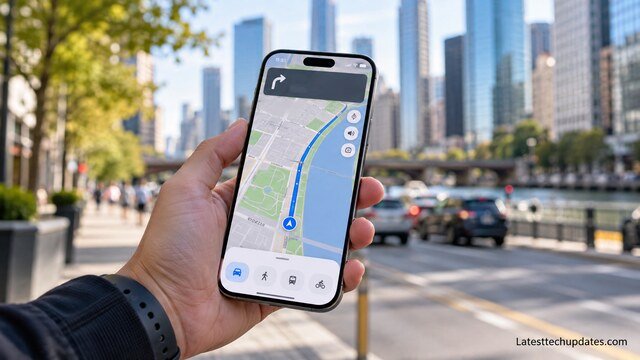
- GPS navigation
- Camera recording
- Gaming
- Video streaming
- Background apps
- Poor cellular signal
- On-device processing
- Hot environmental conditions
Two phones with identical battery capacity can therefore produce very different battery life if their chips, displays, modems, software, and workloads are different.
How Long Does the iPhone 18 Pro Max Battery Actually Last?
Apple gives the eSIM-only iPhone 18 Pro Max three useful battery figures:
Typical use: up to 30 hours
Video playback: up to 45 hours
Streamed video playback: up to 40 hours
For physical-SIM models, Apple lists up to 29 hours of typical use, 43 hours of video playback, and 38 hours of streamed video playback.
The “typical use” number is particularly interesting. Apple says its test combines activities including messaging, photography, music, social media, video streaming, games, web browsing, and navigation over LTE and 5G networks. It is still a controlled manufacturer test, so it should not be treated as a guarantee that every owner will get 30 hours.
Independent battery testing
Tom’s Guide tested the iPhone 18 Pro Max by continuously browsing the web over a cellular connection with the display calibrated to 150 nits. It recorded an average runtime of 18 hours and 27 minutes, compared with 17 hours and 54 minutes for the iPhone 17 Pro Max in the same test.
GSMArena recorded a 19 hour and 20 minute Active Use Rating. Its testing also showed improvements compared with the iPhone 17 Pro Max, which achieved 17 hours and 58 minutes under its methodology.
PhoneArena uses a different testing system and measured particularly strong web-browsing endurance, reporting 29 hours and 38 minutes in its browsing test, 12 hours and 4 minutes of video, and 14 hours and 34 minutes of gaming. Because its methodology differs from Tom’s Guide and GSMArena, these numbers should be compared with other phones tested by PhoneArena rather than directly against results from another publication.
These different results illustrate an important point: there is no single universal real-world battery-life number. A continuous web test, gaming test, video test, and normal mixed-use day put very different loads on the battery.
What Battery Life Should You Expect in Daily Use?
For most users, the iPhone 18 Pro Max should comfortably handle a full day without needing an afternoon recharge. Moderate users may also have enough remaining capacity to continue well into the following day.
Heavy use changes the picture.
Light use
If most of your day involves messaging, occasional calls, email, music, some browsing, and periods with the screen off, the large battery gives considerable headroom.
You may not need to charge every night, although battery life will still depend on signal quality and background activity.
Normal mixed use
Social media, messaging, photography, web browsing, maps, some streaming, and general app use are closer to Apple’s “typical use” model.
This is where the Pro Max’s large battery is most useful. Instead of constantly thinking about the remaining percentage, most users should have a substantial margin for evening use.
Heavy camera and video use
Camera use consumes much more energy than simple messaging or reading.
Recording long 4K videos, processing photos, using high display brightness outdoors, and continuously accessing cellular networks can reduce runtime considerably.
Creators should therefore treat Apple’s 45-hour video-playback figure as a playback measurement, not an indication that the phone can record video for 45 hours.
Gaming
Demanding games keep the GPU, CPU, display, network connection, and sometimes the phone’s thermal-management system active simultaneously.
PhoneArena recorded 14 hours and 34 minutes in its controlled gaming test, but actual games vary widely in graphics complexity, frame rate, networking, and brightness.
Navigation and mobile data
Long periods of GPS navigation can also drain the battery faster, particularly when the display remains bright and the phone is connected to 5G.
Poor cellular reception can make the situation worse because the modem may need more power to maintain a connection.
iPhone 18 Pro Max Charging Speed
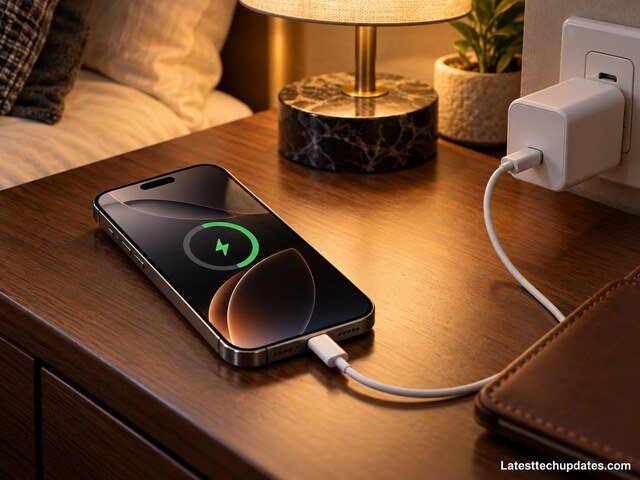
Charging is arguably an even more noticeable upgrade than battery runtime.
Apple says the iPhone 18 Pro models can reach up to 50% charge in around 15 minutes when used with a compatible 60W-capable or higher USB-C power adapter and an appropriate USB-C cable. The adapter must support USB Power Delivery 3.1 or better with Adjustable Voltage Supply, commonly called AVS.
One common misunderstanding is to describe this simply as “60W charging.”
The phone does not continuously draw 60 watts. The 60W figure refers primarily to the capability Apple requires from the power source. GSMArena reported that the iPhone 18 Pro Max retail box lists a maximum charging power of 54W and measured roughly 53W during the first part of its charging test.
That distinction matters when buying a charger.
A random adapter labeled 60W is not automatically guaranteed to provide the fastest possible charging. Support for the required USB PD and AVS charging standards matters too.
How Fast Does It Charge in Independent Testing?
GSMArena tested the iPhone 18 Pro Max using a 67W USB PD/AVS charger and measured:
- 50% after 15 minutes
- 81% after 30 minutes
- 100% displayed after about 55 minutes
- Charging fully stopped after about 73 minutes
The difference between reaching a displayed 100% and completely stopping power delivery is normal behavior in modern lithium-ion charging systems. Charging slows significantly near full capacity to control heat and reduce stress on the battery.
Tom’s Guide recorded similarly rapid top-ups in its testing. Results varied slightly between its comparisons, which reinforces that charger, battery temperature, starting percentage, software, and test conditions can influence charging measurements.
This faster first half of the charging curve is arguably more useful than the full-charge time. If you notice a low battery shortly before leaving home, 10 to 15 minutes on a suitable charger can now restore a substantial amount of capacity.
Apple also says five minutes of wired charging can provide around seven hours of video playback under its test conditions. That figure should be understood as an Apple playback estimate rather than seven hours of demanding mixed use.
MagSafe and Qi2 Wireless Charging
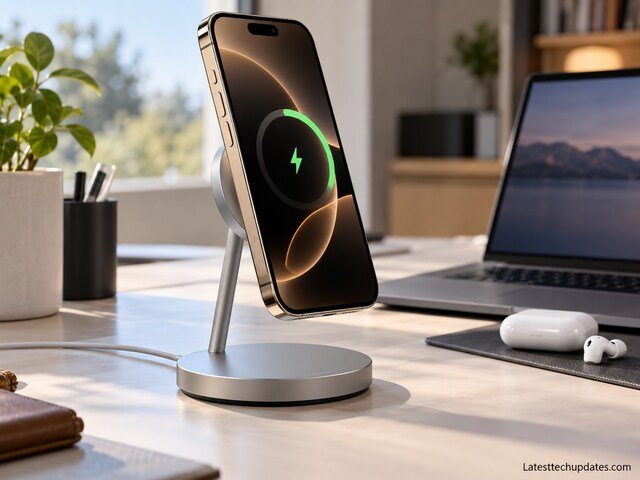
The iPhone 18 Pro Max supports:
MagSafe wireless charging up to 25W
Qi2 wireless charging up to 25W
Apple says MagSafe can charge the battery to about 50% in 30 minutes when paired with a 35W or higher power adapter.
Wireless charging is convenient for desks, bedside tables, and stands, but wired USB-C remains the better choice when charging speed matters.
Wireless charging also creates additional heat because energy must travel through the inductive charging system instead of a direct cable connection. Actual charging power can therefore change according to temperature and charger design.
Why Charging Slows Near 80% and 100%
Fast charging is deliberately not maintained at maximum power from empty to full.
Lithium-ion batteries can accept higher charging power when their state of charge is relatively low. As the battery fills, the charging system progressively reduces power.
Temperature also matters. If the iPhone becomes warm because of charging, gaming, navigation, direct sunlight, or another demanding workload, iOS may reduce charging speed.
This is why a 0 to 50% result cannot simply be doubled to estimate a 0 to 100% charging time.
Battery Health and Charge Limits
Battery life describes how long the phone works between charges. Battery health describes how much capacity the battery can still hold as it chemically ages.
Like every rechargeable lithium-ion battery, the iPhone 18 Pro Max battery gradually loses capacity over time.
Apple allows iPhone 15 and later models to use a configurable Charge Limit. In Settings > Battery > Charging, you can choose a maximum charge level between 80% and 100% in 5% increments. Apple may also recommend a limit based on your charging habits.
A lower limit can make sense if you:
- Keep the phone connected to power for long periods
- Normally finish the day with plenty of battery remaining
- Want to reduce long-term battery wear
If you regularly need maximum runtime, charging to 100% is also reasonable. Apple’s Optimized Battery Charging feature can reduce the amount of time the battery spends sitting fully charged.
Adaptive Power Can Extend Battery Life
The iPhone 18 Pro models also support Adaptive Power.
Adaptive Power analyzes recent usage on the device and can make small adjustments when iOS expects higher-than-normal power consumption. These can include reducing background activity, slightly lowering brightness, making performance adjustments, and automatically using Low Power Mode when appropriate.
For most users, this is more useful than manually changing multiple settings throughout the day.
What Drains the iPhone 18 Pro Max Battery Fastest?
Even a large battery can disappear quickly under demanding conditions.
Screen brightness is one major factor. Keeping the large 6.9-inch OLED display bright outdoors requires significantly more energy than reading indoors at lower brightness.
Cellular conditions matter too. Weak 5G reception can increase modem activity, so a phone in an area with poor coverage may drain faster than the same phone connected to strong Wi-Fi.
Other demanding activities include prolonged GPS navigation, high-end gaming, camera recording, hotspot use, video calls, high-resolution video streaming, and background apps that frequently access location or cellular data.
If battery life suddenly becomes worse than normal, open Settings > Battery and check which apps or activities account for the highest consumption.
Apple also notes that battery life can temporarily decline for several days after a major iOS update because indexing and other background processes may continue after installation.
How the iPhone 18 Pro Max Compares With the iPhone 17 Pro Max
The improvement is real, but battery testing shows that it is not equally dramatic in every workload.
Tom’s Guide measured:
| Model | Tom’s Guide battery test |
| iPhone 18 Pro Max | 18 hours 27 minutes |
| iPhone 17 Pro Max | 17 hours 54 minutes |
That is a 33-minute improvement in its continuous cellular web-browsing test.
GSMArena saw a larger increase in its Active Use Rating:
| Model | GSMArena Active Use Rating |
| iPhone 18 Pro Max | 19 hours 20 minutes |
| iPhone 17 Pro Max | 17 hours 58 minutes |
The bigger practical change may be charging. The new model can recover much more battery during a short top-up, which is useful even for someone who rarely runs the phone completely flat.
Is the eSIM Version Better for Battery Life?
Slightly, yes.
The eSIM-only iPhone 18 Pro Max contains a larger battery because Apple can use space that would otherwise be occupied by the physical SIM hardware.
Apple’s ratings illustrate the difference:
eSIM-only: up to 30 hours of typical use and 45 hours of video playback.
Physical SIM: up to 29 hours of typical use and 43 hours of video playback.
This should not be the only reason to choose a regional model. Carrier support, eSIM availability, warranty considerations, cellular bands, and international travel requirements can matter much more than the relatively small battery advantage.
Practical Tips to Get Better Battery Life
You do not need to disable every useful iPhone feature to improve battery endurance.
The most effective approach is to fix unnecessary power use while keeping features you actually value.
Use Auto-Brightness where practical, prefer Wi-Fi when cellular reception is weak, and check Settings > Battery if an app appears unusually active in the background. Apple also recommends 5G Auto, which lets the phone switch to LTE when 5G would not noticeably improve the experience.
Adaptive Power can help automatically on unusually heavy days. Low Power Mode remains useful when you need to stretch the final part of the battery.
For long-term battery health, avoid unnecessary heat. Charging a hot phone, leaving it in direct sunlight, or performing demanding tasks while it is already very warm can increase battery stress.
Frequently Asked Questions
What is the iPhone 18 Pro Max battery capacity?
It depends on the model. Physical-SIM versions are rated at 5,391 mAh, while an iFixit teardown measured 5,567 mAh for the eSIM-only version.
How long does the iPhone 18 Pro Max battery last?
Apple rates the eSIM-only version for up to 30 hours of typical use, 45 hours of local video playback, and 40 hours of streamed video playback. Independent continuous battery tests have produced results around 18 to 19 hours depending on methodology.
Does the iPhone 18 Pro Max support 60W charging?
A more accurate description is that Apple requires a 60W-capable or higher USB-C PD 3.1 adapter with AVS for its fastest charging claim. Independent GSMArena testing observed about 53W during the early charging phase, while the phone’s packaging lists a 54W maximum charging rating.
How quickly can the iPhone 18 Pro Max reach 50%?
Apple says around 15 minutes with the required wired charging equipment. GSMArena independently measured 50% after 15 minutes with a compatible 67W PD/AVS charger.
How fast is MagSafe charging?
The iPhone 18 Pro Max supports MagSafe at up to 25W. Apple says it can reach about 50% in 30 minutes when the MagSafe Charger is connected to a 35W or higher adapter.
Should I charge the iPhone 18 Pro Max to 100% every night?
You can, but it is not always necessary. If you usually have plenty of battery left at the end of the day, using Apple’s Charge Limit feature can reduce the amount of time the battery spends at a very high state of charge. You can select limits between 80% and 100%.
Final Assessment
The iPhone 18 Pro Max improves battery performance in three useful ways: it carries a substantially larger battery, Apple’s newer hardware uses that energy more efficiently, and wired charging is much faster when paired with the correct USB-C PD/AVS equipment.
The regional difference deserves attention. The physical-SIM model has a 5,391 mAh battery, while the eSIM-only version reaches 5,567 mAh and receives slightly higher official endurance ratings.
Independent tests confirm that it is a very long-lasting iPhone, although they also show why manufacturer video-playback claims should not be interpreted as normal screen-on runtime. Tom’s Guide recorded 18 hours and 27 minutes of continuous cellular browsing, while GSMArena reached a 19 hour and 20 minute Active Use Rating under its own test methodology.
For everyday use, the biggest practical benefit is not simply the mAh figure. It is the combination of enough endurance for demanding days and the ability to recover roughly half a charge in about 15 minutes when the right wired charger is available.
Read Also: Expected Display Sizes for Apple’s Foldable iPhone Revealed
