
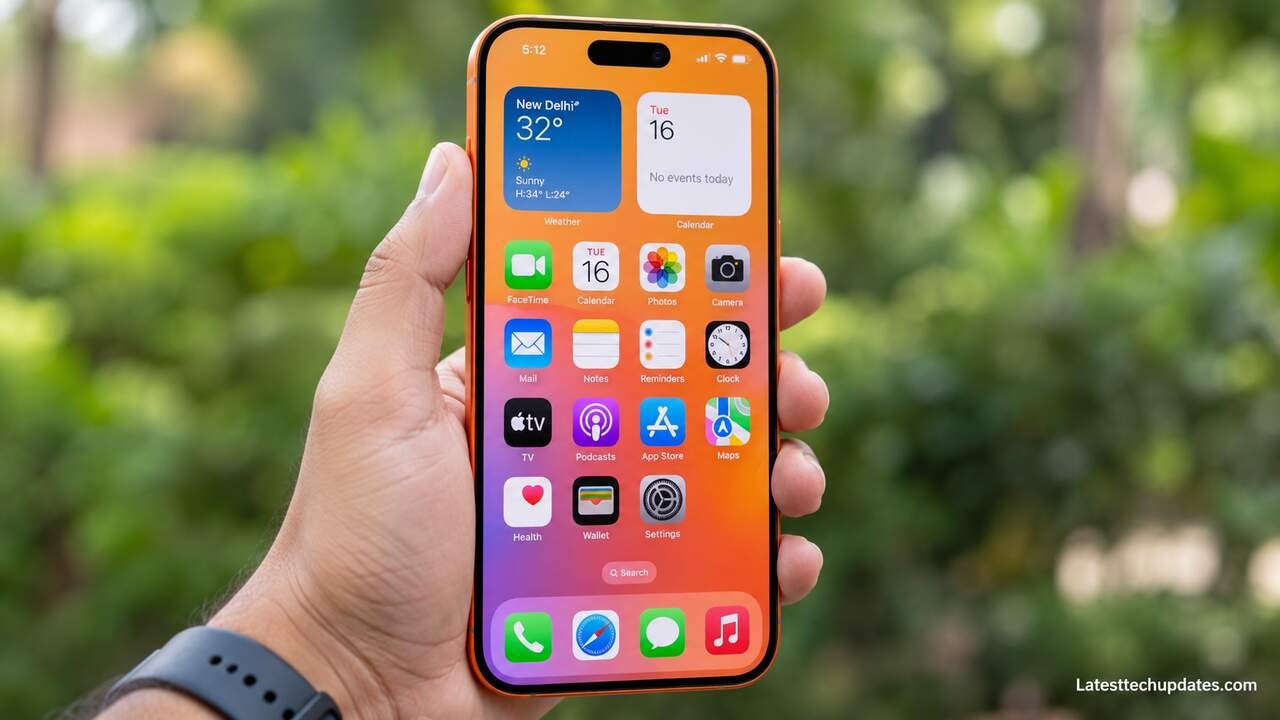
The iPhone 18 Pro Max uses a 6.9-inch Super Retina XDR OLED display with a 2868 x 1320 resolution, 460 pixels per inch, ProMotion up to 120Hz, an Always-On display, and up to 3,000 nits of peak outdoor brightness. The biggest display-related change from the iPhone 17 Pro Max is not a larger or brighter panel. It is the redesigned, smaller Dynamic Island, which can now make room for more information on screen.
That distinction matters. Apple has kept many of the core display specifications unchanged from the previous Pro Max generation, while refining how the area around the front camera and Face ID system is used.
iPhone 18 Pro Max display specifications
Apple lists the iPhone 18 Pro Max as having a 6.9-inch all-screen OLED Super Retina XDR display. Because the screen has rounded corners, the diagonal measurement is 6.86 inches when measured as a standard rectangle, and the actual visible area is slightly smaller. Resolution is 2868 x 1320 pixels at 460 ppi.
| Display feature | iPhone 18 Pro Max |
| Display type | Super Retina XDR OLED |
| Advertised size | 6.9 inches |
| Rectangular measurement | 6.86 inches |
| Resolution | 2868 x 1320 |
| Pixel density | 460 ppi |
| ProMotion | Adaptive refresh rates up to 120Hz |
| Always-On display | Yes |
| Typical maximum brightness | 1,000 nits |
| HDR peak brightness | 1,600 nits |
| Outdoor peak brightness | 3,000 nits |
| Minimum brightness | 1 nit |
| Contrast ratio | 2,000,000:1 typical |
| Color | Wide color (P3), True Tone |
| Surface treatment | Fingerprint-resistant oleophobic and anti-reflective coatings |
These are Apple’s official specifications rather than independent laboratory measurements.
ProMotion up to 120Hz: what it actually changes
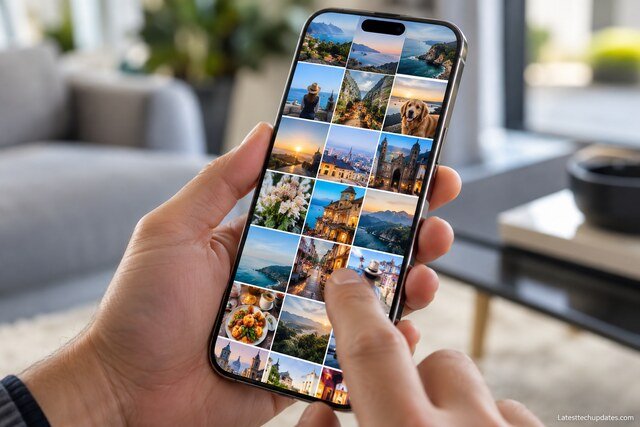
ProMotion allows the display refresh rate to change according to what is happening on screen rather than running continuously at one fixed refresh rate.
A higher refresh rate means the screen can update more frequently each second. At up to 120Hz, scrolling through Safari, moving between Home Screen pages, navigating long social feeds, and watching supported animations can look smoother than on a conventional 60Hz display.
The important word is adaptive. The iPhone does not simply operate at 120Hz all the time. iOS can change the refresh rate according to the content being displayed, which can reduce unnecessary power consumption when very high refresh rates provide little benefit.
This also means a 120Hz display does not guarantee that every app, animation, video, or game will constantly run at 120 frames per second. Application support, system conditions, the content itself, Low Power Mode, and device temperature can affect refresh behavior.
For normal users, the most noticeable benefit is usually interface smoothness rather than a specification number. Once someone becomes accustomed to a high-refresh-rate phone, moving back to a basic 60Hz screen can make scrolling and animations feel less fluid.
How bright is the iPhone 18 Pro Max display?
Apple specifies four useful brightness figures: 1,000 nits typical maximum brightness, 1,600 nits peak brightness for HDR content, 3,000 nits peak outdoor brightness, and a minimum brightness of 1 nit.
These numbers describe different operating conditions, so they should not be interpreted as meaning the entire screen runs at 3,000 nits whenever brightness is set to maximum.
3,000 nits outdoors
The 3,000-nit specification is designed around visibility in very bright surroundings. Higher brightness helps the screen remain readable when sunlight would otherwise overpower the display.
That matters when using Maps outdoors, framing photos in sunlight, reading messages while walking, or checking the phone at the beach or another strongly lit location.
Peak outdoor brightness is still a conditional mode. Factors such as ambient lighting, display content, heat, and system power management can affect how brightness is managed.
1,600 nits for HDR
High Dynamic Range, or HDR, allows compatible photos and video to contain much brighter highlights alongside deep dark areas.
The iPhone 18 Pro Max supports a specified 1,600-nit HDR peak. This is especially relevant when watching HDR movies, reviewing HDR photographs, or viewing content containing bright reflections, sunlight, lamps, and other intense highlights.
The OLED panel also provides a typical 2,000,000:1 contrast ratio. OLED pixels can control their own light instead of relying on a conventional backlight, which helps produce deep blacks and strong contrast.
1 nit minimum brightness
Maximum brightness tends to receive more attention, but the 1-nit minimum is useful at the opposite end of the scale.
A very dim display is easier to live with when checking the phone in a dark bedroom, aircraft cabin, theater environment, or another low-light location. It also makes the Always-On display less visually distracting.
Does the iPhone 18 Pro Max have a better display than the iPhone 17 Pro Max?
On the core specifications, the change is much smaller than the model number might suggest.
Both the iPhone 17 Pro Max and iPhone 18 Pro Max use a 6.9-inch OLED panel, 2868 x 1320 resolution, 460 ppi, ProMotion up to 120Hz, 1,600-nit HDR peak brightness, 3,000-nit outdoor peak brightness, a 1-nit minimum, an Always-On display, True Tone, P3 color, and an anti-reflective coating.
So someone upgrading specifically for a larger screen, a higher resolution, a faster maximum refresh rate, or a higher official brightness rating will not find a major specification increase.
The more meaningful front-display change is the Dynamic Island.
The smaller Dynamic Island is the main visible change
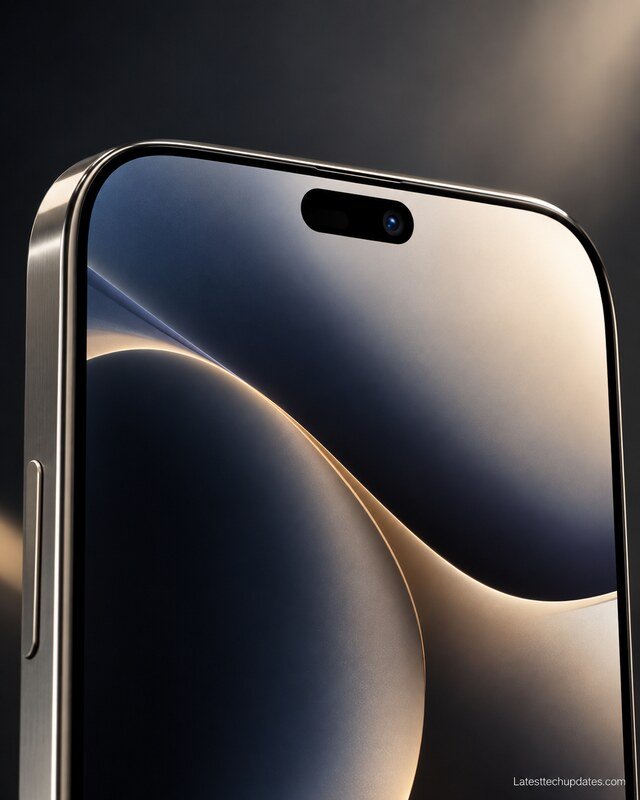
The Dynamic Island has been redesigned and is smaller on the iPhone 18 Pro models. More importantly, the revised design creates space for additional information.
The updated Dynamic Island can display up to three Live Activities at once. The phone also retains Face ID for unlocking the device, authenticating purchases, and signing into supported apps.
This is a more useful improvement than simply reducing the physical cutout for appearance alone.
Live Activities can provide continuously changing information such as timers, ongoing journeys, sports information from compatible apps, deliveries, or other active events. Giving the interface more room means the top area of the display can communicate more without forcing users to open the associated application.
There is an important distinction here: the Dynamic Island has not disappeared. The iPhone 18 Pro Max still has a visible Dynamic Island rather than a completely uninterrupted screen with every front sensor hidden beneath the display.
Always-On display and low-refresh operation
The iPhone 18 Pro Max continues to support an Always-On display. This allows selected Lock Screen information to remain visible while the phone is locked rather than turning the panel completely black.
ProMotion is important here because an adaptive display can reduce its refresh activity when the image is largely static instead of refreshing at maximum speed unnecessarily.
For users, the practical benefit is quick access to information such as the time, widgets, notifications, and Live Activities without fully waking the phone.
The tradeoff is power use. An Always-On display still requires energy, even when the system aggressively reduces display activity. Users who prioritize maximum battery endurance can disable the feature in iOS.
Anti-reflective coating is important outdoors too
Brightness is only one part of outdoor readability. Reflections can make even a very bright screen difficult to see.
The iPhone 18 Pro Max includes an anti-reflective coating alongside its fingerprint-resistant oleophobic coating.
The oleophobic layer is intended to reduce how strongly oils from fingers adhere to the glass and make the surface easier to clean. The anti-reflective treatment addresses light bouncing back toward the viewer.
Neither coating eliminates fingerprints or reflections completely. Their practical value is reducing two common problems that make a glossy smartphone display harder to see.
True Tone and P3 wide color
The display supports both True Tone and the P3 wide color gamut.
True Tone adjusts the display’s white balance according to surrounding light. A white page may therefore look slightly warmer in warm indoor lighting and cooler in another environment. The idea is to make the screen appear more natural relative to the room around it.
P3 wide color gives supported photos, videos, applications, and graphics access to a broader range of colors than the older sRGB color space.
Users editing photographs or judging color should remember that True Tone changes the screen’s appearance according to ambient lighting. Someone who needs a more consistent visual reference may prefer to turn True Tone off while evaluating color.
Display size and physical design
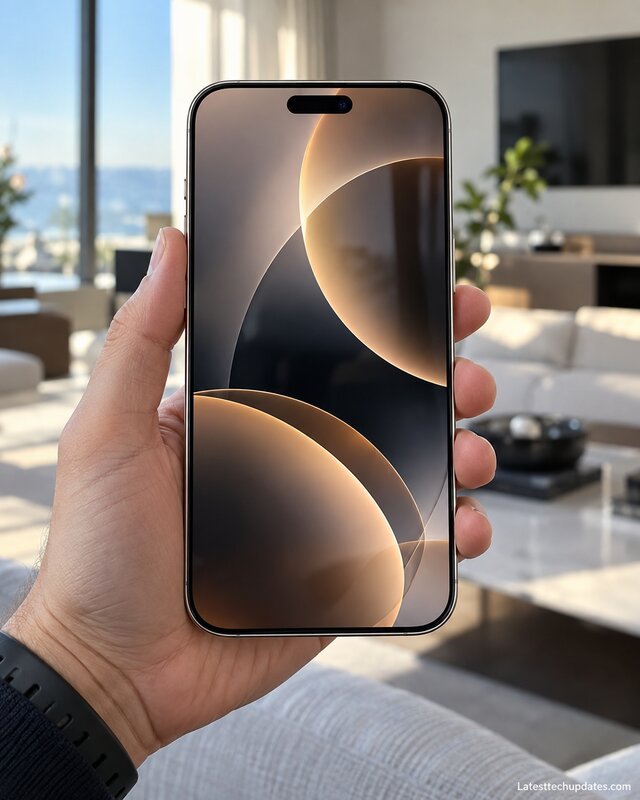
The iPhone 18 Pro Max remains a genuinely large phone. Its large 6.9-inch display provides plenty of room for video, games, photography, document viewing, editing controls, and larger text.
The tradeoff is ergonomics. A larger display gives content more room, but it also makes one-handed use less convenient for many people. Screen size should therefore be treated as a usability choice rather than automatically as an advantage.
The iPhone 18 Pro Max also keeps the same listed display size and resolution as the iPhone 17 Pro Max, which reinforces the idea that this generation focuses more on refinement than a dramatic panel redesign.
Is the iPhone 18 Pro Max display a major upgrade?
For an iPhone 17 Pro Max owner, the display specifications alone provide relatively little reason to upgrade. Screen size, resolution, pixel density, ProMotion maximum refresh rate, Always-On capability, official brightness levels, contrast specification, and display coatings are all substantially the same.
The redesigned Dynamic Island is the notable change. Its smaller footprint and ability to accommodate up to three Live Activities improve how Apple uses the top portion of the display.
For someone moving from a much older iPhone, particularly a model without ProMotion, the difference can be much more noticeable. A large OLED panel, adaptive refresh up to 120Hz, very high outdoor brightness, an Always-On display, HDR support, and the newer Dynamic Island together create a substantially more modern display experience.
Frequently asked questions
Does the iPhone 18 Pro Max have a 120Hz display?
Yes. It supports ProMotion with adaptive refresh rates up to 120Hz. The system changes refresh behavior according to the content and operating conditions rather than forcing 120Hz continuously.
How bright is the iPhone 18 Pro Max?
It is rated at 1,000 nits typical maximum brightness, 1,600 nits peak for HDR, up to 3,000 nits peak outdoors, and 1 nit at minimum brightness.
Is the Dynamic Island gone on the iPhone 18 Pro Max?
No. It is smaller and redesigned, but the iPhone 18 Pro Max still uses Dynamic Island and Face ID.
Is the iPhone 18 Pro Max screen larger than the iPhone 17 Pro Max?
No. Both generations use a 6.9-inch display with a 2868 x 1320 resolution at 460 ppi.
Does the iPhone 18 Pro Max use OLED?
Yes. It uses Super Retina XDR OLED display technology. OLED allows individual pixels to control their own light output, which is particularly useful for deep blacks, high contrast, HDR content, and the Always-On display.
Is 3,000 nits available all the time?
No. The 3,000-nit figure refers specifically to peak outdoor brightness, not continuous normal screen brightness. The typical maximum specification is 1,000 nits, while HDR peak brightness is rated at 1,600 nits.
Final assessment
The iPhone 18 Pro Max still has one of Apple’s most capable display configurations: a large 6.9-inch OLED panel, sharp 460 ppi resolution, adaptive ProMotion up to 120Hz, high outdoor brightness, HDR, an Always-On display, and strong contrast.
But the important detail is what did not change. Compared with the iPhone 17 Pro Max, the screen size, resolution, official maximum refresh rate, and rated peak brightness remain largely the same.
The real display-generation change is the smaller, more capable Dynamic Island. For iPhone 17 Pro Max owners, that is a refinement rather than a wholesale display upgrade. For people coming from an older 60Hz iPhone or a model without an Always-On display and Dynamic Island, the overall screen experience can represent a much larger step forward.
