
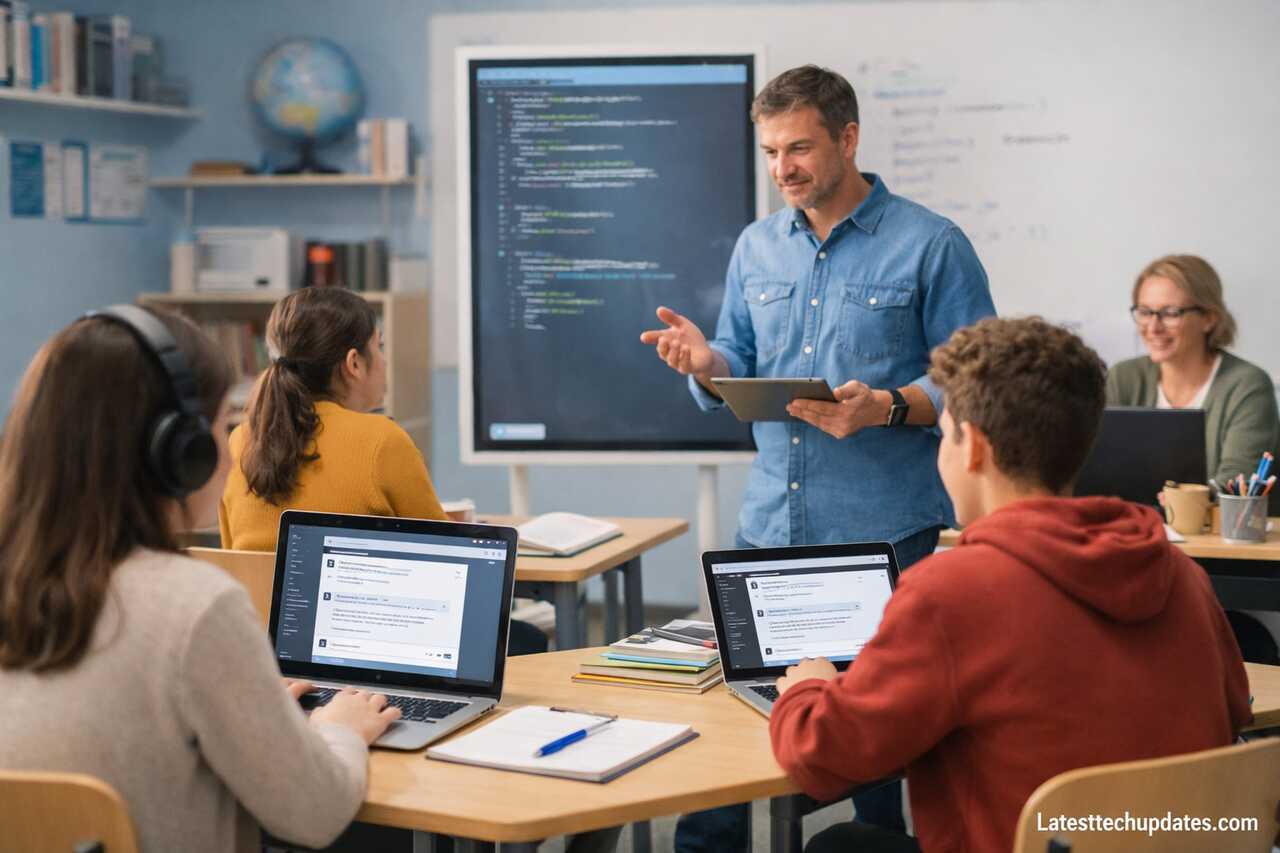
Highlights
- Students use ChatGPT effectively when structured prompts guide learning instead of replacing thinking.
- Teachers increase productivity when AI drafts lesson plans, quizzes, and feedback that educators refine with professional judgment.
- Academic growth improves when learners request step by step explanations rather than final answers.
- Ethical usage depends on transparency, originality, and clear school policies.
- Writing skills strengthen when students use AI for outlining, editing, and counterargument testing instead of full essay generation.
- Exam preparation becomes more interactive through mock quizzes and adaptive questioning.
- Collaborative learning improves when AI supports brainstorming and structured debate preparation.
- Digital literacy and critical thinking become essential skills in AI integrated classrooms.
- Long term educational success depends on balancing human mentorship with intelligent assistance.
Introduction
Students and teachers can use ChatGPT effectively by integrating structured prompting, critical thinking, ethical guidelines, and workflow alignment into daily academic tasks. Productive usage depends on clarity of goals, verification of output, personalization of learning pathways, and responsible collaboration. Educational success with AI requires human judgment, curriculum awareness, and transparent communication.
Artificial intelligence has moved from experimental technology to practical classroom assistant. ChatGPT, developed by OpenAI, functions as a conversational language model capable of generating explanations, summaries, lesson plans, feedback, coding assistance, and creative ideas. Academic environments benefit most when both students and teachers understand how to guide responses with precision, evaluate information critically, and align outputs with curriculum standards. I have personally tested multiple classroom workflows using ChatGPT, and the difference between random usage and strategic prompting is dramatic. Strategic usage increases clarity, saves preparation time, and deepens understanding, while careless usage creates confusion and dependency.
Why Should Students Use ChatGPT as a Learning Assistant Instead of a Shortcut?
Students should use ChatGPT as a structured learning assistant because guided interaction strengthens understanding, while blind copying weakens academic integrity. Effective use requires asking targeted questions, requesting step-by-step explanations, and verifying answers through textbooks or teacher feedback. Academic growth happens when AI becomes a support system rather than a replacement for thinking.
ChatGPT supports comprehension by breaking down complex topics into simpler language. When students ask for conceptual explanations, alternative examples, or analogies, deeper cognitive connections form. Strong prompts such as “Explain photosynthesis at a 10th-grade level with real-world examples” generate contextual learning instead of surface-level answers.
Responsible usage also builds independent thinking. Students who compare AI-generated answers with classroom notes practice evaluation skills. I always advise learners to treat ChatGPT as a discussion partner. When you challenge the answer, refine your prompt, or ask for clarification, you develop reasoning rather than dependence.
How Can Students Improve Homework Understanding?
Students improve homework understanding by requesting step-by-step breakdowns instead of final answers. Structured prompts such as “Guide me through solving this equation without giving the final result” transform ChatGPT into a tutor rather than an answer machine.
How Can Students Use ChatGPT for Exam Preparation?
Students prepare for exams by asking for mock quizzes, practice questions, and topic summaries tailored to difficulty level. Custom revision prompts simulate teacher-style questioning and improve retention.
| Student Task | Ineffective Use | Effective Use |
| Homework | Copying full answer | Requesting guided steps |
| Essay Writing | Generating full essay | Asking for outline and feedback |
| Exam Revision | Reading summary once | Practicing quizzes and explanations |
| Research | Copying paragraphs | Asking for topic clarification |
How Can Teachers Use ChatGPT to Save Time Without Reducing Teaching Quality?

Teachers can use ChatGPT to streamline lesson planning, differentiate instruction, and generate assessment materials while maintaining academic oversight. Efficiency increases when AI handles drafting, formatting, and brainstorming, while educators refine and contextualize content.
Lesson planning often consumes hours of preparation. ChatGPT can generate structured lesson outlines aligned with specific grade levels and objectives. When I experimented with curriculum-based prompts, I reduced preparation time significantly while maintaining content depth. Human editing remains essential because classroom context varies across regions and student backgrounds.
Assessment design also benefits from AI support. Teachers can request multiple-choice questions, discussion prompts, or project rubrics. Final responsibility stays with the educator, who ensures alignment with learning standards and classroom culture.
How Can Teachers Create Differentiated Content?
Teachers create differentiated content by requesting multiple versions of the same lesson adjusted for beginner, intermediate, and advanced learners. Adaptive content supports inclusive education.
How Can Teachers Use ChatGPT for Feedback?
Teachers generate structured feedback templates that can be personalized quickly. AI assists in organizing comments, while the teacher adds emotional intelligence and specific guidance.
| Teaching Task | AI Contribution | Teacher Role |
| Lesson Planning | Draft structure | Contextual refinement |
| Quiz Creation | Generate question pool | Select and validate |
| Feedback | Draft comments | Personalize and guide |
| Parent Communication | Provide format | Adjust tone and details |
How Can ChatGPT Improve Research and Writing Skills?

ChatGPT improves research and writing skills when learners use it for brainstorming, outlining, editing, and clarification rather than content replacement. Structured engagement develops organization and coherence.
Idea generation becomes easier when students request topic suggestions, thesis statements, or argument angles. Brainstorming prompts unlock creative direction. During my own academic projects, I used ChatGPT to test thesis clarity by asking for counterarguments. Counterargument exploration strengthened my final draft.
Editing support also enhances writing clarity. Tools such as Grammarly focus primarily on grammar, while ChatGPT explains reasoning behind structural improvements. Combined usage creates powerful revision cycles.
How Can Students Use ChatGPT for Essay Outlines?
Students request structured outlines including introduction hooks, body arguments, evidence suggestions, and conclusion strategies. Clear structure prevents disorganized writing.
How Can ChatGPT Help With Academic Language?
ChatGPT refines tone by transforming informal drafts into academic style. Students learn by comparing original and improved versions.
What Are the Ethical Boundaries When Using ChatGPT in Education?
Ethical usage depends on transparency, originality, and compliance with institutional guidelines. Academic integrity remains a foundational principle regardless of technological advancement.
Plagiarism detection systems such as Turnitin evaluate originality, yet ethical responsibility begins with the learner. ChatGPT should assist thinking, not replace authorship. Educators must establish clear classroom policies outlining acceptable AI usage.
Transparency builds trust. Students who disclose AI assistance demonstrate honesty. Teachers who communicate AI policies reduce confusion and misconduct.
How Can Schools Create Clear AI Policies?
Schools define acceptable and unacceptable use cases, including research support versus full assignment generation. Clear documentation prevents misuse.
How Can Students Avoid Overdependence?
Students avoid overdependence by limiting AI use to planning and feedback stages. Manual writing practice maintains skill development.
How Can ChatGPT Support Collaborative Learning?
ChatGPT enhances collaboration by facilitating discussion prompts, group project planning, and debate simulations. Structured interaction encourages teamwork.
Group assignments benefit from idea organization. ChatGPT can generate role distribution suggestions and timeline plans. During collaborative workshops I facilitated, structured prompts helped teams clarify responsibilities quickly.
Debate preparation improves when students request opposing viewpoints. Exposure to multiple perspectives strengthens argumentation skills and critical thinking.
How Can ChatGPT Help With Group Brainstorming?
ChatGPT generates categorized idea lists that groups can evaluate collectively. Structured brainstorming reduces confusion.
How Can Teachers Use ChatGPT in Classroom Discussions?
Teachers use AI-generated discussion starters aligned with curriculum topics. Engaging questions stimulate active participation.
How Can ChatGPT Integrate With Educational Tools and Platforms?
ChatGPT integrates with writing platforms, document editors, and online learning environments to streamline workflows. Productive integration improves efficiency.
Students often combine AI assistance with platforms such as Google Docs and Microsoft Word. Drafting inside document editors while consulting ChatGPT enhances real-time revision. Integration encourages iterative improvement.
Online learning platforms such as Khan Academy provide structured courses, while ChatGPT supplements explanations. Combined usage bridges conceptual gaps.
How Can Students Use AI Alongside Digital Notes?
Students paste summarized notes into ChatGPT and request clarification or quiz questions. Active recall strengthens retention.
How Can Teachers Integrate AI Into LMS Systems?
Teachers provide prompt templates within Learning Management Systems to guide safe and effective AI interaction.
What Is the Long-Term Impact of ChatGPT on Education?
ChatGPT influences future education by promoting adaptive learning, personalized tutoring, and skill-based evaluation. Human educators remain central, while AI expands accessibility.
Personalized tutoring becomes scalable when students receive instant explanations tailored to individual pace. Educational equity improves when learners without private tutoring access AI guidance.
Future classrooms will emphasize critical thinking, creativity, and problem-solving over memorization. I believe educators who embrace guided AI usage will lead more innovative learning environments. Resistance to technology often delays progress, while structured adaptation creates opportunity.
Will AI Replace Teachers?
AI will not replace teachers because emotional intelligence, mentorship, and classroom leadership require human presence. AI supports instruction rather than substitutes it.
What Skills Will Students Need in an AI Era?
Students will need prompt engineering skills, critical evaluation abilities, digital literacy, and ethical awareness. Analytical thinking becomes more valuable than rote memorization.
Conclusion
Students and teachers can use ChatGPT effectively when structured prompting, ethical awareness, and critical thinking guide interaction. Academic success depends on collaboration between human judgment and AI efficiency. Students gain deeper understanding when they request explanations instead of final answers. Teachers save time when AI drafts materials that they refine professionally. Research, writing, collaboration, and lesson planning improve through responsible integration. Educational institutions that define clear policies encourage innovation without compromising integrity. Future classrooms will balance human mentorship with intelligent digital assistance, creating more personalized and efficient learning ecosystems.
FAQ’s
Is ChatGPT safe for academic use?
ChatGPT is safe when students and teachers follow institutional guidelines, verify information, and maintain originality. Responsible usage ensures academic integrity.
Can ChatGPT detect plagiarism?
ChatGPT does not function as a plagiarism detector. Tools specifically designed for originality checking perform that task.
How often should students use ChatGPT?
Students should use ChatGPT strategically for clarification, practice questions, and feedback rather than daily answer generation.
Can teachers rely completely on AI for lesson planning?
Teachers should not rely completely on AI. Professional judgment, curriculum alignment, and classroom awareness remain essential.
Does ChatGPT improve grades automatically?
Grades improve when students use ChatGPT to enhance understanding, practice actively, and refine skills. Passive copying produces no long-term benefit.
